Kratall for children
Ukraine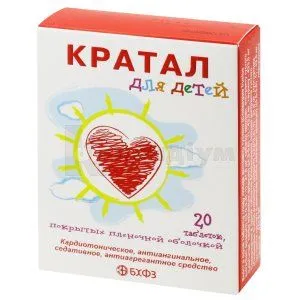
INSTRUCTIONS |
KRATAL FOR CHILDREN |
Composition:Active ingredients: 1 tablet contains hawthorn fruit dry extract (Crataegi fructus extractum spissum) ((3.0–3.3):1, extraction solvent: ethanol 70% v/v), calculated as dry substance – 21.5 mg; motherwort herb dry extract (Leonuri herba extractum spissum) ((4.5–5.6):1, extraction solvent: ethanol 70% v/v), calculated as dry substance – 43.5 mg; taurine, calculated as 100% dry substance – 433.5 mg; Excipients: microcrystalline cellulose, sodium croscarmellose, magnesium stearate, colloidal anhydrous silicon dioxide, polyvinyl alcohol, macrogol, talc, titanium dioxide (E 171), red iron oxide (E 172), black iron oxide (E 172), yellow iron oxide (E 172). |
| Pharmaceutical form. Film-coated tablets. Main physicochemical properties: brown oval-shaped, biconvex tablets with a film coating. Two layers are visible upon breaking. |
| Pharmacotherapeutic group. Drugs affecting the cardiovascular system. Various combined cardiological preparations. ATC code C01EX. Pharmacological properties.Pharmacodynamics. |
| Kratal for Children exerts mild cardiotonic, antianginal, coronary dilating, antiarrhythmic, antihypoxic, antiaggregant, adaptogenic, and energy-enhancing effects. It improves blood supply and functional state of the myocardium, increases "coronary reserve", enhances contractile and pumping function of the heart muscle, moderately reduces elevated arterial pressure and normalizes heart rate. Kratal for Children increases physical performance, improves mood, and has a calming effect. The drug inhibits the renin-angiotensin and kallikrein-kinin systems, lipid peroxidation processes, positively affects cAMP production, and promotes correction of endothelial dysfunction and microcirculation disorders in organs. Pharmacokinetics. Not studied. Clinical characteristics.Indications. For vegetative disorders (neurocirculatory and vegetative-vascular syndromes such as increased fatigue, emotional lability, sleep disturbances, headache, dizziness). |
| Contraindications.
Interaction with other medicinal products and other forms of interaction. Enhances antianginal effects of nitrates, β-blockers, calcium antagonists, anti-hypoxants, neuroprotectants, cardiac glycosides. Reduces signs of digitalis intoxication. The drug should not be used concomitantly with class III antiarrhythmics, cisapride. Special precautions.Consult a physician before starting treatment with Kratal for Children. Do not exceed the recommended dosage. If symptoms of illness do not begin to subside, or conversely, if the condition worsens, or adverse effects occur, discontinue the drug and consult a physician for further advice. Use during pregnancy or breastfeeding. There are no data on the use of the drug during pregnancy or breastfeeding. Ability to influence reaction rate when driving or operating machinery. For use in children. |
Method of administration and dosage.Children aged 6 to 11 years – 1 tablet three times daily; Children aged 12 to 18 years – 2 tablets three times daily. The drug should be taken orally before meals with sufficient amount of water. The treatment course is 1 month. If necessary, the course may be repeated. The frequency of repeated treatment courses is determined individually by a physician for each child. Children. There is no information on the use of the drug in children under 6 years of age. |
| Overdose. Symptoms: hypersensitivity reactions, allergic reactions, arterial hypotension, bradycardia, dyspeptic symptoms, general weakness, fatigue, dizziness, drowsiness. Treatment: discontinue the drug and provide symptomatic therapy. |
Adverse reactions.Possible manifestations of increased sensitivity, allergic reactions (hyperemia, rash, itching, swelling, urticaria), dyspeptic symptoms, general weakness, increased fatigue, dizziness, drowsiness, arterial hypotension, bradycardia. If any adverse effects occur, consult a physician. Shelf life. 3 years. Do not use the drug after the expiry date stated on the package. |
| Storage conditions. Store in original packaging at temperature not exceeding 25 °C. Keep out of reach of children. Packaging. 10 tablets per blister, 2 blisters per carton; 90 tablets in a container; 90 tablets in a container with carton. |
| Prescription status. Over-the-counter. Manufacturer. Public Joint-Stock Company "Scientific-Production Center "Borshchagovskiy Chemical and Pharmaceutical Plant". Manufacturer's name and address of manufacturing site. Ukraine, 03134, Kyiv, Miru St., 17. |
INSTRUCTIONS
for medical use of the medicinal product
KRAL FOR CHILDREN
| Composition: Active substances: 1 tablet contains hawthorn fruit dry extract (Crataegi fructus extractum spissum) ((3.0–3.3):1, extraction solvent: 70% ethanol (v/v)), calculated as dry substance – 21.5 mg; motherwort dry extract (Leonuri herba extractum spissum) ((4.5–5.6):1, extraction solvent: 70% ethanol (v/v)), calculated as dry substance – 43.5 mg; taurine, calculated as 100% dry substance – 433.5 mg. Excipients: microcrystalline cellulose, sodium croscarmellose, magnesium stearate, colloidal anhydrous silicon dioxide, polyvinyl alcohol, macrogol, talc, titanium dioxide (E 171), red iron oxide (E 172), black iron oxide (E 172), yellow iron oxide (E 172). |
| Pharmaceutical form. Film-coated tablets. Basic physicochemical characteristics: brown oval-shaped, biconvex, film-coated tablets. Two layers are visible upon breaking. |
| Pharmacotherapeutic group. Drugs affecting the cardiovascular system. Various combined cardiological preparations. ATC code C01EX. |
| Pharmacological properties. Pharmacodynamics. Kratall for children exerts a mild cardiotonic, antianginal, coronary dilating, antiarrhythmic, anti-hypoxic, anti-aggregatory, adaptogenic, and energy-metabolism enhancing effect. It improves blood supply and functional state of the myocardium, increases "coronary reserve", enhances contractile and pumping function of the heart muscle, moderately reduces elevated arterial pressure and normalizes heart rate. Kratall for children increases physical performance, improves mood, and has a calming effect. The drug inhibits the renin-angiotensin and kallikrein-kinin systems, lipid peroxidation processes, positively affects cAMP production, and promotes correction of endothelial dysfunction and microcirculation disorders in organs. Pharmacokinetics. Not studied. Clinical characteristics. Indications. For vegetative disorders (neurocirculatory and vegetative-vascular conditions such as increased fatigue, emotional lability, sleep disturbances, headache, dizziness). |
| Contraindications.
Interaction with other medicinal products and other types of interactions. Enhances antianginal effects of nitrates, β-blockers, calcium antagonists, anti-hypoxants, neuroprotectors, cardiac glycosides. Reduces signs of digitalis intoxication. Do not use the drug together with class III antiarrhythmic agents, cisapride. Special precautions. Before starting treatment with Kratall for children, it is recommended to consult a physician. Do not exceed the recommended dosage. If symptoms of the disease do not begin to disappear, or conversely, if health condition worsens or adverse effects occur, drug administration should be discontinued and medical advice should be sought regarding further use. |
| Use during pregnancy or breastfeeding. Currently, there are no data on the use of the drug during pregnancy or breastfeeding. Ability to affect reaction rate when driving or operating machinery. For use in children. |
| Administration and dosage. Children aged 6 to 11 years – 1 tablet three times daily; children aged 12 to 18 years – 2 tablets three times daily. The drug should be taken orally before meals with sufficient amount of water. The treatment course is 1 month. If necessary, the course may be repeated. The frequency of repeated courses is determined individually by the physician for each child. Children. No information is available on the use of the drug in children under 6 years of age. Overdose. Symptoms: hypersensitivity reactions, allergic reactions, arterial hypotension, bradycardia, dyspeptic reactions, general weakness, fatigue, dizziness, somnolence. Treatment: discontinue the drug and provide symptomatic therapy. Adverse reactions. Possible manifestations of hypersensitivity, allergic reactions (hyperemia, rash, itching, swelling, urticaria), dyspeptic symptoms, general weakness, increased fatigue, dizziness, somnolence, arterial hypotension, bradycardia. If any adverse effects occur, consult a physician. Shelf life. 3 years. Do not use the drug after the expiry date stated on the package. Storage conditions. Store in the original packaging at a temperature not exceeding 25 °C. Keep out of reach of children. Packaging. 10 tablets per blister, 2 blisters per pack; 90 tablets per container; 90 tablets per container and pack. |
| Prescription status. Over-the-counter. Manufacturer. Public Joint-Stock Company "Scientific-Production Center "Borshchagov Chemical and Pharmaceutical Plant". Manufacturer's name and address of place of operation. 17 Myru Street, Kyiv, 03134, Ukraine. |