Collomac® m
Ukraine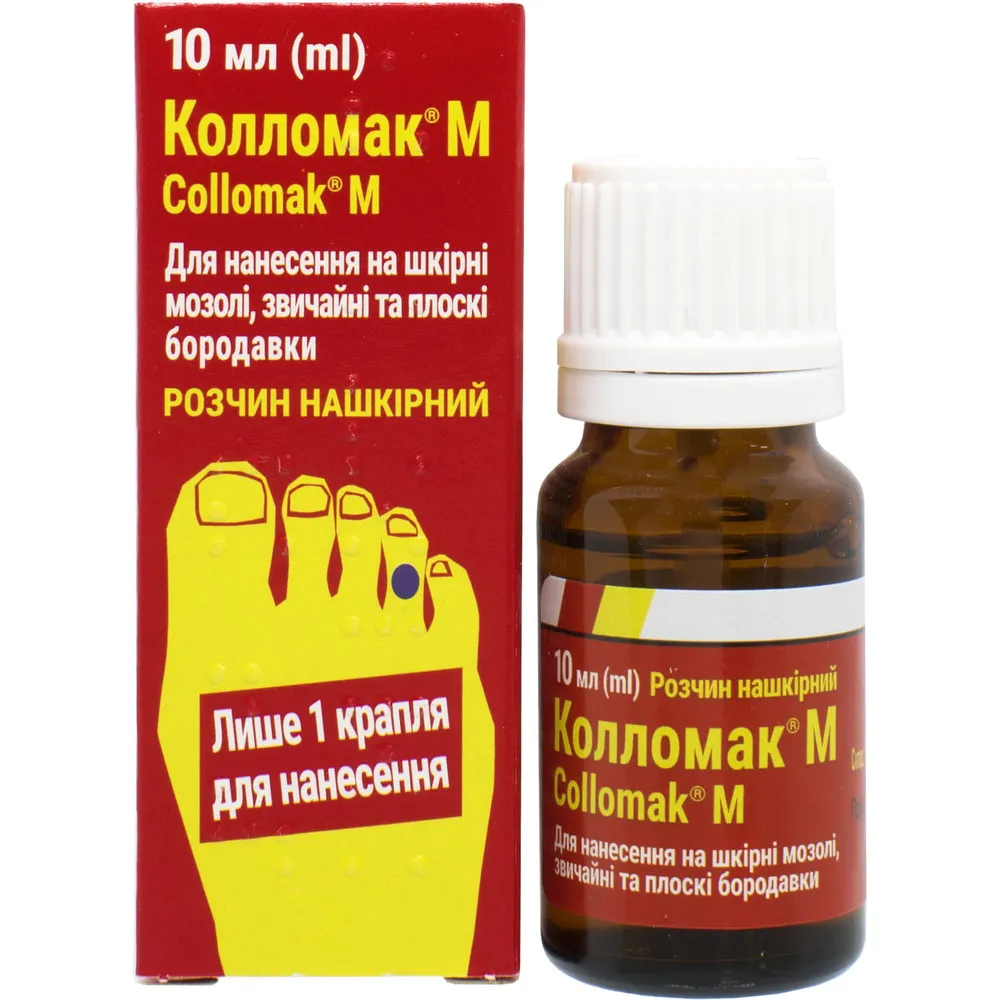
INSTRUCTIONS FOR MEDICAL USE OF THE MEDICINAL PRODUCT Collomak® M (Collomak® M)
Composition:Active ingredient: salicylic acid; 1 g of solution contains 167.0 mg of salicylic acid; Excipients: lactic acid (90%), collodion flexible. |
|||||||||||||||
| Pharmaceutical form. Topical solution. Basic physical and chemical properties: clear yellowish liquid with an ether-like odour, which turns yellowish-brown upon storage. |
|||||||||||||||
| Pharmacotherapeutic group. Agents for treatment of warts and corns. ATC code D11AF. |
|||||||||||||||
Pharmacological properties.Pharmacodynamics. Collomac® M is a keratolytic agent. Salicylic acid exerts keratolytic and moderate antiseptic effects: it softens and removes the stratum corneum by enhancing endogenous hydration, softening the skin, and lowering pH. It also has moderate antifungal and antibacterial activity. Pharmacokinetics. Salicylic acid is absorbed through the skin and slowly excreted in urine. |
|||||||||||||||
Clinical characteristics.Indications. Treatment of the following conditions:
|
|||||||||||||||
| Contraindications. Hypersensitivity to the components of the medicinal product. Diabetes. Circulatory disorders. Diabetic microangiopathy. Facial warts, hairy warts, and anogenital warts. Damaged skin, moles, or birthmarks. Strictly contraindicated for use on mucous membranes! Do not use in children under 2 years of age. |
|||||||||||||||
| Special precautions. Collomac® M is intended for EXTERNAL USE ONLY. Collomac® M may irritate the eyes and mucous membranes. Contact with these areas should be avoided. In case of contact with eyes or mucous membranes, rinse the affected areas with water for 15 minutes. Avoid inhaling vapours of the medicinal product. Warts may be contagious; therefore, patients should use individual hygiene items. Avoid contact with clothing, plastic, wood, and other materials, as this may cause damage. Collomac® M is highly flammable; therefore, it should be used and stored away from fire and heating devices. |
|||||||||||||||
| Interaction with other medicinal products and other forms of interaction. Salicylic acid may increase skin permeability to other topical medicinal products, thereby enhancing their systemic absorption. Additionally, salicylic acid may potentiate the adverse effects of methotrexate and the hypoglycaemic effect of oral antidiabetic agents that are sulphonylurea derivatives. |
|||||||||||||||
Special instructions.Salicylic acid is readily absorbed through the skin, and prolonged or excessive use over large areas increases the risk of salicylate toxicity. To minimize absorption after topical application, salicylic acid should not be used for long periods, at high concentrations, over large body areas, or on inflamed or damaged skin. Alternative treatment methods should be considered if warts cover a large body surface area (more than 5 cm²), due to the potential risk of salicylate toxicity. Patients with peripheral neuropathy should use Collomac® M only under medical supervision. Oral salicylates taken during or immediately after a viral illness have been associated with Reye's syndrome; therefore, there is a theoretical risk of Reye's syndrome with topical application of salicylates. Thus, Collomac® M is not recommended for use in children or adolescents during or immediately after varicella, influenza, or other viral infections. It is known that salicylates are excreted in breast milk (see section "Use during pregnancy or breastfeeding"). Use during pregnancy or breastfeeding. Data on the use of Collomac® M during pregnancy are lacking or limited. During pregnancy and breastfeeding, use is possible only after consultation with a physician, when the benefit to the woman outweighs the potential risk to the fetus or infant. Collomac® M should not be used during pregnancy except for short-term treatment of a small isolated area (no more than 5 cm²) of skin for removal of warts and hyperkeratosis. Animal studies with orally administered salicylic acid have demonstrated embryotoxicity at high doses. It is unknown whether systemic exposure to Collomac® M achieved after topical application could be harmful to the embryo/fetus. During the third trimester of pregnancy, systemic use of prostaglandin synthetase inhibitors may cause cardiopulmonary and renal toxicity in the fetus. Towards the end of pregnancy, prolonged bleeding may occur in both mother and child, and labour may be prolonged. Salicylates are excreted in breast milk. Use of Collomac® M in breastfeeding women is possible only under medical prescription. Prevent accidental exposure of the infant to the drug through contact with treated maternal skin surfaces. Ability to affect reaction rate when driving vehicles or operating machinery Does not affect reaction speed when driving vehicles or operating machinery. |
|||||||||||||||
Method of administration and dosage.Collomac® M is intended for external use only. Collomac® M should be applied to the wart once daily. Application instructions. Before applying the medicinal product, the wart area should be soaked in warm water for at least 5 minutes, then thoroughly dried with a clean towel. To enhance the therapeutic effect, the surface of the wart should be gently rubbed with a nail file, pumice stone, sanding block, or coarse sponge—carefully, to avoid causing bleeding.
If warts do not disappear after 12 weeks of treatment, the patient should consult a pharmacist or physician. Children. Collomak® M should not be used in children under 2 years of age. Children under 12 years of age should use the product under adult supervision. |
|||||||||||||||
| Overdose. Collomak® M is intended for EXTERNAL USE ONLY. In case of accidental ingestion, salicylate toxicity symptoms may occur. The risk of developing salicylate poisoning or salicylism increases with excessive use of Collomak® M or prolonged application. Therefore, duration of use and adherence to the recommended frequency are very important. If Collomak® M is applied over a large skin area at high concentration or for prolonged periods, it may lead to skin irritation, crusting, and burning sensation. In such cases, treatment should be discontinued and medical advice sought. Symptomatic therapy is recommended. |
|||||||||||||||
Adverse reactions.Adverse reactions are listed by organ systems according to the Medical Dictionary for Regulatory Activities (MedDRA) and classified by frequency: very common (≥1/10), common (≥1/100, <1/10), uncommon (≥1/1000, <100), rare (≥1/10000, <100), very rare (<1/10000), frequency not known (cannot be estimated from available data).
If any adverse reactions occur, consult a physician immediately. Reporting suspected adverse reactions <Reporting of adverse reactions following registration of the medicinal product is of great importance. It enables ongoing monitoring of the benefit-risk balance of the medicinal product. Medical and pharmaceutical professionals, as well as patients or their legal representatives, are encouraged to report all suspected adverse reactions and lack of efficacy through the Automated Pharmacovigilance Information System at the following link: https://aisf.dec.gov.ua. |
|||||||||||||||
| Shelf life. 2 years. The shelf life after first opening the vial is 1 year. |
|||||||||||||||
| Storage conditions. Keep out of reach of children. Store at temperatures not exceeding 25 °C in the original packaging. Flammable preparation. Keep tightly closed. Packaging. Vials (Type III) made of amber-colored glass, closed with a polyethylene cap equipped with an applicator made of the same material. Each vial contains 10 ml, one vial per cardboard box. Supply category. Over-the-counter (without prescription). Manufacturer. Medinfar Manufacturing S.A. Manufacturer's location and address of the place of business. Parque Industrial Armando Martins Tavares, Rua Outeiro da Armada, 5, Condeixa-a-Nova, 3150-194 Sebal, Portugal Marketing Authorization Holder. ALEXPHARM GMBH LTD. Address of the Marketing Authorization Holder. 13 John Prince Street, 2nd floor, London, England W1G 0JR, United Kingdom. |
|||||||||||||||


