Cocarboxylase-forte
Ukraine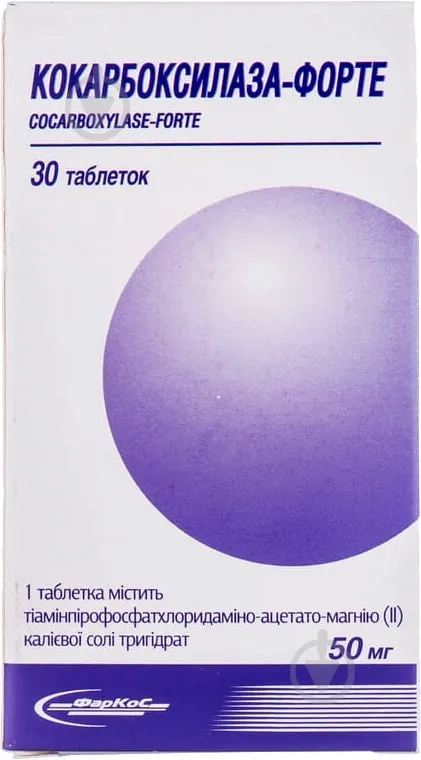
Table of Contents
INSTRUCTION FOR MEDICAL USE OF THE MEDICINAL PRODUCT KOCARBOXYLASE-FORTE (COCARBOXYLASE-FORTE)
Composition:
Active substance: cocarboxylase;
One tablet contains 50 mg of thiamine pyrophosphate chloride aminoacetate-magnesium (II) potassium salt trihydrate, calculated as 100% substance;
Excipients: lactose monohydrate; microcrystalline cellulose; sugar powder; calcium stearate.
Pharmaceutical form. Tablets.
Main physico-chemical properties: white, round, biconvex tablets with a score line on one side.
Pharmacotherapeutic group.
Simple vitamin B1 preparations. ATC code: A11DA.
Pharmacological properties.
Pharmacodynamics.
Thiamine pyrophosphate chloride aminoacetate-magnesium (II) potassium salt trihydrate is an original coordination compound of cocarboxylase (thiamine pyrophosphate hydrochloride). The presence in the compound of magnesium ions and the amino acid glycine enhances the activity of cocarboxylase towards enzymes of carbohydrate metabolism, for which it serves as a coenzyme.
In the body, cocarboxylase in complex with protein and magnesium ions is a component of the carboxylase enzyme, which catalyzes decarboxylation and carboxylation of α-keto acids. Cocarboxylase activates key enzymes of carbohydrate metabolism, resulting in enhanced tissue utilization of glucose. Enhanced glucose metabolism leads to activation of tissue respiration, increased ATP production, and reduced accumulation of lactic acid. This effect is accompanied by improvement of metabolic processes, particularly in diabetes mellitus. Cocarboxylase promotes more complete utilization of pyruvic acid, resulting in improved nerve fiber function in diabetes mellitus and reduction of neuropathic symptoms.
Cocarboxylase-Forte promotes normalization of cellular metabolism under conditions of ischemia and hypoxia. Administration of the drug in conditions associated with activation of free radical reactions is accompanied by improvement of antioxidant status.
Pharmacokinetics.
After sublingual administration, the components of the drug are rapidly absorbed into the bloodstream. Maximum plasma concentration is reached within 0.5–1.5 hours. Metabolism products are excreted by the kidneys.
Clinical characteristics.
Indications.
As part of complex therapy:
- diabetes mellitus and its complications;
- liver diseases regardless of etiology, to enhance hepatocyte activity against various pathological influences (viral, inflammatory, toxic);
- hepatic insufficiency;
- ischemic heart disease;
- peripheral neuritis;
- inflammatory and toxic lesions of the myocardium (myocarditis);
- cardiomyopathies.
Contraindications.
Hypersensitivity to the drug.
Interaction with other medicinal products and other types of interactions.
When Cocarboxylase-Forte is used concomitantly with hypoglycemic agents, enhanced activity of these agents should be taken into account.
Cocarboxylase enhances the cardiotonic effect of cardiac glycosides and improves their tolerability.
Special precautions for use
When using the drug Cocarboxylase-Forte in patients with diabetes mellitus, blood glucose levels should be monitored.
During complex therapy, the property of cocarboxylase to enhance the cardiotonic effect of cardiac glycosides must be taken into account.
The drug should not be used in patients with rare hereditary disorders of lactose intolerance, Lapp lactase deficiency, or glucose-galactose malabsorption.
Use during pregnancy or breastfeeding
The efficacy and safety of using cocarboxylase hydrochloride during pregnancy or breastfeeding have not been established; therefore, the drug is not recommended for use during these periods.
Ability to influence reaction speed while driving or operating machinery
Has not been studied.
Method of Administration and Dosage
The method and dosage of the drug are determined individually by a physician in each case.
Adults and children aged 12 years and older usually take the tablets sublingually, holding them in the mouth until completely dissolved, 3–4 times daily. The drug may also be taken orally, 10–15 minutes before meals, 3–4 times daily. The usual duration of treatment is 20–30 days.
Children
The efficacy and safety of cocarboxylase in children under 12 years of age have not been studied; therefore, the drug is not recommended for use in this age group.
Overdose
An overdose may enhance manifestations of increased individual sensitivity to the drug. Symptoms of overdose may present as more pronounced forms of adverse reactions.
Discontinuation of the drug is recommended; symptomatic treatment aimed at normalizing respiration and cardiovascular function should be administered.
Side effects.
Immune system: allergic reactions are possible, including hypersensitivity reactions. Symptoms may range from itching, skin rash, urticaria to anaphylactic shock.
In such cases, the dose should be reduced or the drug discontinued. After discontinuation of the drug, all adverse effects quickly resolve.
Shelf life.
3 years.
Storage conditions.
Store in the original packaging at a temperature not exceeding +15 °C.
Keep out of reach of children.
Packaging.
10 tablets in a blister; 2 or 3 blisters per pack.
Availability. Over-the-counter.
Manufacturer.
ASTRAFARM LLC.
Manufacturer's address and place of business.
6, Kyivska Street, Vyshneve, Kyiv-Sviatoshyn District, Kyiv Region, 08132, Ukraine.
Manufacturer.
Pharmaceutical Company "Farkos" LLC.
Manufacturer's address and place of business.
360, Sviato-Pokrovska Street, mst. Hostomel, city of Irpin, Kyiv Region, 08290, Ukraine.