Cognifen®
Ukraine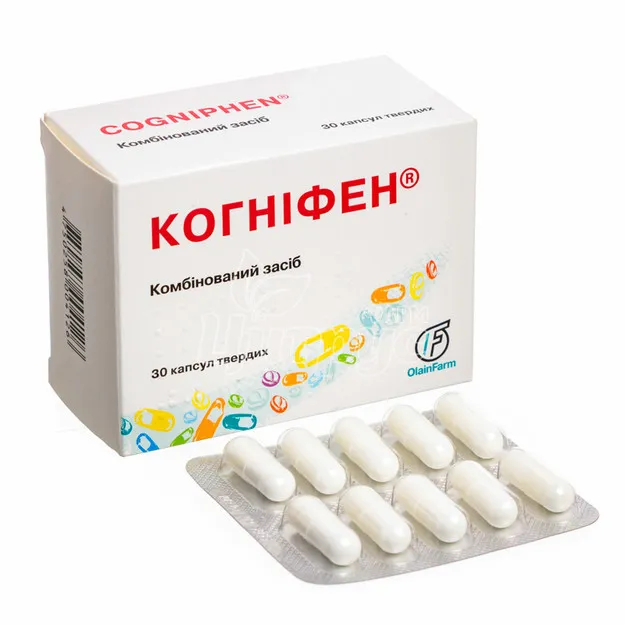
Table of Contents
INSTRUCTIONS FOR MEDICAL USE OF THE MEDICINAL PRODUCT COGNIPHEN® (COGNIPHEN®)
Composition:
Active substances: phenibut, ipidacrins hydrochloride (ipidacrine);
1 capsule contains phenibut 300 mg, ipidacrine hydrochloride 5 mg, recalculated to 100% anhydrous substance;
Excipients: mannite (E 421), potato starch, sodium stearyl fumarate, capsule shell: titanium dioxide (E 171), gelatin.
Pharmaceutical form. Hard capsules.
Main physico-chemical properties: hard gelatin capsules, white, containing a powder ranging from white to white with a yellowish tint. Non-uniformity in particle size and agglomerates of particles, which may be compressed into a column, is acceptable.
Pharmacotherapeutic group.
Psychostimulants and nootropic agents, combination. ATC code N06BX.
Pharmacological Properties
Pharmacodynamics
Cog-nifen® is a combined medicinal product containing phenibut (γ-amino-β-phenylbutyric acid hydrochloride) and ipidacrine, thus combining the properties of a nootropic and an anticholinesterase agent.
The drug restores and stabilizes impaired integrative functions of the brain and balances activating and inhibitory mechanisms of brain function.
Cog-nifen® optimizes energy processes in the brain, thereby enhancing resistance of the central nervous system (CNS) to hypoxia and toxic factors.
Cog-nifen® normalizes brain cell metabolism, exhibits anti-hypoxic, analgesic, and anti-amnesic effects, reduces manifestations of asthenia and nervous tension, improves mental performance, and possesses anti-asthenic and moderate analgesic properties.
The drug enhances learning processes and improves memory, increases physical performance, relieves tension, anxiety, fear, and improves sleep. It significantly reduces symptoms of asthenia and vasovegetative symptoms, including headache, sensation of heaviness in the head, sleep disturbances, irritability, emotional lability, and enhances mental performance.
Cog-nifen® is a combined drug whose pharmacotherapeutic action is determined by the properties of its components.
Phenibut (γ-amino-β-phenylbutyric acid hydrochloride) is a derivative of γ-aminobutyric acid (GABA) and phenylethylamine. Its main mechanism of action is a direct modulating effect on GABA-mediated neurotransmission in the central nervous system (CNS). It improves brain function by normalizing tissue metabolism and influencing cerebral circulation (increases volumetric and linear velocity of cerebral blood flow, reduces cerebral vascular resistance, improves microcirculation, and exhibits anti-aggregant activity). Its predominant effects are anti-hypoxic and anti-amnesic. Phenibut enhances learning processes and memory, increases physical performance, relieves tension, anxiety, fear, and improves sleep.
Phenibut significantly reduces symptoms of asthenia and vasovegetative symptoms, including headache, sensation of heaviness in the head, sleep disturbances, irritability, emotional lability, and enhances mental performance. Psychological parameters (attention, memory, speed and accuracy of sensorimotor reactions) improve under the influence of phenibut. In patients with asthenia and emotionally labile individuals, subjective well-being improves from the first days of phenibut administration, with increased interest, initiative, and motivation for activity, without undesirable sedation or excitation. It has been established that phenibut, when administered after traumatic brain injury, increases the number of mitochondria in the perifocal area and improves brain bioenergetics. Although phenibut does not affect cholinergic, adrenergic, or other types of neurotransmission, ipidacrine does.
Ipidacrine is the second active pharmaceutical ingredient in Cog-nifen® and represents a biologically favorable combination of two molecular effects: blockade of potassium permeability of neuronal and muscle cell membranes and reversible inhibition of cholinesterase in synapses, which directly stimulates impulse conduction in the CNS and neuromuscular junctions. The blockade of potassium membrane permeability plays a decisive role. In cholinergic synapses, cholinesterase inhibition leads to further accumulation of the neurotransmitter in the synaptic cleft and enhanced functional activity of the postsynaptic cell (transmission of excitation between neurons, muscle contraction). Ipidacrine enhances the effect on smooth muscles not only of acetylcholine but also of adrenaline, serotonin, histamine, and oxytocin. It also blocks sodium membrane permeability, although this effect is significantly weaker compared to its effect on potassium permeability. This effect is partially responsible for the weak sedative and analgesic properties of ipidacrine. Thus, ipidacrine acts on all levels of the chain of processes ensuring excitation conduction: increasing presynaptic axon activity, enhancing neurotransmitter release into the synaptic cleft in all synapses, and strengthening stimulation of the postsynaptic cell.
Ipidacrine exhibits the following pharmacological effects: restores and stimulates neuromuscular transmission; restores impulse conduction in the central and peripheral nervous systems; enhances contractility of smooth-muscle organs under the influence of all antagonists except potassium chloride; improves memory and learning ability; inhibits the progressive development of dementia; moderately and specifically stimulates the CNS; exhibits analgesic effect; exhibits antiarrhythmic effect.
The combination of properties of both active substances enhances cognitive brain functions through effects on GABAergic, cholinergic, and dopaminergic systems of the brain.
Pharmacokinetics
Phenibut is well absorbed after oral administration and rapidly penetrates into all tissues of the body, crossing the blood-brain barrier effectively. Distribution in the liver and kidneys is close to uniform, while in the brain and blood it is lower than uniform. The highest binding of phenibut occurs in the liver (80%), and this binding is non-specific. It is metabolized by hepatocytes by 80–95%; metabolites are pharmacologically inactive. A significant amount of administered phenibut is detected in urine within 3 hours, while the concentration of the drug in brain tissue does not decrease and remains detectable in the brain for up to 6 hours. On the following day, phenibut can only be detected in urine; it remains detectable for up to 2 days after administration, but the amount found constitutes only 5% of the administered dose. No accumulation is observed with repeated administration.
Ipidacrine is rapidly absorbed after oral intake. Maximum plasma concentration is reached within one hour after administration. Ipidacrine is predominantly absorbed from the duodenum, to a lesser extent from the small and ileal intestine, and only 3% of the dose is absorbed in the stomach. Approximately 40–50% of ipidacrine binds to plasma proteins. From the blood, ipidacrine rapidly distributes into tissues; therefore, only 2% of the drug remains detectable in blood serum at the stabilization phase. Elimination of ipidacrine from the body occurs through a combination of renal and extrarenal mechanisms (biotransformation, biliary secretion), with urinary excretion being predominant. Only 3.7% of ipidacrine is excreted unchanged in urine, indicating its rapid metabolism in the body. The elimination half-life during the distribution phase is 40 minutes.
The combined pharmacokinetics of phenibut and ipidacrine have not been studied.
Clinical characteristics.
Indications.
Diseases of the nervous system with impaired intellectual and mnemonic functions:
- cognitive disorders of vascular, post-traumatic and other etiologies;
- age-related degenerative processes in the brain in elderly patients;
- cerebral atherosclerosis;
- pathological conditions associated with chronic cerebral circulation insufficiency;
- memory disorders of various etiologies (Alzheimer's disease and other forms of senile dementia), as well as disorders of praxis, attention, and speech;
- decreased intellectual and emotional activity, impaired attention due to stress or overexertion.
Rehabilitation in the post-stroke period.
Contraindications.
Hypersensitivity to the drug or its components.
Epilepsy, extrapyramidal disorders with hyperkinesia, angina pectoris, severe bradycardia, bronchial asthma, mechanical intestinal or urinary tract obstruction, peptic ulcer of the stomach or duodenum in the acute phase, acute renal failure.
Interaction with other medicinal products and other types of interactions.
When used concomitantly with psychotropic agents—tranquilizers and neuroleptics—the effects are mutually enhanced.
Concomitant use with cholinesterase inhibitors and M-cholinomimetic agents may enhance their effects and adverse reactions.
The risk of developing bradycardia increases if β-adrenoblockers were administered prior to starting treatment with Cogniphen®.
Alcohol consumption should be avoided during treatment.
Special precautions for use
Use during pregnancy or breastfeeding
Ipidacrine, which is part of Cognifen®, increases uterine muscle tone and may provoke premature labor; therefore, the use of the drug during pregnancy is not recommended.
Cognifen® is contraindicated during breastfeeding.
Ability to affect reaction speed when driving or operating machinery
Patients who experience drowsiness, dizziness, or other central nervous system disturbances during treatment with this drug should refrain from driving or operating vehicles and machinery.
Method of administration and dosage.
The capsule is taken orally, swallowed with water after meals. The capsule must not be chewed.
The drug is prescribed 1 capsule 2–3 times daily. The treatment course is 30 days.
Children.
There is no experience with the use of the drug in children; therefore, its use is contraindicated.
Overdose.
Cases of overdose are unknown.
Side effects.
From the nervous system: (when using high doses) dizziness, headache, drowsiness, weakness, muscle cramps.
From the respiratory system: increased bronchial secretion, bronchospasm.
From the gastrointestinal tract: salivation; nausea, vomiting (when using high doses); diarrhea, epigastric pain.
From the skin and subcutaneous tissues: increased sweating; after taking high doses, allergic reactions are possible (urticaria, angioneurotic edema, itching, rash).
From the reproductive system: increased uterine tone.
Cardiac disorders: palpitations, bradycardia, chest pain.
These side effects are typical for doses exceeding the recommended dose of the drug by 4 times.
Shelf life. 3 years.
Storage conditions.
Store in the original packaging at a temperature not exceeding 25 °C.
Keep out of reach of children.
Packaging.
10 capsules in a blister pack. 3 blisters in a cardboard box.
Prescription status. Prescription only.
Manufacturer.
JSC «Olainfarm».
Manufacturer's address and place of business.
5 Rupnicu street, LV-2114, Olaine, Latvia.