Caffeine-sodium benzoate
Ukraine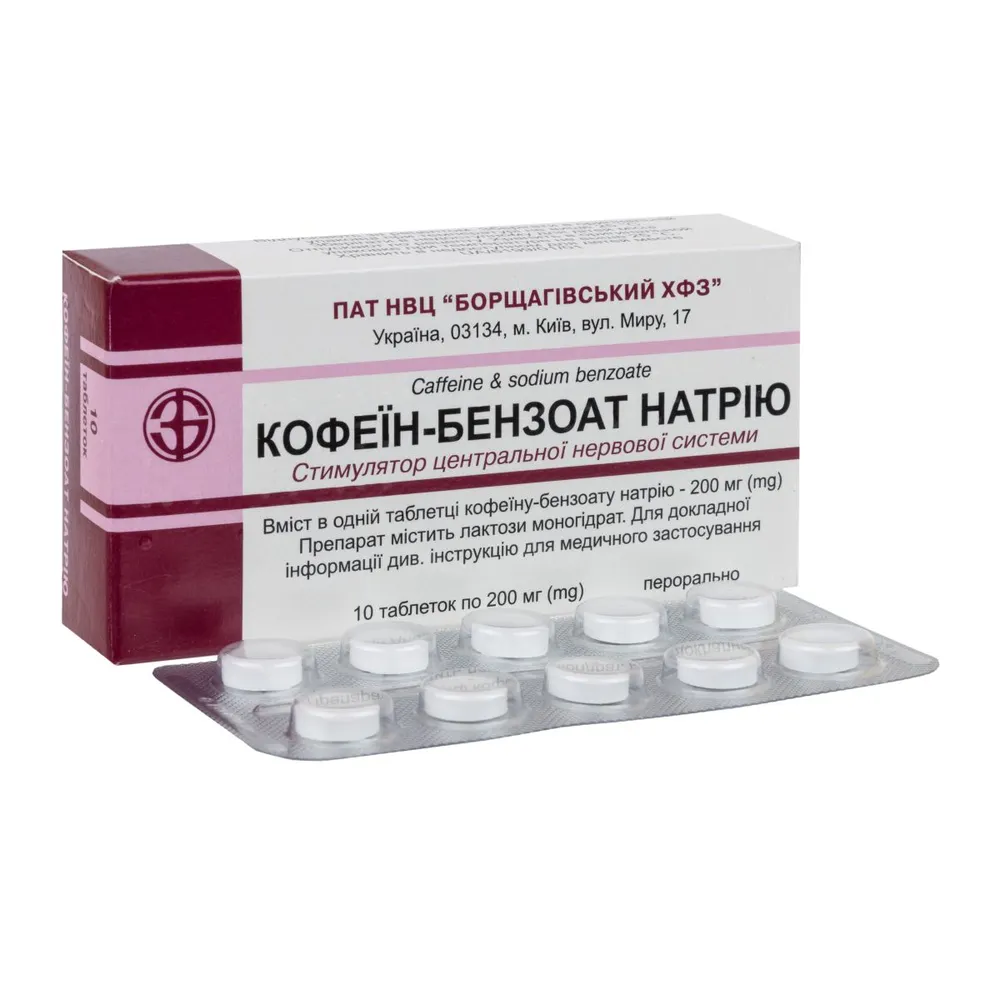
Table of Contents
INSTRUCTIONS FOR MEDICAL USE OF THE MEDICINAL PRODUCT COFFEEINE-SODIUM BENZOATE
Composition:
Active substance: caffeine-sodium benzoate;
1 tablet contains caffeine-sodium benzoate (recalculated to 100% dry substance) – 200 mg;
Excipients: lactose monohydrate, microcrystalline cellulose, corn starch, povidone, calcium stearate.
Pharmaceutical form. Tablets.
Main physicochemical properties: round-shaped tablets, white-colored, with flat surface, beveled edges, and a score line.
Pharmacotherapeutic group.
Psychostimulants, drugs for use in attention deficit hyperactivity disorder (ADHD), and nootropic agents. Xanthine derivatives. ATC code N06B C01.
Pharmacological properties.
Pharmacodynamics.
Sodium benzoate caffeine is used primarily as a central nervous system stimulant.
The mechanism of action of the drug is based on the inhibition by caffeine of the enzyme phosphodiesterase, leading to accumulation of intracellular cyclic adenosine monophosphate. The latter enhances glycogenolysis and stimulates metabolism in organs and tissues, including the central nervous system and muscles. An important component in the mechanism of the stimulant effect of the drug is the binding of caffeine to purine receptors in the brain.
Caffeine enhances and regulates excitation processes in the cerebral cortex, strengthens positive reflexes, and increases motor activity. These effects are dose-dependent and contribute to improved mental and physical performance, reduced fatigue and drowsiness. In excessively high doses, caffeine may lead to exhaustion of nerve cells.
The drug reduces the effects of hypnotics and narcotic agents, increases reflex excitability of the spinal cord, and stimulates the respiratory and vasomotor centers. Under the influence of the drug, cardiac activity is enhanced and heart rate is increased.
Under the influence of sodium benzoate caffeine, diuresis is slightly enhanced (mainly due to reduced electrolyte reabsorption in the renal tubules).
Pharmacokinetics.
The drug is well absorbed from the gastrointestinal tract. It is evenly distributed in the body. It readily penetrates the blood-brain barrier. It crosses the placenta and is excreted in breast milk. During biotransformation, it undergoes demethylation and oxidation. The half-life is 3–7 hours. It is excreted from the body in urine and feces as metabolites, with a small portion (about 8%) excreted unchanged.
Clinical characteristics.
Indications.
- Infectious and other diseases accompanied by depression of the central nervous and cardiovascular systems;
- arterial hypotension;
- asthenic syndrome;
- cerebral vessel spasms;
- drowsiness;
- increased mental and physical performance.
Contraindications.
- Hypersensitivity to caffeine, other xanthine derivatives (theophylline, theobromine), or to any component of the drug;
- increased excitability;
- insomnia;
- marked increase in blood pressure, arterial hypertension;
- organic cardiovascular diseases (including acute myocardial infarction, paroxysmal tachycardia, atherosclerosis);
- glaucoma;
- age over 60 years.
Interaction with other medicinal products and other forms of interactions.
Concomitant use of sodium benzoate caffeine with:
- MAO inhibitors, furazolidone, procarbazine, and selegiline – may cause development of dangerous cardiac arrhythmias or marked increase in arterial pressure;
- barbiturates, primidone, anticonvulsant drugs (hydantoin derivatives, especially phenytoin) – enhanced metabolism and increased clearance of caffeine;
- ketoconazole, disulfiram, ciprofloxacin, norfloxacin, enoxacin, pipemidic acid – may cause delayed elimination of caffeine and increased its blood concentration;
- cimetidine, hormonal contraceptives, isoniazid – potentiation of caffeine effects;
- fluvoxamine – increased plasma caffeine levels in blood;
- mexiletine – reduced elimination of caffeine by 50%;
- nicotine – increased rate of caffeine elimination;
- methoxsalen – decreased elimination of caffeine from the body with possible enhancement of its effect and development of toxic effects;
- clozapine – increased clozapine concentration in blood;
- theophylline and other xanthines – reduced clearance of these drugs, increased risk of additive pharmacodynamic and toxic effects;
- β-adrenergic blockers – may lead to mutual inhibition of therapeutic effects;
- thyrotropic agents – enhancement of thyroid effect;
- opioid analgesics, anxiolytics, hypnotics and sedatives – reduced effect of these drugs;
- lithium preparations – increased urinary excretion of lithium;
- calcium preparations – reduced absorption of these drugs;
- cardiac glycosides – accelerated absorption, enhanced action, and increased toxicity of cardiac glycosides;
- analgesic antipyretics – enhanced effect;
- ergotamine – improved absorption of ergotamine from the gastrointestinal tract;
- xanthine derivatives, α- and β-adrenergic agonists, psychostimulants – potentiation of their effects.
Caffeine is an antagonist of anesthetic agents and other drugs that depress the central nervous system, and a competitive antagonist of adenosine preparations, ATP.
Beverages and medicinal products containing caffeine, when used concomitantly with the drug, may lead to excessive stimulation of the central nervous system. High doses of caffeine may cause tremors and palpitations. Patients should avoid excessive consumption of coffee or tea.
Special precautions for use.
When using the drug, avoid excessive consumption of coffee, strong tea, other tonic beverages, alcohol, and medicinal products containing caffeine.
Prolonged use of the drug may lead to the development of psychological dependence. Abrupt discontinuation of treatment may result in increased central nervous system depression (drowsiness, depression).
The drug's effect largely depends on the type of nervous system and may manifest either as excitation or inhibition of higher nervous activity.
Caffeine may cause a false increase in blood uric acid levels determined by the Bittner method.
Caffeine may increase urinary levels of 5-hydroxyindoleacetic acid (5-HIAA), vanillylmandelic acid (VMA), and catecholamines, which may lead to false-positive results in the diagnosis of pheochromocytoma and neuroblastoma.
Use with caution in patients with a history of peptic ulcer of the stomach and duodenum.
The drug contains lactose. Patients with rare hereditary forms of galactose intolerance, lactase deficiency, or glucose-galactose malabsorption syndrome should not take this drug.
Use during pregnancy or breastfeeding.
The drug is contraindicated during pregnancy or breastfeeding.
Ability to affect reaction rate when driving or operating machinery.
Until the individual patient's response to the drug is established, patients should refrain from driving or operating machinery, considering that adverse reactions involving the central nervous system may occur during treatment.
Dosage and Administration.
Take orally 2–3 times a day. The single dose for adults is 100–200 mg.
Maximum single dose – 500 mg; maximum daily dose – 1 g.
For children aged 12 years and older, the recommended dose is 100 mg 2–3 times a day.
Maximum daily dose for children – 500 mg.
The physician determines the dosage and duration of treatment individually, depending on the severity of the disease and the therapeutic response.
Children.
Caffeine-sodium benzoate in tablet form is not recommended for children under 12 years of age.
Overdose.
Symptoms: gastric pain, agitation, anxiety, motor restlessness, confusion, delirium, dehydration, tachycardia, arrhythmias, hyperthermia, increased frequency of urination, headache, increased tactile or pain sensitivity, tremor or muscle twitching; nausea and vomiting, sometimes with blood; tinnitus, seizures (in acute overdose – tonic-clonic seizures).
Treatment: gastric lavage, administration of enterosorbents, maintenance of lung ventilation and oxygenation; in case of seizures – intravenous diazepam, phenobarbital, or phenytoin; fluid and electrolyte balance support; hemodialysis. There is no specific antidote.
Adverse Reactions.
Nervous system: excitation, anxiety, tremor, restlessness, headache, dizziness, muscle twitching, seizures, increased reflexes, tachypnea, insomnia; upon abrupt discontinuation – increased central nervous system depression with increased fatigue, drowsiness, muscle tension, and depression.
Cardiovascular system: chest tightness, palpitations, tachycardia, arrhythmias, increased arterial pressure.
Gastrointestinal tract: nausea, vomiting, diarrhea, exacerbation of peptic ulcer disease.
Urinary system: increased frequency of urination, increased creatinine clearance, increased excretion of sodium and calcium.
Immune system: possible manifestations of hypersensitivity reactions, including skin rashes, pruritus, urticaria, Quincke's edema (angioedema), bronchospasm, anaphylactic shock, Stevens-Johnson syndrome.
Laboratory parameters: possible false increase in blood uric acid when measured by the Bittner method, hypoglycemia/hyperglycemia, slight increase in urinary excretion of 5-hydroxyindoleacetic acid (5-HIAA), vanillylmandelic acid (VMA), and catecholamines.
Other: nasal congestion; with prolonged use – reduced effect of caffeine due to formation of new adenosine receptors, drug dependence.
Reporting of suspected adverse reactions.
Reporting of suspected adverse reactions after drug registration is of great importance. It enables continuous monitoring of the benefit-risk balance of the medicinal product. Healthcare and pharmacy professionals, as well as patients or their legal representatives, should report all suspected adverse reactions and lack of drug efficacy via the Automated Information System for Pharmacovigilance at the following link: https://aisf.dec.gov.ua.
Shelf life. 4 years.
Storage conditions.
Store in the original packaging at a temperature not exceeding 25 °C.
Keep out of reach of children.
Packaging.
10 tablets per blister, 1 blister per carton; 10 tablets per blister.
Prescription status. Prescription only.
Manufacturer.
Public Joint-Stock Company "Scientific and Production Center "Borshchahivskiy Chemical and Pharmaceutical Plant".
Limited Liability Company "Agrofarm".
Manufacturer's address and place of business.
Ukraine, 03134, Kyiv, Miru St., 17.
Ukraine, 08200, Kyiv Oblast, Irpin, Centralna St., 113-A.