Caffeine-sodium benzoate-darnitsa
Ukraine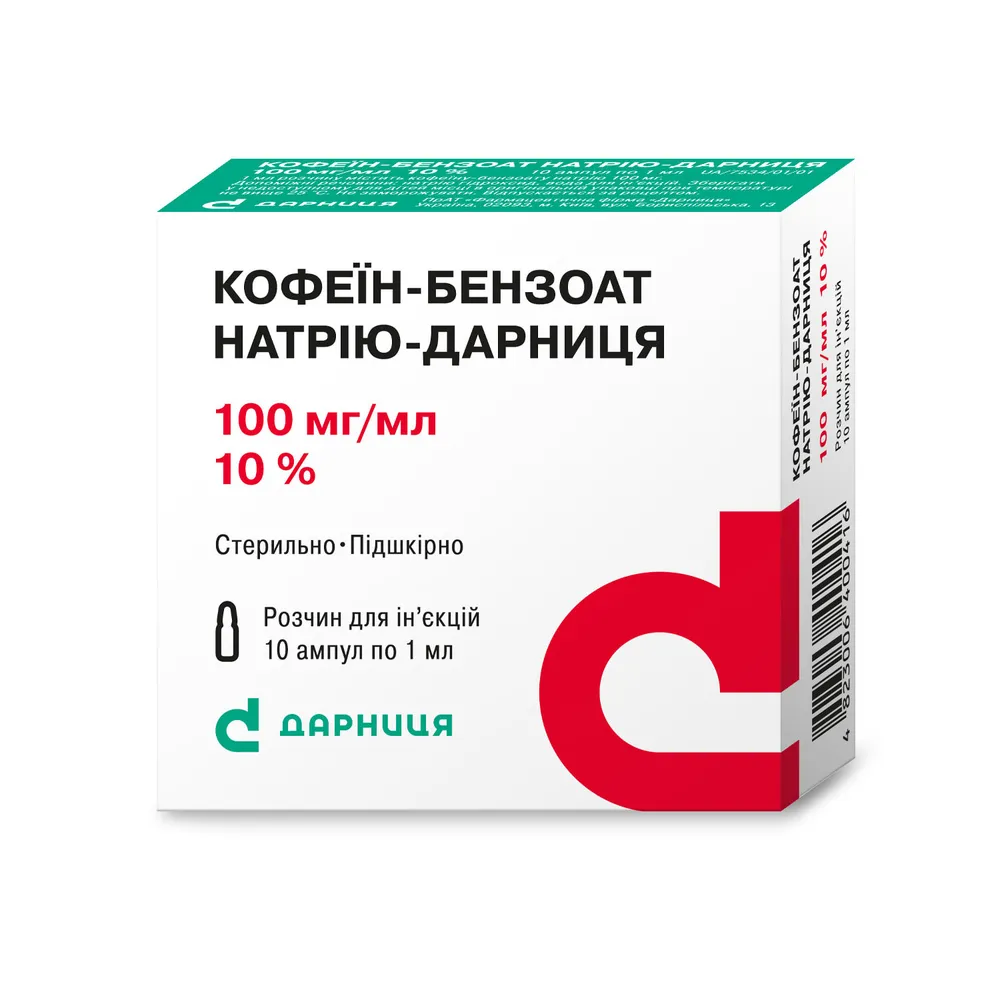
Table of Contents
INSTRUCTIONS FOR MEDICAL USE OF THE MEDICINAL PRODUCT Caffeine-benzoatesodium-Darnitsa (Caffeine-benzoatesodium-Darnitsa)
Composition:
Active substances: 1 ml of solution contains 100 mg of sodium caffeine benzoate;
Excipients: sodium hydroxide, water for injections.
Pharmaceutical form. Injection solution.
Main physicochemical properties: clear, colorless or slightly yellowish liquid.
Pharmacotherapeutic group. Psychostimulants, drugs used in attention deficit hyperactivity disorder (ADHD) and nootropic agents. Xanthine derivatives.
ATC code N06B C01.
Pharmacological Properties
Pharmacodynamics
Caffeine is an alkaloid found in tea leaves and coffee beans. The pharmacological properties of the drug are categorized into central and peripheral effects. The central effects, in turn, are divided into psychostimulant and analeptic actions.
The psychostimulant effect of Sodium Caffeine Benzoate-Darnitsya is associated with its antagonism toward adenosine in the mechanism of action on purinergic (adenosine) A-1 and A-2 receptors in the central nervous system (CNS). Adenosine is known to suppress CNS functions. Under the influence of the drug, mental activity, cognitive performance, and physical endurance improve. The psychostimulant effect is directly dose-dependent. Low doses stimulate CNS functions, while higher doses suppress them (due to exhaustion of nerve cells).
The analeptic effect of Sodium Caffeine Benzoate-Darnitsya is related to its influence on the respiratory and hemodynamic centers in the medulla oblongata. As a result, an increase in respiratory rate and tidal volume is observed.
The peripheral effects of the drug are variable and depend on its dose and level of impact on the vascular system and myocardium. Coronary blood flow initially increases and then decreases; renal blood flow increases; blood vessels in the abdominal cavity and skin constrict. Under the influence of the drug, central circulation is suppressed and cerebrospinal fluid pressure is reduced, which explains its efficacy in migraine. The drug's effect on the heart is variable. In low doses, it produces a positive inotropic effect; in higher doses, a positive chronotropic effect. In some individuals, it may cause tachycardia and even arrhythmia.
Pharmacokinetics
The drug is rapidly distributed throughout all organs and tissues of the body. Plasma protein binding (to albumins) is 25–36%. It readily crosses the blood-brain barrier and placenta and enters breast milk. The volume of distribution is 0.4–0.6 L/kg in adults and 0.78–0.92 L/kg in infants. More than 90% of the administered dose undergoes hepatic metabolism; in infants during the first year of life, this is up to 10–15%. In adults, approximately 80% of the caffeine dose is metabolized to paraxanthine, about 10% to theobromine, and about 4% to theophylline. These compounds are subsequently demethylated into monomethylxanthines and then into methylated uric acids. The elimination half-life in adults is 3.9–5.3 hours (sometimes up to 10 hours), and in infants (aged 4–7 months) it is 65–130 hours. Caffeine and its metabolites are excreted by the kidneys (1–2% unchanged in adults; up to 85% unchanged in infants).
Clinical characteristics.
Indications.
Infectious and other diseases accompanied by depression of the central nervous and cardiovascular systems; respiratory depression, asphyxia; poisoning with narcotics and other substances that depress the central nervous system; asthenic syndrome; cerebral vessel spasms.
Contraindications.
Hypersensitivity to xanthine derivatives and to other components of the medicinal product; increased excitability; insomnia; marked increase in arterial pressure; atherosclerosis; organic cardiovascular diseases, including acute myocardial infarction; paroxysmal tachycardia; arterial hypertension; glaucoma; age over 60 years.
Interaction with other medicinal products and other types of interactions.
Possible interactions when sodium coffeinate is used concomitantly with other medicinal products:
with alpha- and beta-adrenomimetics, analgesic-antipyretics, clozapine, xanthine derivatives, psychostimulants, cardiac glycosides, thyrotropic agents – enhancement of the effects of the aforementioned medicinal products;
with anxiolytics, opioid analgesics, hypnotics and sedatives – reduction of the effects of the aforementioned medicinal products;
with antiarrhythmic medicinal products (mexiletine), oral hormonal contraceptives, disulfiram, enoxacin, erythromycin, isoniazid, methoxsalen, norfloxacin, ofloxacin, cimetidine, norfloxacin, ciprofloxacin – enhancement of caffeine effects;
with antidepressants, barbiturates, beta-adrenoblockers, primidone, anticonvulsant medicinal products (hydantoin derivatives, especially phenytoin), cholestyramine, cholinolytics – reduction of caffeine effects;
with medicinal products that stimulate the central nervous system, beverages containing caffeine – excessive stimulation of the central nervous system;
with monoamine oxidase inhibitors (MAO inhibitors), procarbazine, furazolidone – dangerous cardiac arrhythmias or marked increase in arterial pressure;
with ergotamine – enhanced absorption of the latter from the gastrointestinal tract;
with calcium preparations – reduced absorption of the latter from the gastrointestinal tract;
with lithium preparations – enhanced excretion of the latter in urine;
with nicotine – enhanced excretion of caffeine in urine.
The medicinal product slightly increases the concentration of 5-hydroxyindoleacetic acid when determined in urine.
The medicinal product slightly increases the concentration of catecholamines and vanillylmandelic acid, which may lead to false-positive test results in the diagnosis of pheochromocytoma and neuroblastoma. The medicinal product should not be used during testing.
The medicinal product may lead to false results in the determination of urate concentration in blood serum by the Bittner method.
Special precautions for use.
The effect on the central nervous system depends on the type of nervous system and may manifest as either excitation or inhibition of higher nervous activity.
Since the effect of caffeine on arterial pressure consists of both vascular and cardiac components, either stimulation of the heart or mild suppression of its activity may develop.
Use with caution in patients with a history of peptic ulcer disease of the stomach and duodenum.
Caffeine or caffeine citrate, but not sodium caffeine benzoate, is used for apnea in neonates and infants during the postoperative period (prophylaxis).
Use during pregnancy or breastfeeding.
This medicinal product should not be used during pregnancy or breastfeeding.
Ability to influence reaction rate while driving or operating machinery.
During treatment, caution should be exercised when driving or operating machinery. If adverse effects on the nervous system occur, avoid potentially hazardous activities requiring increased attention and rapid psychomotor reactions.
Method of administration and dosage.
For adults, administer the medicinal product subcutaneously at a dose of 1–2 mL of a 10 % solution (100–200 mg). The maximum single dose is 400 mg; the maximum daily dose is 1 g.
For children aged 12 years and older, administer the medicinal product subcutaneously at a dose (depending on age) of 0.25–1 mL of a 10 % solution (25–100 mg).
Children.
The medicinal product is contraindicated in children under 12 years of age.
Overdose.
Symptoms: anxiety, excitation, motor restlessness, agitation, tremor or muscle twitching, epileptic seizures (in acute overdose – tonic-clonic convulsions), hyperesthesia, flickering scotoma, tinnitus, headache, insomnia, confusion, hallucinations, delirium, tachycardia, arrhythmia, hyperthermia, increased urination, dehydration, nausea, vomiting, sometimes with blood.
Treatment: maintain lung ventilation and oxygenation, maintain fluid and electrolyte balance, hemodialysis; for epileptic seizures – intravenous diazepam, phenobarbital, or phenytoin.
Adverse Reactions.
Gastrointestinal system: nausea, vomiting, diarrhea, exacerbation of peptic ulcer disease.
Nervous system: excitement, anxiety, tremor, restlessness, insomnia, headache, dizziness, epileptic seizures, increased reflexes, tachypnea. Upon abrupt discontinuation of the drug after prolonged use – enhanced effect on the central nervous system, increased fatigue, drowsiness, muscle tension, depression.
Cardiovascular system: palpitations, chest tightness, tachycardia, arrhythmias, increased blood pressure.
Immune system: hypersensitivity reactions, including rash, pruritus, urticaria, Quincke's edema, bronchospasm.
Laboratory parameters: hypo- or hyperglycemia, increased creatinine clearance, increased excretion of sodium and calcium, falsely elevated plasma uric acid concentration when measured by the Bittner method, slight increase in urinary concentration of 5-hydroxyindoleacetic acid, vanillylmandelic acid, and catecholamines.
Other: increased frequency of urination, nasal congestion; with prolonged use – habituation, drug dependence.
Shelf life.
5 years.
Storage conditions.
Store in the original packaging, out of reach of children, at a temperature not exceeding 25 °C. Do not freeze.
Incompatibility.
Caffeine is an adenosine antagonist.
Packaging.
1 ml in an ampoule; 5 ampoules in a contour cell pack; 2 contour cell packs in a carton.
Prescription category.
Prescription only.
Manufacturer.
JSC "Pharmaceutical Company "Darnytsia".
Manufacturer's address and place of business.
13, Boryspilska St., Kyiv, 02093, Ukraine.