Clomiphene®
Ukraine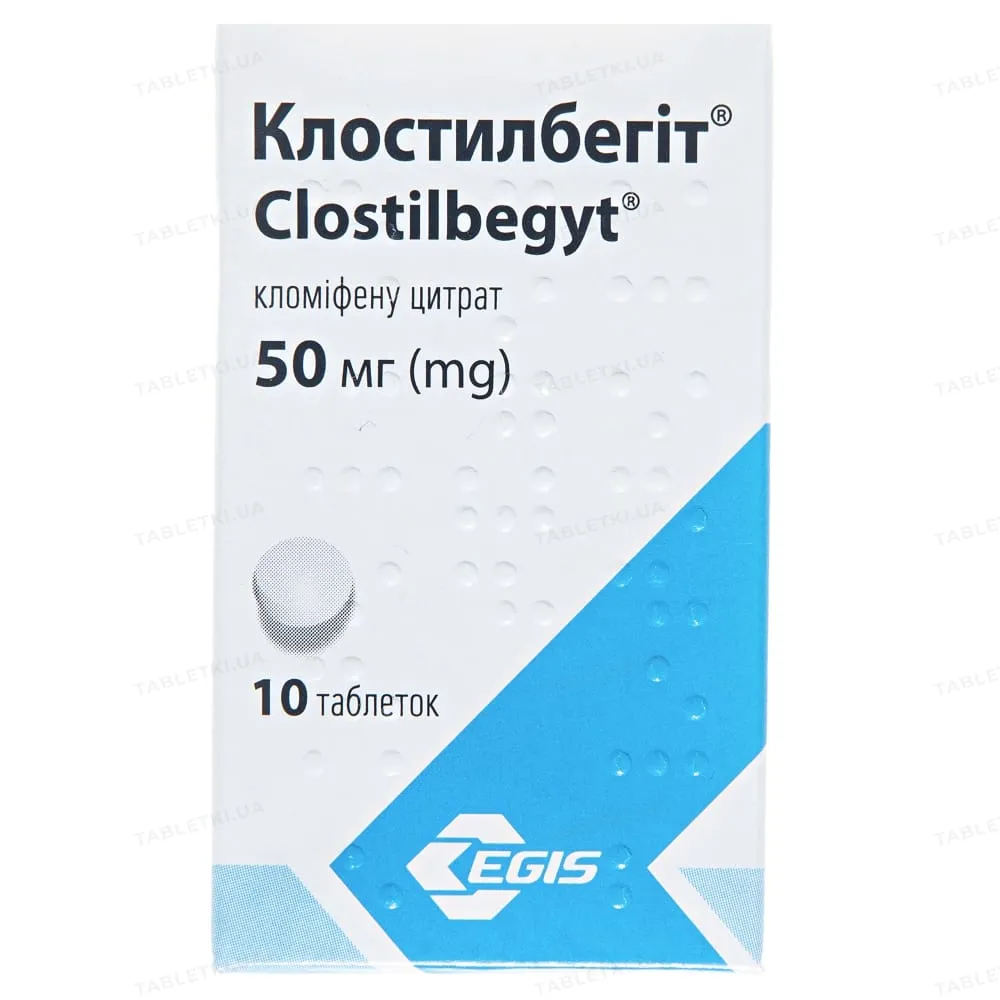
Table of Contents
INSTRUCTIONS FOR MEDICAL USE OF THE MEDICINAL PRODUCT CLOSTILBEGYT® (CLOSTILBEGYT®)
Composition:
Active substance: 1 tablet contains 50 mg of clomiphene citrate;
Excipients: lactose monohydrate, potato starch, talc, magnesium stearate, stearic acid, gelatin.
Pharmaceutical form. Tablets.
Main physicochemical properties: round, flat tablets with a score line and engraved "CLO" on one side, white, yellowish-white or greyish-white in colour; odourless or almost odourless.
Pharmacotherapeutic group. Ovulation stimulants, synthetic. ATC code G03G B02.
Pharmacological properties.
Pharmacodynamics.
Clomiphene is a non-steroidal antiestrogen that stimulates ovulation. Its mechanism of action is explained by its ability to specifically bind to estrogen receptors in the hypothalamus and ovaries. At low doses, the drug enhances secretion of gonadotropic hormones (prolactin, follicle-stimulating hormone, and luteinizing hormone) and stimulates ovulation. At high doses, the drug inhibits gonadotropin secretion. It does not exhibit gestagenic or androgenic activity.
Pharmacokinetics.
After administration, it is completely absorbed from the gastrointestinal tract. It is metabolized in the liver. It is excreted mainly via bile, undergoes enterohepatic recirculation, and is predominantly eliminated in feces. The elimination half-life is 5–7 days.
Clinical characteristics.
Indications.
Treatment of ovulatory disorders, including induction of ovulation in women with anovulatory cycles in order to achieve pregnancy.
Secondary amenorrhea of various etiologies (including amenorrhea following contraceptive use). Stein-Leventhal syndrome. Oligomenorrhea. Chiari-Frommel syndrome (syndrome of prolonged postpartum amenorrhea-galactorrhea). Oligospermia.
Contraindications.
Hypersensitivity to the active substance or to any other component of the medicinal product. Liver disease or impaired liver function in medical history.
Ovarian cyst (except polycystic ovary syndrome).
Reduced pituitary function.
Functional disorders of the thyroid or adrenal glands.
Uterine bleeding of unknown etiology.
Hormone-dependent tumors.
Visual disturbances (recent or chronic visual disorders).
Pregnancy.
Contraindicated in patients with ovarian dysfunction, during menopause, or in other conditions where the drug cannot be used.
Interaction with other medicinal products and other forms of interaction.
Not established.
Special precautions for use.
Before starting treatment, the patient should be informed about the purpose and risks associated with therapy with Clomiphene**®. It is important to emphasize that the goal of Clomiphene®** therapy is to induce ovulation for subsequent pregnancy. During patient counseling, the physician must pay special attention to potential risks. Prior to initiating treatment, it is recommended to assess liver function, hormonal status, and gonadotropin levels in urine, as well as to perform a thorough gynecological examination. The drug should only be used when total urinary gonadotropin levels are below or within the lower limit of normal, when ovaries are normal in size upon palpation, and when thyroid and adrenal gland functions are normal.
In the absence of ovulation, other possible causes of infertility should be ruled out and corrected before starting clomiphene therapy. If ovarian enlargement or cystic transformation of the ovaries is observed, treatment with the drug is not permitted until the ovaries return to normal size. In such cases, the dose or duration of treatment should be reduced in subsequent cycles.
Ovaries should be monitored regularly during treatment.
During Clomiphene**®** therapy, the timing of ovulation is difficult to determine, and luteal phase deficiency frequently occurs as a result. Therefore, it is recommended to initiate prophylactic progesterone therapy after conception.
The drug must be administered under constant supervision of a gynecologist!
Warning.
A good level of endogenous estrogen (based on evaluation of vaginal smears, endometrial biopsy, urinary estrogen levels, or progesterone-induced endometrial bleeding) allows for a favorable prognosis of ovulation during Clomiphene**®** treatment.
Low estrogen levels, although less favorable clinically, do not exclude a successful therapeutic outcome. Clomiphene**®** therapy is ineffective in patients with primary hypopituitarism or primary ovarian insufficiency. Clomiphene**®** therapy cannot replace specific treatment in other cases of anovulatory dysfunction, such as thyroid or adrenal gland disorders.
Hyperprolactinemia has other effective treatment options. Clomiphene**®** is not the first-line treatment for low body weight associated with amenorrhea and infertility, and it is not indicated in cases of elevated FSH (follicle-stimulating hormone) levels observed during early menopause.
Ovarian hyperstimulation syndrome (OHSS).
Ovarian hyperstimulation syndrome has been reported in patients taking clomiphene to enhance ovulation.
OHSS has been observed following cyclic administration of clomiphene or when used in combination with gonadotropins.
Other conditions associated with OHSS during clomiphene therapy have also been reported: exudative pericarditis, anasarca, hydrothorax, acute abdomen, renal failure, pulmonary edema, ovarian hemorrhage, deep vein thrombosis, ovarian torsion, and acute respiratory distress syndrome.
In case of conception, a severe form of OHSS may develop.
The physician may reduce the dose or limit treatment duration.
To minimize the risk of abnormal ovarian enlargement, the lowest effective doses of the drug should be used. More than 6 treatment cycles are not recommended.
Patients should be warned to inform their physician if they experience lower abdominal or pelvic pain, weight gain, or discomfort after taking the drug. If lower abdominal pain occurs during clomiphene therapy, a thorough examination should be performed, and if ovarian enlargement is detected, treatment should be discontinued until ovarian size returns to normal. Maximum ovarian enlargement may occur several days after the end of a Clomiphene**®** treatment cycle. In such cases, the dose and duration of treatment in the next cycle should be reduced.
Some patients with polycystic ovary syndrome are sensitive to gonadotropins and may therefore be more sensitive to standard doses of Clomiphene**®**.
Patients who complain of abdominal or pelvic pain, discomfort, or bloating after taking clomiphene should be examined to rule out ovarian cysts or other conditions. Due to the sensitivity of enlarged ovaries, abdominal and pelvic examinations should be performed very carefully in severe cases. If abnormal ovarian enlargement occurs, Clomiphene**®** should not be administered until the ovaries return to normal size. Ovarian enlargement and cyst formation associated with clomiphene tablets usually regress spontaneously within several days or weeks after discontinuation of treatment.
Most patients should be managed conservatively. The dose and/or duration of the next treatment cycle should be reduced.
Visual disturbances.
Patients should be warned about possible visual problems such as blurred vision or other symptoms including spots or flashes (scintillating scotoma), which may occur during or shortly after discontinuation of Clomiphene**®** therapy.
Visual disturbances are usually reversible; however, cases of prolonged visual disturbances have been reported, including after discontinuation of treatment.
Visual disturbances may also be irreversible, particularly with high-dose or prolonged therapy.
The nature of visual disturbances is not fully understood. However, if any symptoms occur, treatment should be discontinued and a thorough ophthalmological examination should be performed.
Patients should be informed about these symptoms and advised not to drive or operate machinery, especially when lighting conditions change.
Clomiphene**®** should not be re-administered if visual disturbances develop.
Excipients.
Clomiphene**®** contains lactose; therefore, it is contraindicated in patients with hereditary galactose intolerance, lactase deficiency, or glucose-galactose malabsorption.
Precautions.
Hypertriglyceridemia.
Cases of hypertriglyceridemia have been reported in post-marketing studies of clomiphene (see section "Adverse reactions"). The risk of hypertriglyceridemia may be associated with doses higher than recommended and/or prolonged treatment duration, as well as with pre-existing hyperlipidemia or a family history of the disease.
Plasma triglyceride levels should be monitored in such patients.
Multiples pregnancy.
The frequency of multiple pregnancies increases during Clomiphene**®** therapy. Potential complications and risks of multiple pregnancies should be discussed with the patient. In clinical trials, the rate of multiple pregnancies was 7.9% (186 out of 2369 pregnancies reported in association with Clomiphene**®**). Among these 2369 pregnancies, there were 165 (6.9%) twin pregnancies, 11 (0.5%) triplet pregnancies, 7 (0.3%) quadruplet pregnancies, and 3 (0.13%) quintuplet pregnancies. Among the 165 twin pregnancies with sufficient data, the monozygotic twin ratio was 1:5.
Ectopic pregnancy.
The risk of ectopic pregnancy (including tubal and ovarian sites) is increased during treatment with the drug.
Multiple pregnancies, including simultaneous intrauterine and ectopic pregnancies, have been reported.
Uterine fibroids.
Clomiphene**®** should be used with caution in patients with uterine fibroids due to the potential for further fibroid growth.
Spontaneous abortion and congenital anomalies.
The overall frequency of congenital anomalies reported during studies associated with drug use during pregnancy (before or after conception) was within the range observed in the general population.
Isolated cases of congenital anomalies, such as partial neural tube defects, have been reported and associated with ovulation induced by Clomiphene**®**, but this has not been confirmed by human studies.
The physician should inform patients about the risks of pregnancy, regardless of whether it occurs through medication or naturally.
Patients being considered for clomiphene therapy should also be informed about significant pregnancy risks such as advanced parental age, history of abortions, Rh factor, menstrual cycle disorders, history of infertility (regardless of cause), heart disease, diabetes, effects of infectious diseases such as rubella, and familial history of congenital anomalies. The appropriateness of prescribing the drug should be determined after evaluating the patient's condition and consultation with a geneticist.
Published population reports suggest a possible increased risk of Down syndrome with ovulation stimulation and an increased risk of trisomy following spontaneous abortions in subfertile women receiving ovulation-stimulating agents (none of these women received clomiphene alone without additional stimulatory agents). However, current observational data are insufficient to confirm or refute an increased risk that would justify amniocentesis beyond standard indications based on age and family history.
In clinical studies of Clomiphene**®**, among patients with all diagnoses, pregnancy loss (singleton or multiple) or fetal loss occurred in 21.4% (abortion rate 19.0%), ectopic pregnancy in 1.18%, hydatidiform mole in 0.17%, blighted ovum in 0.04%, and pregnancies with one or more stillbirths in 1.01%.
According to data on Clomiphene**®** therapy after conception and pregnancy outcomes in clinical studies, congenital malformations were observed in 8 newborns from 7 pregnancies out of 158 pregnancy cases. There was no difference in the frequency of congenital malformations whether Clomiphene**®** was administered before day 19 or between days 20 and 35 after conception. This frequency falls within the expected range in the general population.
Ovarian cancer.
Rare cases of ovarian cancer have been reported during treatment with fertility drugs, but infertility itself is a major risk factor for this condition.
Epidemiological data suggest that prolonged use of Clomiphene**®** increases the risk of ovarian cancer. Therefore, treatment duration should not exceed recommended limits (see section "Dosage and administration").
After successful completion of a Clomiphene**®** treatment course, the physician may prescribe prophylactic progesterone therapy.
The drug must be used under constant supervision of a gynecologist.
Use during pregnancy or breastfeeding.
Pregnancy
Clomiphene**®** is contraindicated during pregnancy. There is no evidence that clomiphene has a negative effect on the human fetus; however, data show that clomiphene has a negative effect on the fetus in rats and rabbits when administered to pregnant animals in high doses.
Following ovulation induction with clomiphene, certain congenital malformations have been observed, but their frequency did not exceed that in the general population (< 1%): congenital heart defects, Down syndrome, foot deformities, intestinal developmental anomalies, hypospadias.
To avoid accidental drug intake in early pregnancy, ovulation tests should be used before each treatment cycle, and a pregnancy test should also be performed before each subsequent treatment cycle.
Breastfeeding
It is unknown whether clomiphene passes into breast milk, but the drug may reduce lactation.
Ability to affect reaction speed when driving or operating machinery.
Transient visual disturbances may occur at the beginning of treatment; in such cases, patients should not drive or operate machinery.
Method of Administration and Dosage
In cases of infertility, the dosage and duration of treatment depend on the sensitivity (responsiveness) of the ovaries. For patients with regular menstrual cycles, treatment is recommended to begin on day 5 of the cycle (or on day 3 of the cycle in cases of early ovulation if the follicular phase is shorter than 12 days). In patients with amenorrhea, treatment may be initiated at any time during the cycle.
Treatment regimen I: A daily dose of 50 mg should be administered for 5 days, with monitoring of ovarian response through clinical and laboratory evaluations. Ovulation typically occurs between days 11 and 15 of the cycle. If ovulation does not occur in response to this treatment, proceed to treatment regimen II.
Treatment regimen II: Starting on day 5 of the next cycle, administer 100 mg daily for 5 days. If ovulation does not occur during this course, the same treatment (100 mg daily) should be repeated once more.
If ovulation still does not occur, a three-month break is recommended, after which another three-cycle course of treatment may be initiated. If ovulation does not occur after this course, further treatment is not recommended. The total dose of the drug during any single cycle should not exceed 750 mg.
In amenorrhea following the use of contraceptive agents, the dose is 50 mg daily for 5 days.
Children. The use of Clomiphene (Clomiphenum) in children is contraindicated.
Overdose.
Symptoms of overdose: nausea, vomiting, vasomotor phenomena, visual disturbances (blurred vision, flashes, scotomata), ovarian enlargement, abdominal pain.
Besides active removal of the substance, only supportive therapy can be used in case of overdose.
There is no data on the effectiveness of dialysis for elimination of clomiphene.
Adverse Reactions
Adverse events observed during the use of clomiphene are classified by organ systems and frequency as follows:
very common (> 1/10)
common (from 1/100 to < 1/10)
uncommon (from > 1/1000 to < 1/100)
rare (from > 1/10,000 to < 1/1000)
very rare (< 1/10,000)
frequency not known (available data are insufficient to estimate frequency).
| Very common |
Common |
Uncommon |
Rare |
Very rare |
Frequency not known |
||
| Benign, malignant and unspecified neoplasms (including cysts and polyps) |
Endocrine or dependent tumors/neoplasms or their exacerbation, ovarian cancer (see section "Special precautions") |
||||||
| Immune system disorders |
Allergic reaction |
||||||
| Metabolism and nutrition disorders |
Hypertriglyceridemia |
||||||
| Psychiatric disorders |
Depression |
Paranoid psychosis, anxiety, mood disorders (including mood changes, mood swings, irritability) |
|||||
| Nervous system disorders |
Headache |
Dizziness/vertigo, nervous tension / insomnia, fatigue |
Convulsions |
Syncope/fainting, cerebral circulation disorders, cerebral thrombosis, neurological disorders, disorientation and speech disorders, transient paresthesia |
|||
| Eye disorders |
Visual disturbances: blurred vision, spots, flashes (scintillating scotoma), afterimage on retina from bright image |
Cataract, optic neuritis |
Scotoma, phosphenes (flashes), decreased visual acuity |
||||
| Cardiac disorders |
Tachycardia, palpitations |
||||||
| Vascular disorders |
Hot flushes |
||||||
| Gastrointestinal disorders |
Vomiting, nausea, bloating, flatulence |
Pancreatitis |
|||||
| Hepatobiliary disorders |
Liver cell function disorders: abnormal liver function tests (see below), jaundice, elevated transaminase levels |
||||||
| Skin and subcutaneous tissue disorders |
Alopecia |
Urticaria, dermatitis/rash, erythema multiforme, ecchymosis, angioneurotic edema |
|||||
| Pregnancy, puerperium and perinatal conditions |
Multiple pregnancy, simultaneous intrauterine and ectopic pregnancy, ectopic pregnancy |
||||||
| Reproductive system and breast disorders |
Ovarian enlargement |
Breast discomfort, intermenstrual bleeding or menorrhagia |
Endometriosis, endometriosis complications, decreased endometrial thickness, abnormal ovarian enlargement, ovarian hyperstimulation syndrome (OHSS) |
||||
Adverse effects are dose-dependent and often occur when high doses are used and during prolonged treatment courses, as noted in studies.
When recommended doses are used, adverse reactions generally do not significantly affect treatment.
Seizures have been reported; patients with a history of seizures have a higher risk of experiencing these adverse reactions.
Ovarian enlargement
Ovarian enlargement occurs infrequently when the drug is used at recommended doses, although ovarian size may increase with cycle changes. Similarly, ovarian pain may intensify during cycle changes (ovulatory syndrome).
Additionally, with increased dosage and prolonged treatment, ovarian enlargement may result in cyst formation and prolongation of the luteal phase of the cycle.
Cases of abnormal ovarian enlargement have been observed. One such case was reported in a patient with polycystic ovary syndrome who received Clomiphene® therapy at a dose of 100 mg/day for 14 days.
Abnormal ovarian enlargement usually regresses spontaneously; in such cases, conservative management is generally recommended for most patients.
Visual disturbances
Symptoms typically described as blurred vision, spots, or flashes (scintillating scotoma) increase with higher cumulative doses. These symptoms are caused by the formation of an afterimage on the retina following exposure to bright light.
Symptoms often appear or worsen upon exposure to bright light. Reports include scotoma, phosphenes, and decreased visual acuity. Rare cases of cataract and optic neuritis have been reported. These visual disturbances are usually reversible. However, cases of prolonged visual disturbances, including after discontinuation of clomiphene, have been recorded. Visual disturbances may be irreversible, particularly with high-dose or prolonged treatment.
Hepatobiliary system disorders
The bromsulphthalein test (BSP) is a liver function test based on the clearance of a known amount of bromsulphthalein from the blood over a measured period of time. Normal values are less than 5% retention at 45 minutes after intravenous administration of a 5 mg/kg body weight dose. This test is useful for detecting hepatocellular damage and detoxification impairment but is not applicable in cases of extrahepatic or intrahepatic obstructive jaundice.
Among 141 patients who underwent this test, bromsulphthalein retention exceeding 5% was recorded in 32 patients, including 5 out of 43 patients who received approximately the same clomiphene dose currently recommended. Retention was generally minimal unless associated with prolonged continuous clomiphene administration or pre-existing liver disease. Other liver function tests were generally normal. In a subsequent study in which patients received 6 consecutive monthly courses of clomiphene (50 or 100 mg/day for 3 days) or placebo, 94 patients underwent the BSP test. Values exceeding 5% retention were recorded in 11 patients, 6 of whom were receiving the active drug and 5 receiving placebo.
In a single case report, jaundice developed on day 19 of treatment in a patient receiving 50 mg clomiphene daily; liver biopsy revealed cholestasis without signs of hepatitis.
Nutritional and metabolic disorders
Hypertriglyceridemia, in some cases associated with pancreatitis, has been observed in patients with hypertriglyceridemia or a family history of hypertriglyceridemia and/or when dosage and duration of treatment exceeded recommended levels.
Reporting of suspected adverse reactions
Reporting suspected adverse reactions after drug authorization is of great importance. It allows continuous monitoring of the benefit-risk balance of the medicinal product. Healthcare professionals should report any adverse reactions through the national pharmacovigilance system.
Shelf life. 5 years.
Storage conditions. Store at temperatures not exceeding 25 °C, in a place inaccessible to children.
Packaging. 10 tablets in a brown bottle; 1 bottle in a cardboard package.
Prescription status. Prescription only.
Manufacturer. EGIS Pharmaceuticals Ltd.
Manufacturer's address and location of its business operations.
65 Matyas Kiraly Street, Kermend, 9900, Hungary.