Chondro-ric
Ukraine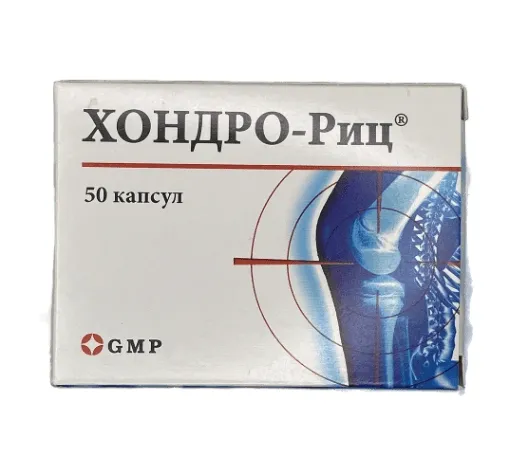
Table of Contents
INSTRUCTIONS FOR MEDICAL USE OF THE MEDICINAL PRODUCT CHONDRO-RITZ (CHONDRO-RITZ)
Composition:
Active substances: chondroitin sulfate, D-glucosamine sulfate;
1 capsule contains chondroitin sulfate 200 mg, D-glucosamine sulfate (polycrystalline form) equivalent to glucosamine sulfate 250 mg;
Excipients: magnesium stearate, colorants indigocarmine FD&C Blue 2 (E 132), titanium dioxide (E 171), yellow iron oxide (E 172).
Pharmaceutical form. Capsules.
Main physicochemical properties: hard gelatin capsules size № 0. Capsule color: green body and cap. Contents of the capsules: white powder with a creamy shade.
Pharmacotherapeutic group. Agents used in disorders of the musculoskeletal system. Other non-steroidal anti-inflammatory and anti-rheumatic agents.
ATC code M01AX.
Pharmacological Properties.
Pharmacodynamics.
The medicinal product regulates metabolism in cartilage tissue and stimulates its regeneration. It exerts anti-inflammatory and analgesic effects, reduces pain at rest and during walking, and decreases the need for nonsteroidal anti-inflammatory drugs. Chondroitin and glucosamine stimulate the synthesis of both endogenous proteoglycans and endogenous hyaluronic acid, reduce the catabolic activity of chondrocytes by inhibiting certain enzymes that degrade cartilage, such as collagenase, elastase, proteoglycanase, phospholipase A2, N-acetylglucosaminidase, etc., and also inhibit the formation of other substances that may damage cartilage tissue (in vitro), such as superoxide radicals; they suppress the activity of lysosomal enzymes.
Chondroitin sulfate is a substance affecting calcium-phosphate metabolism in cartilage tissue, a high-molecular-weight mucopolysaccharide. It slows down bone resorption and reduces calcium loss, accelerates bone tissue restoration, reduces inflammatory activity at early stages, and thus inhibits the degeneration process of cartilage tissue. It prevents compression of connective tissue and acts as a kind of lubricant for joint surfaces. It normalizes metabolism in hyaline tissue, stimulates regeneration of articular cartilage, contributes to pain reduction, improves joint function, and reduces the need for nonsteroidal anti-inflammatory drugs in osteoarthritis of knee and hip joints.
D-glucosamine sulfate is an endogenous substance that is part of proteoglycans and glycosaminoglycans. It ensures structural integrity of cartilage tissue and is a major component of synovial fluid. It slows the progression of degenerative processes in joints, spine, and perispinal soft tissues by activating the synthesis of proteoglycans and hyaluronic acid.
Pharmacokinetics.
Chondroitin sulfate. After oral administration, more than 70% of the dose is absorbed in the gastrointestinal tract. In blood, 85% of chondroitin and its depolymerized derivatives are bound to several plasma proteins. Bioavailability is approximately 13%. Maximum plasma concentration (Cmax) is reached within 3–4 hours after single oral administration. At least 90% of the administered chondroitin dose is initially metabolized by lysosomal phosphatases, followed by depolymerization by hyaluronidase, β-glucuronidase, and β-N-acetylhexosaminidase in the liver, kidneys, and other organs. Chondroitin accumulates in synovial fluid (Cmax is reached within 4–5 hours). The elimination half-life ranges from 5 to 15 hours. It is excreted by the kidneys.
Glucosamine. Bioavailability after oral administration is 25% (first-pass effect in the liver). After oral administration, glucosamine hydrochloride is rapidly and almost completely absorbed in the intestine. The pharmacokinetics of glucosamine are linear when the standard dose of 1500 mg once daily is administered, and higher doses do not proportionally increase the maximum glucosamine concentration. Maximum concentrations are observed in the liver, kidneys, and articular cartilage. Approximately 30% of the administered dose persists long-term in bone and muscle tissue. Due to the first-pass effect in the liver, more than 70% of glucosamine is metabolized into urea, carbon dioxide, and water. It is primarily excreted unchanged in urine. The elimination half-life is 68 hours.
Indications.
- Treatment and prevention of degenerative-dystrophic joint and spinal disorders;
- primary and secondary osteoarthritis;
- periarthritis of the shoulder and scapula;
- spinal osteochondrosis;
- fractures (to accelerate formation of bone callus).
Contraindications.
Known hypersensitivity to any component of the medicinal product.
Phenylketonuria.
Tendency to bleeding.
Thrombophlebitis.
Diabetes mellitus.
Liver or kidney dysfunction in the decompensation stage.
Increased sensitivity (allergy) to seafood.
Pregnancy.
Breastfeeding period.
Childhood age.
Interaction with other medicinal products and other types of interactions.
No specific studies on drug interactions have been conducted; however, physicochemical and pharmacokinetic properties of glucosamine and chondroitin suggest a low probability of interactions. The medicinal product is compatible with nonsteroidal anti-inflammatory drugs and corticosteroids.
Chondroitin sulfate may enhance the effect of anticoagulants, requiring more frequent monitoring of blood coagulation parameters during concomitant use. Some studies indicate that concomitant use of glucosamine and warfarin may increase the international normalized ratio (INR) and lead to bleeding. Therefore, coagulation parameters should be monitored during concomitant administration.
Treatment efficacy is enhanced by enriching the diet with vitamins A and C, and salts of manganese, magnesium, copper, zinc, and selenium.
When used concomitantly, glucosamine enhances gastrointestinal absorption of tetracyclines and reduces absorption of penicillins and chloramphenicol. The product reduces the need for nonsteroidal anti-inflammatory drugs.
Special precautions for use
Do not exceed the recommended daily dose.
Patients with diabetes mellitus should monitor their blood glucose levels more frequently, especially at the beginning of treatment.
Exacerbation of asthma symptoms has been reported in patients with asthma after initiating glucosamine therapy; therefore, such patients should be aware of the potential worsening of symptoms.
In rare cases, edema and/or fluid retention have been observed in patients with heart failure. This may be related to the osmotic effect of chondroitin sulfate.
Use during pregnancy or breastfeeding
The medicinal product is contraindicated during pregnancy.
If the drug is prescribed to women who are breastfeeding, a decision should be made whether to discontinue breastfeeding.
Ability to affect reaction speed when driving or operating machinery
No studies have been conducted on the effect of the drug on the ability to drive or operate machinery. However, patients should monitor any changes in their reaction speed before driving or operating machinery. The treatment may negatively affect the ability to drive or operate machinery; therefore, patients are advised to avoid potentially hazardous activities during treatment.
Dosage and Administration.
The medicinal product is intended for use in adults. Capsules should be taken orally before meals with a small amount of liquid.
The recommended dose is 2 capsules three times daily during the first three weeks, followed by 2–4 capsules twice daily for 2–3 months.
This medicinal product is not intended for the treatment of acute pain. Symptom relief (particularly pain relief) may not occur even after several weeks of treatment, and in some cases may take longer. If no improvement is observed after 2–3 months of treatment, the patient should consult a physician. Patients should consult a doctor if symptoms worsen after starting therapy with this medicinal product.
Children.
The medicinal product is intended for use in adults. Due to insufficient experience of use in children, administration to children is contraindicated.
Overdose.
Symptoms of overdose have not been described; however, adverse effects may be intensified. Based on studies of acute and chronic toxicity, no toxic symptoms are expected, even with administration of high doses. In case of doses exceeding the recommended amounts, medical advice should be sought. Treatment of overdose is symptomatic. Standard supportive measures should be applied.
Side effects
Available data indicate that glucosamine and chondroitin sulfate, at the doses usually prescribed (1500 mg/day and 1200 mg/day, respectively), are non-toxic and do not cause adverse reactions.
The side effects described below were reported during the post-marketing period of the medicinal product use. Since the information was provided voluntarily from a population of unknown size, the frequency of these reactions cannot always be reliably determined.
Gastrointestinal disorders
Abdominal pain, nausea, flatulence, diarrhea, constipation, vomiting, dyspepsia.
Immune system disorders
Allergic reactions, including skin rash, urticaria, pruritus, erythema, dermatitis, maculopapular rash, edema, angioneurotic edema. If allergic reactions occur, treatment should be discontinued; specialist consultation is required.
Nervous system disorders
Dizziness, somnolence, headache, insomnia, increased fatigue.
Other side effects reported in the literature
Cases of extrasystoles, visual disturbances, and alopecia have been reported during administration of 1200 mg of chondroitin sulfate; however, these are very rare.
If any unusual reactions occur, consult a physician immediately.
Reporting of suspected adverse reactions
Reporting suspected adverse reactions after medicinal product authorization is of great importance. It enables ongoing monitoring of the benefit-risk balance of the medicinal product. Healthcare professionals, patients, and their legal representatives are encouraged to report all suspected adverse reactions and lack of efficacy through the Automated Pharmacovigilance Information System at the following link: https://aisf.dec.gov.ua
Shelf life. 3 years.
Do not use after the expiry date stated on the packaging.
Storage conditions. Store at 10–25 °C in a place inaccessible to children.
Packaging. 10 capsules in a blister pack, 5 blisters in a cardboard box with labeling in Ukrainian.
Availability. Over-the-counter (without prescription).
Manufacturer.
GM Pharmaceuticals Ltd.
Manufacturer's address and place of business.
52 Rustavi Highway, Tbilisi, Georgia