Chymotrypsin crystalline
Ukraine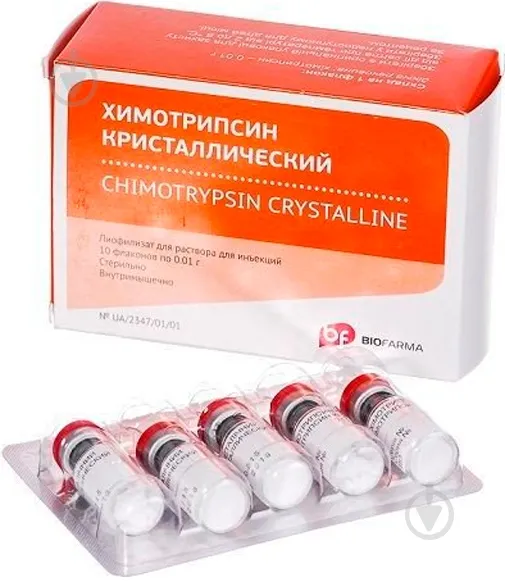
Table of Contents
INSTRUCTION FOR MEDICAL USE OF THE MEDICINAL PRODUCT CHYMOTRYPSIN CRYSTALLINE
Composition:
Active substance: chymotrypsin;
1 vial contains 0.01 g of chymotrypsin.
Excipients: sodium citrate dihydrate, citric acid monohydrate.
Pharmaceutical form. Lyophilisate for solution for injection.
Main physico-chemical properties: porous mass or white odourless powder, hygroscopic.
Pharmacotherapeutic group. Agents for treatment of wounds and ulcerative lesions. Enzymes. ATC code: D03B.
Pharmacological properties.
Pharmacodynamics.
A proteolytic enzyme derived from the pancreas of cattle, which hydrolyzes primarily bonds formed by residues of tyrosine, phenylalanine, and other aromatic amino acids. It cleaves peptide bonds in protein molecules and their degradation products. Exhibits anti-inflammatory activity, since inflammatory mediators are proteins or high-molecular-weight peptides (bradykinin, serotonin, necrotic products).
Lyses necrotic tissues without affecting viable cells due to the presence of specific antienzymes in the latter.
Pharmacokinetics.
Not studied.
Clinical characteristics.
Indications.
Respiratory tract diseases accompanied by accumulation of thick, viscous sputum – tracheitis, bronchitis, bronchiectasis, pneumonia, lung abscesses, atelectasis, bronchial asthma with increased secretion.
In surgery and traumatology – prevention of postoperative complications after lung surgery, burns and pressure sores, thrombophlebitis, purulent wounds.
In otorhinolaryngology – in purulent sinusitis, acute and subacute laryngotracheitis and bronchitis with thick viscous sputum, after tracheotomy to facilitate removal of thick viscous exudate, in acute and subacute purulent otitis media and eustachitis with viscous exudate.
In ophthalmology – in massive thrombosis of the central retinal vein, acute occlusion of the central retinal artery, opacification of the vitreous body of traumatic and inflammatory origin, cataract extraction.
Contraindications.
Decompensated cardiac function, pulmonary emphysema with respiratory insufficiency, decompensated forms of pulmonary tuberculosis, acute dystrophy and liver cirrhosis, infectious hepatitis, pancreatitis, nephritis, hemorrhagic diathesis. Chymotrypsin should not be administered into centers of inflammation, bleeding wounds or cavities, nor applied onto surfaces with diagnosed malignant neoplasms. Hypersensitivity to the drug or to products of proteolysis.
Interaction with other medicinal products and other forms of interaction.
Chymotrypsin may be used in combination with antibiotics and bronchodilators.
Special precautions for use.
Chymotrypsin should be used with caution in the treatment of respiratory tract diseases in patients with active acute-phase tuberculosis due to the risk of developing a pronounced temperature-related histamine-like reaction. Because of the above, it is recommended to administer antihistamine agents prophylactically (for prevention of respiratory tract complications) prior to chymotrypsin administration, and to remove necrotic tissues after the drug's action (by expectoration or suction of sputum, wound irrigation).
Chymotrypsin should also be used with caution in patients with tuberculous pleural empyema, as dissolution of exudate may promote the development of bronchopleural fistula.
This medicinal product contains less than 1 mmol (23 mg) of sodium per dose, i.e. it is practically sodium-free.
Use during pregnancy or breastfeeding. Not studied.
Ability to affect reaction speed when driving or operating machinery. Not studied.
Administration and Dosage
When using procaine as a solvent, the safety information regarding procaine should be taken into account. For respiratory diseases (tracheitis, bronchitis, bronchiectasis, pneumonia, lung abscesses, atelectasis, bronchial asthma with increased secretion), the drug should be administered intramuscularly to adults at a dose of 5–10 mg once daily for 10–12 days. After an interval of 7–10 days, the treatment course may be repeated. In chronic prolonged conditions, treatment may be repeated 3–4 times.
The drug may be used in exudative pleurisies and empyemas – administered intrapleurally:
- in surgical practice:
- to prevent postoperative complications (lung surgery), administer the drug intramuscularly to adults at 5–10 mg once daily, starting 5–10 days before surgery and continuing for 3–4 days after surgery. In the postoperative period (in cases of developed atelectasis or early-stage pneumonia), the drug should be prescribed intramuscularly to adults at a single dose of 5–10 mg (in 1–3 mL of 0.25% procaine solution) daily. Concurrent administration of intramuscular chymotrypsin with vagosympathetic block according to Vishnevsky is recommended, along with aerosol inhalations of chymotrypsin in a 5% aqueous solution, administered in doses of 3–4 mL. In hemothorax and empyema, chymotrypsin should be administered daily by intrapleural injection at 20–30 mg (diluted in 5–10 mL of 0.9% sodium chloride solution or 0.25% procaine);
- in phthisiosurgery, the drug should be prescribed for the same indications and at the same doses against the background of specific antibacterial therapy. In chronic fibrocavitary pulmonary tuberculosis complicated by bronchitis, the preoperative preparation course is longer (10–12 days) and may be repeated until maximum bronchial tree sanitation is achieved;
- in general surgery, for the treatment of burns and pressure ulcers, after removal of necrotic tissues that can be easily detached, chymotrypsin at a dose of 20 mg should be diluted in 20 mL of 0.25% procaine solution and injected subeschar in several small injections using a fine needle. It is advisable to make small incisions in the eschar prior to injection. During the next dressing, liquefied necrotic tissues should be mechanically removed;
- in thrombophlebitis, the drug should be administered intramuscularly to adults at 5–10 mg once daily for 7–10 days. If the first treatment course is ineffective, subsequent courses are not recommended;
- for the treatment of purulent wounds, intramuscular administration of the drug should be combined with local wound treatment using gauze dressings moistened with a 5% solution (prepared in 0.9% sodium chloride solution);
in ophthalmology:
- during cataract extraction, chymotrypsin diluted 1:5000 should be injected into the posterior chamber of the eye, followed by irrigation of the anterior chamber with 0.9% sodium chloride solution 4 minutes after administration;
- for treatment of central retinal vein thrombosis and acute central retinal artery occlusion, chymotrypsin should be used as a 5% solution prepared in 1% procaine solution. Administer subconjunctivally, 0.2 mL, 1–2 times per week;
in otolaryngology:
- in sinusitis, inject the drug into the maxillary sinus cavity in a dose of 5–10 mg in 3–5 mL of 0.9% sodium chloride solution after puncture and irrigation;
- in otitis, instill 0.5–1 mL of 0.1% chymotrypsin solution (prepared in 0.9% sodium chloride solution) into the ear;
- during microsurgery of the ear aimed at restoring or improving hearing (tympanoplasty, stapedectomy), to soften fibrous formations in the middle ear during surgery, inject 0.1% chymotrypsin solution into the cavity. Concurrently with local application, chymotrypsin should be administered intramuscularly to adults at 5 mg 1–2 times daily. The medicinal product should be diluted in 1–2 mL of 0.25–0.5% procaine solution or 0.9% sodium chloride solution.
Children.
Experience with use in children is lacking.
Overdose. Marked manifestations of adverse reactions.
Adverse reactions.
Respiratory system: irritation of the mucous membrane of the upper respiratory tract, hoarseness, which disappear without any treatment, are occasionally observed after inhalation with chymotrypsin.
Cardiovascular system: tachycardia.
Eye disorders: irritation and swelling of the conjunctiva. In such cases, it is recommended to use the drug at a lower concentration.
Skin: reactions at the injection site, including pain and hyperemia.
Immune system: hypersensitivity reactions, including hyperthermia, itching, rash, skin hyperemia, urticaria, anaphylactic shock, breathing difficulties.
Neurological disorders: dizziness.
Shelf life. 3 years.
Storage conditions. Store in the original packaging protected from light at a temperature between 2 °C and 8 °C.
Incompatibility. Not studied. The drug should not be mixed with other medicinal products. Only use recommended solvents.
Packaging. 0.01 g in a vial. 5 vials in a blister pack. 2 blisters in a cardboard box.
Prescription category. Prescription only.
Manufacturer. FZ "STADA" LLC, Ukraine.
Manufacturer's address and place of business.
Ukraine, 09100, Kyiv Oblast, Bila Tserkva, Kyivska St., 37.