Hepe derm forte aerosol
Ukraine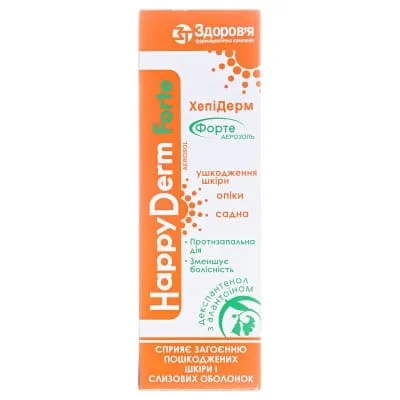
Table of Contents
INSTRUCTION FOR MEDICAL USE OF THE MEDICINAL PRODUCT HEPIDERM FORTE AEROSOL (HAPPYDERM FORTE AEROSOL)
Composition:
Active substances: dexpanthenol, allantoin;
1 g of the preparation (excluding propellant 134a) contains dexpanthenol 50 mg, allantoin 1 mg;
Excipients: DL-pantolactone, cetylstearyl alcohol, potassium cetyl phosphate, glycerol, dimethicone DM 100, purified water, propellant 134a; Euxyl® PE 9010 (Euxyl), containing phenoxyethanol and ethylhexylglycerin.
Pharmaceutical form. Topical foam.
Main physicochemical properties: the preparation forms a white foam upon release from the can.
Pharmacotherapeutic group. Agents for treatment of wounds and ulcers. ATC code D03A X03.
Pharmacological properties.
Pharmacodynamics.
The active ingredient of the drug is dexpanthenol – a provitamin B5, which has the same biological efficacy as pantothenic acid due to intermediate metabolism. In skin cells, dexpanthenol is rapidly converted into pantothenic acid. Pantothenic acid and its salts are water-soluble vitamins that, as part of coenzyme A, participate in numerous metabolic processes. Pantothenic acid is essential for the formation and healing of damaged skin and mucous membranes.
Topical application of dexpanthenol may compensate for the increased demand of injured skin and/or mucous membranes for pantothenic acid.
Allantoin has anti-inflammatory and astringent effects, softens tissues and stimulates epidermal granulation. It promotes epithelial regeneration and reduces pain.
Pharmacokinetics.
The active substance is absorbed through the skin. More detailed studies regarding the metabolism of the active ingredient in the skin and mucous membranes have not been conducted.
Clinical characteristics.
Indications.
Apply for various skin and mucous membrane injuries, including abrasions, burns, aseptic postoperative wounds, skin grafts, bullous and pemphigoid dermatitis.
Contraindications.
Hypersensitivity to any component of the drug.
Interaction with other medicinal products and other forms of interaction.
Interaction with other medicinal products is unknown when the drug is used according to indications.
Special precautions for use
The aerosol can is pressurized; therefore, avoid dropping, impact, exposure to direct sunlight, and heating above 50 °C.
After the product has been used, do not pierce or burn the can. Do not spray near open flames or hot objects. Avoid contact with eyes. In case of accidental contact with eyes, rinse thoroughly with water.
Cetostearyl alcohol may cause local skin reactions (e.g. contact dermatitis).
Use during pregnancy or breastfeeding
Dexpanthenol crosses the placental barrier via an active transport process and is distributed into breast milk in proportion to maternal intake.
Since the systemic availability of dexpanthenol following topical application is unknown, when use of the product is required during pregnancy or breastfeeding, especially over large skin areas, the benefit to the mother and the potential risk to the fetus/infant should be carefully weighed. Use during pregnancy is possible under medical supervision. When used to treat nipple fissures during breastfeeding, the product should be washed off prior to nursing.
Ability to influence reaction rate when driving or operating machinery
No special warnings apply.
Method of Administration and Dosage
The preparation should be evenly sprayed onto the affected area one or several times daily. When spraying the preparation, hold the can vertically with the nozzle pointing upwards. To obtain a proper foam, the can must be shaken vigorously before each use, especially if it has not been used for an extended period. When the preparation is used for the first time, only gas may be released initially before the foam forms.
The duration of treatment depends on the type and course of the disease and should be determined after consultation with a physician.
If applying the preparation to the facial area, do not spray it directly onto the face. It is preferable to spray the preparation onto the hand and then apply it to the appropriate area of the face. Avoid spraying the preparation into the eyes, directly into the mouth, or nose.
Children
The preparation should be used in children only as directed by a physician and under adult supervision.
Overdose
Cases of overdose with topical application of the preparation are unknown.
Dexpanthenol is well tolerated, even at high doses, and is considered non-toxic. Hypervitaminosis has not been reported.
Side effects.
Allergic reactions: allergic contact dermatitis and skin irritation may very rarely occur, manifesting as symptoms such as itching, erythema, eczema, rash, urticaria, and blisters.
If any adverse reactions occur, discontinue use of the medicinal product and consult a physician.
Shelf life. 3 years.
Storage conditions.
Store in the original packaging at a temperature not exceeding 25 ºC.
Do not freeze.
Keep out of reach of children.
Packaging.
58.5 g or 117 g in a can equipped with a foaming valve with a spray dispenser and protective cap, in a box.
Availability.
Over-the-counter (without prescription).
Manufacturer.
Limited Liability Company "Pharmaceutical Company "Zdorovya".
Manufacturer's address and location of its business activities.
22, Shevchenka Street, Kharkiv, Kharkiv Oblast, 61013, Ukraine.