Casodex
Ukraine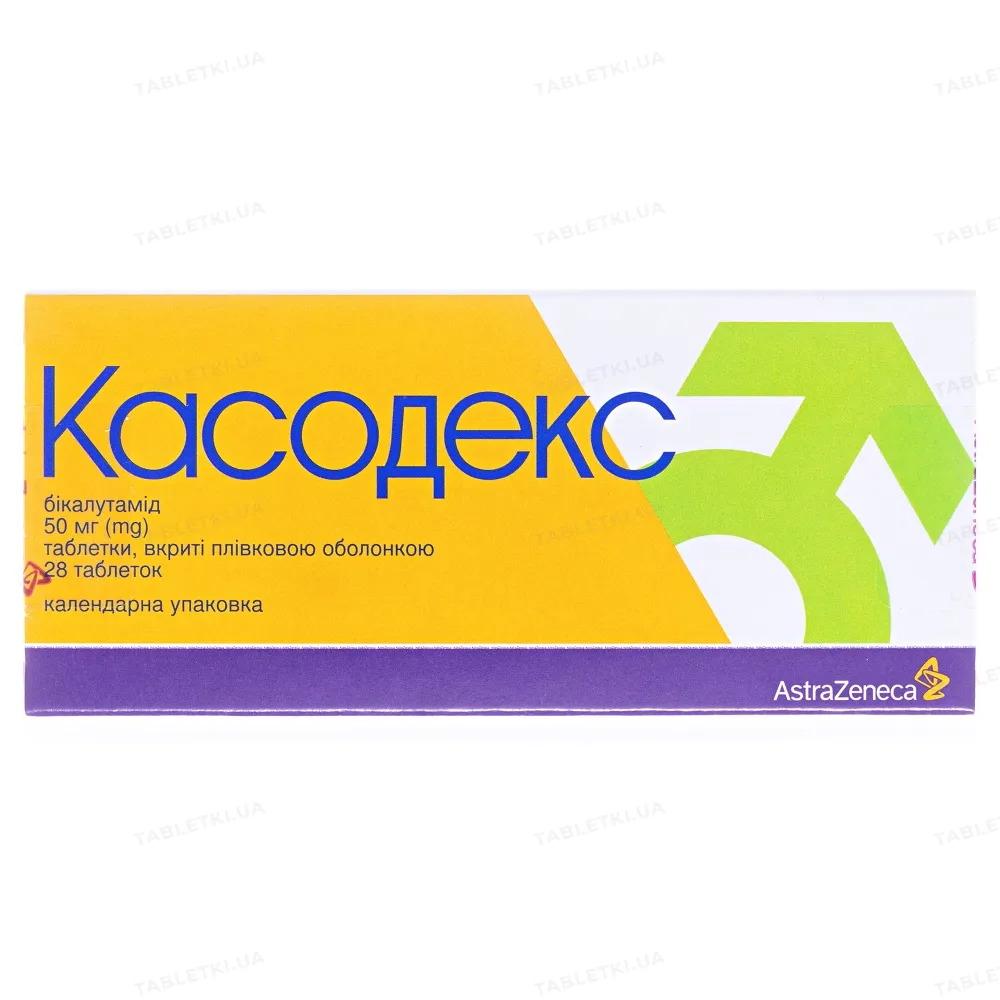
Table of Contents
INSTRUCTIONS FOR MEDICAL USE OF THE MEDICINAL PRODUCT KASODEX (CASODEX®)
Composition:
Active ingredient: bicalutamide;
One film-coated tablet contains 50 mg of bicalutamide;
Excipients: lactose monohydrate; magnesium stearate; hypromellose; macrogol 300; povidone; sodium starch glycolate (type A); titanium dioxide (E 171).
Pharmaceutical form. Film-coated tablets.
Main physicochemical properties: round, biconvex, white, film-coated tablets, with "Cdx 50" embossed on one side and the logo on the other.
Pharmacotherapeutic group. Antiandrogens. ATC code L02B B03.
Pharmacological Properties
Pharmacodynamics
Casodex is a nonsteroidal antiandrogen that has no other effect on the endocrine system. The drug binds to androgen receptors without activating gene expression, thereby inhibiting androgenic stimulation. As a result of this inhibition, regression of prostate tumor tissue is observed. Upon discontinuation of Casodex, a withdrawal syndrome may occur in some patients.
Casodex is a racemic mixture with antiandrogenic activity primarily attributable to the (R)-enantiomer.
Pharmacokinetics
Absorption
Casodex is well absorbed following oral administration. There is no evidence of clinically significant food effects on the bioavailability of the drug.
Distribution
Casodex is highly protein-bound (96% for the racemate, >99% for the (R)-enantiomer) and undergoes extensive metabolism (via oxidation and glucuronidation); its metabolites are excreted in approximately equal amounts via the kidneys and bile.
Biological Transformation
The (S)-enantiomer is rapidly eliminated compared to the (R)-enantiomer, the elimination of which from plasma is approximately 1 week.
With daily administration of Casodex, the (R)-enantiomer accumulates in plasma approximately 10-fold due to its long elimination half-life.
A steady-state concentration plateau of the (R)-enantiomer at approximately 9 mcg/mL is achieved with a daily dose of 50 mg of Casodex. At steady state, the predominantly active (R)-enantiomer accounts for 99% of the total circulating enantiomers.
Elimination
During a clinical study, the mean concentration of (R)-bicalutamide in semen of men receiving 150 mg of Casodex was 4.9 mcg/mL. The amount of bicalutamide potentially transferred to a female partner during sexual intercourse is low, estimated at approximately 0.3 mcg/mL, which is below the level shown to affect offspring in laboratory animals.
Special Patient Groups
The pharmacokinetics of the (R)-enantiomer are independent of age, renal impairment, or mild to moderate hepatic impairment. Evidence indicates that in patients with severe hepatic impairment, the (R)-enantiomer is eliminated more slowly from plasma.
Clinical characteristics.
Indications.
Treatment of advanced prostate cancer in combination with luteinizing hormone-releasing hormone (LHRH) analogues or surgical castration.
Contraindications.
Casodex is contraindicated in women and children (see section "Use in pregnancy and lactation").
Hypersensitivity to the active substance or to any of the excipients.
Concomitant administration of Casodex with terfenadine, astemizole, or cisapride is contraindicated (see section "Interaction with other medicinal products and other forms of interaction").
Interaction with other medicinal products and other forms of interaction.
There is no evidence of pharmacodynamic or pharmacokinetic interaction between Casodex and luteinizing hormone-releasing hormone (LHRH) analogues.
In vitro studies have shown that R-bicalutamide is an inhibitor of CYP3A4 and has a lesser inhibitory effect on the activity of CYP2C9, 2C19, and 2D6.
Although clinical studies using antipyrine as a marker of cytochrome P450 (CYP) activity did not indicate a potential interaction with Casodex, the mean concentration of midazolam (area under the pharmacokinetic curve) increased by up to 80% when co-administered for 28 days with Casodex. For drugs with a narrow therapeutic index, such an increase may be clinically significant. Therefore, concomitant use with terfenadine, astemizole, and cisapride is contraindicated (see section "Contraindications"). Casodex should also be used with caution when administered concomitantly with drugs such as cyclosporine and calcium channel blockers. Dose reduction of these agents may be necessary, especially if signs of enhanced drug effect or adverse reactions occur.
When cyclosporine is used, careful monitoring of its plasma concentration and the patient's clinical status is recommended after initiation or discontinuation of Casodex therapy.
Casodex should be prescribed with caution when used with drugs that may inhibit drug oxidation, such as cimetidine and ketoconazole. This may theoretically lead to increased plasma concentrations of Casodex, potentially enhancing its adverse effects.
In vitro studies have shown that Casodex may displace the coumarin anticoagulant warfarin from its protein-binding sites. Therefore, careful monitoring of prothrombin time is recommended when Casodex is prescribed to patients already receiving coumarin anticoagulants.
In vitro studies have shown that bicalutamide may displace the coumarin anticoagulant warfarin from its protein-binding sites. Enhanced effects of warfarin and other coumarin anticoagulants have been reported when administered concomitantly with Casodex. Therefore, careful monitoring of PT/INR is recommended during Casodex use in patients receiving coumarin anticoagulants, and dose adjustment of anticoagulants should be considered (see sections "Special precautions" and "Adverse reactions").
Because antiandrogen therapy may lead to QT interval prolongation, Casodex should be used with caution when administered concomitantly with medicinal products capable of prolonging the QT interval or inducing torsades de pointes ventricular tachycardia, such as class IA antiarrhythmics (quinidine, disopyramide) or class III antiarrhythmics (amiodarone, sotalol, dofetilide, ibutilide), methadone, moxifloxacin, neuroleptics, etc. (see section "Special precautions").
Children.
Interaction studies have been conducted only in adults.
Special precautions for use
Treatment with this medicinal product should be initiated under direct medical supervision. Casodex is actively metabolized in the liver. Available data suggest that in patients with severe hepatic impairment, elimination of the drug is slowed, which may lead to its accumulation. Therefore, Casodex should be used with caution in patients with moderate or severe liver impairment.
Due to the possibility of changes in liver function, liver function tests should be monitored periodically. Most such changes are expected to occur within the first 6 months of Casodex treatment.
Rarely, severe changes in liver function have been observed during Casodex administration, and fatal cases have been reported (see section "Adverse reactions"). If severe liver function abnormalities occur, treatment with Casodex should be discontinued.
In patients who have objective disease progression together with rising PSA levels, discontinuation of Casodex therapy should be considered.
In men receiving luteinizing hormone-releasing hormone (LHRH) agonists, glucose tolerance may be reduced. This may manifest as diabetes mellitus or loss of glycemic control in patients with pre-existing diabetes. Therefore, blood glucose levels should be monitored in patients receiving Casodex in combination with LHRH agonists.
Casodex has been shown to inhibit CYP3A4 enzyme activity. Therefore, caution should be exercised when co-administering Casodex with medicinal products that are primarily metabolized by CYP3A4 (see sections "Contraindications" and "Interaction with other medicinal products and other forms of interaction").
Patients with rare hereditary conditions of galactose intolerance, congenital lactase deficiency, or glucose-galactose malabsorption should not take this medicinal product.
Antiandrogen therapy may lead to QT interval prolongation.
In patients with risk factors or a history of QT interval prolongation, as well as in patients concurrently receiving medicinal products that may prolong the QT interval (see section "Interaction with other medicinal products and other forms of interaction"), the physician should assess the benefit-risk ratio before initiating Casodex therapy, considering the potential risk of developing torsade de pointes ventricular tachycardia.
Antiandrogen therapy may cause changes in sperm morphology. Although the effect of bicalutamide on sperm morphology has not been specifically evaluated, and such changes have not been reported in patients receiving Casodex, patients and/or their partners should use effective contraception during treatment and for 130 days after the end of Casodex therapy.
Enhanced effects of coumarin anticoagulants have been reported in patients receiving Casodex concomitantly, which may lead to increased prothrombin time (PT) and international normalized ratio (INR). Some cases were associated with a risk of bleeding. Careful monitoring of PT/INR levels is recommended, and dose adjustment of anticoagulants should be considered (see sections "Interaction with other medicinal products and other forms of interaction" and "Adverse reactions").
The medicinal product contains less than 1 mmol (23 mg) of sodium per dose, i.e., essentially "sodium-free".
Use during pregnancy and lactation
Pregnancy
Bicalutamide is contraindicated for use in women. It is contraindicated during pregnancy.
Lactation
Bicalutamide is contraindicated during breastfeeding.
Fertility
In animal studies, reversible impairment of male fertility was observed. A period of impaired reproductive function or infertility in men should therefore be considered possible.
Ability to affect reaction speed when driving or operating machinery
Casodex does not affect the ability to drive a vehicle or operate complex machinery. However, it should be noted that somnolence is common and dizziness is very common (see section "Adverse reactions"). Patients taking this medicinal product should therefore exercise caution.
Dosage and Administration
Dosage
Adult males, including elderly patients: one tablet (50 mg) once daily.
Treatment with Casodex should be initiated at least 3 days before starting therapy with luteinizing hormone-releasing hormone analogues or concomitantly with surgical castration.
Renal impairment: dosage adjustment is not required in patients with renal impairment.
Hepatic impairment: dosage adjustment is not required in patients with mild hepatic impairment.
Increased accumulation is possible in patients with moderate and severe hepatic impairment (see section "Special Warnings and Precautions for Use").
Children
Casodex is contraindicated in children.
Overdose
Data on overdose in humans are lacking. There is no specific antidote; treatment is symptomatic. Dialysis may be ineffective because Casodex is highly protein-bound and is not excreted unchanged in urine. In case of overdose, general supportive therapy is recommended, including monitoring of vital signs.
Adverse reactions.
Adverse reactions are listed by frequency as follows: very common (≥1/10), common (≥1/100 to <1/10), uncommon (≥1/1000 to <1/100), rare (≥1/10,000 to <1/1000), very rare (≤1/10,000), frequency not known (cannot be estimated from the available data).
| System organ |
Frequency |
Adverse reaction |
| Blood and lymphatic system disorders |
Very common |
Anaemia |
| Immune system disorders |
Uncommon |
Hypersensitivity, angioneurotic oedema, urticaria |
| Metabolism and nutrition disorders |
Common |
Decreased appetite |
| Psychiatric disorders |
Common |
Decreased libido, depression |
| Nervous system disorders |
Very common |
Dizziness |
| Common |
Somnolence |
|
| Cardiac disorders |
Common |
Myocardial infarction (fatal cases reported)4, heart failure4 |
| Frequency unknown |
QT prolongation (see sections "Special warnings and precautions for use" and "Interaction with other medicinal products and other forms of interaction") |
|
| Vascular disorders |
Very common |
Flushing |
| Mediastinal, thoracic and respiratory disorders |
Uncommon |
Interstitial lung disease5 (fatal cases reported) |
| Gastrointestinal disorders |
Very common |
Abdominal pain, constipation, nausea |
| Common |
Dyspepsia, flatulence |
|
| Hepatobiliary disorders |
Common |
Hepatotoxicity, jaundice, increased transaminase activity1 |
| Rare |
Liver failure2 (fatal cases reported) |
|
| Skin and subcutaneous tissue disorders |
Common |
Alopecia, hirsutism/hair regrowth, dry skin, pruritus, rash |
| Uncommon |
Photosensitivity reaction |
|
| Renal and urinary disorders |
Very common |
Haematuria |
| Reproductive system and breast disorders |
Very common |
Gynaecomastia and breast tenderness3 |
| Common |
Erectile dysfunction |
|
| General disorders and administration site reactions |
Very common |
Asthenia |
| Common |
Swelling, breast pain |
|
| Investigations |
Common |
Weight increased |
1 Liver changes are rarely severe and often resolve or diminish with continued treatment or after discontinuation.
2 Included in the list of adverse drug reactions following review of post-marketing data. The frequency was determined based on reports of hepatic failure in patients receiving treatment in open-label studies of the Early Prostate Cancer programme (EPC) in the Casodex 150 mg groups.
3 May decrease with concomitant castration.
4 Observed during a pharmacoepidemiological study of luteinizing hormone-releasing hormone agonists and antiandrogens for the treatment of prostate cancer. The risk increased when Casodex 50 mg was used in combination with luteinizing hormone-releasing hormone agonists, but an increased risk was not observed with Casodex 150 mg used as monotherapy for the treatment of prostate cancer.
5 Included in the list of adverse drug reactions following review of post-marketing data. The frequency was determined based on reports of interstitial pneumonia as an adverse event in patients receiving treatment in open-label studies of the EPC programme in the Casodex 150 mg groups.
Increased prothrombin time/INR: In post-marketing surveillance reports, interactions between coumarin anticoagulants and Casodex have been reported (see sections "Special precautions for use" and "Interaction with other medicinal products and other forms of interaction").
Reporting of suspected adverse reactions.
It is important to report suspected adverse reactions after marketing authorization of the medicinal product. This allows continued monitoring of the benefit-risk balance of the medicinal product. Healthcare professionals are asked to report any suspected adverse reactions.
Shelf life.
5 years.
Storage conditions.
Store at temperatures not exceeding 30 °C. Keep out of reach of children.
Packaging. 14 tablets in a blister, 2 blisters in a cardboard box.
Prescription status. Prescription only.
Manufacturer.
AstraZeneca UK Limited.
Manufacturer's address and place of business.
Silk Road Business Park, Macclesfield, SK10 2NA, United Kingdom.