Carsil
Ukraine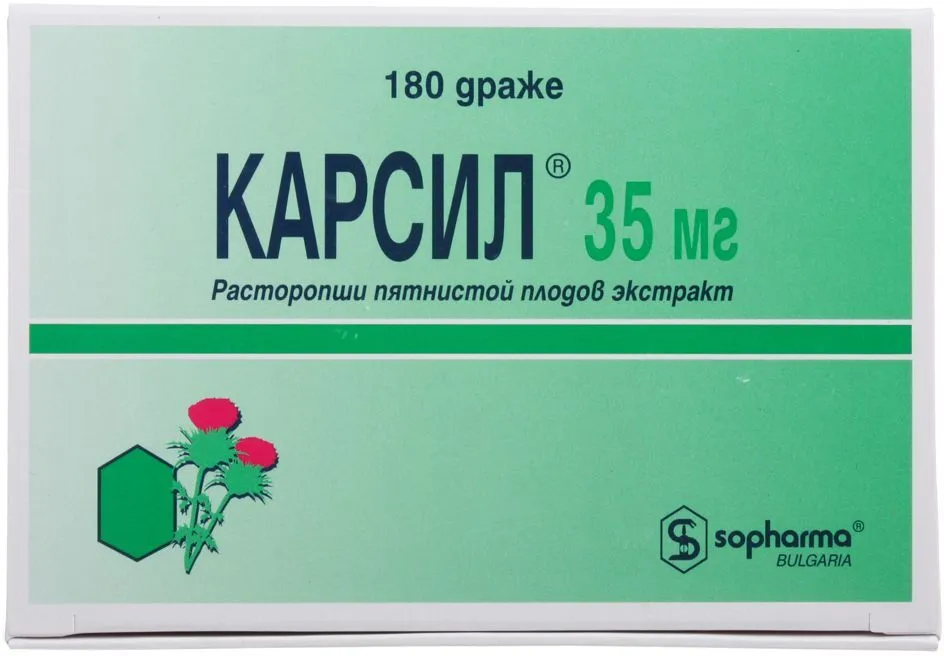
Table of Contents
INSTRUCTION FOR MEDICAL USE OF THE MEDICINAL PRODUCT KARSIl® (CARSIL®)
Composition:
Active substance: dry, refined and standardized milk thistle extract;
One film-coated tablet contains 40.90–50.00 mg of dry, refined and standardized milk thistle extract (Silybi mariani fructus extractum siccum raffinatum et normatum) (35–50:1 or 20–70:1) (extraction solvent: methanol or acetone), equivalent to 22.5 mg of silymarin expressed as silibinin;
Excipients: lactose monohydrate, microcrystalline cellulose, wheat starch, povidone, polysorbate 80, mannitol (E 421), crospovidone, talc, magnesium stearate, sodium bicarbonate;
Film coating: Opadry AMB II 88A265025 brown (polyvinyl alcohol, talc, iron oxide red (E 172), iron oxide yellow (E 172), glycerol monocaprylocaprate, titanium dioxide (E 171), iron oxide black (E 172), sodium lauryl sulfate).
Pharmaceutical form. Film-coated tablets.
Main physicochemical properties: film-coated tablets, round-shaped, brown in colour.
Pharmacotherapeutic group. Drugs used in gastrointestinal disorders. Drugs used in liver disorders, lipotropic agents. Silymarin.
ATC code A05BA03.
Pharmacological Properties
Pharmacodynamics
Karsil® belongs to hepatoprotective medicinal agents. It is a mixture of polyphenols and flavonoids derived from the plant Silybum marianum. Six main flavonolignans are known: silybin A and B, isosilybin A and B, silydianin, silychristin, and the flavonoid taxifolin. The most active component is silybin. The mechanism of action has not yet been fully elucidated. There is evidence supporting several key mechanisms of action of silymarin and silybin.
Silymarin stabilizes cellular membranes and regulates permeability, thereby preventing hepatotoxic agents from entering liver cells. The effect of silymarin on membrane permeability is associated with quantitative and qualitative changes in membrane lipids—cholesterol and phospholipids. It has been established that the membrane-stabilizing action of silymarin is based on competitive interaction with receptors of corresponding toxins in hepatocyte membranes.
Silymarin possesses antioxidant properties related to free radicals and regulation of intracellular glutathione levels. Depending on concentration, it inhibits microsomal lipid peroxidation induced by NADPH-Fe2+-ADP. It affects enzyme systems associated with glutathione and superoxide dismutase. Data indicate that silymarin components inhibit linolenic acid peroxidation catalyzed by lipoxygenase and protect hepatocyte mitochondria and microsomes from lipid peroxidation products caused by various agents.
Silymarin accelerates protein synthesis by stimulating the activity of nuclear RNA polymerase I. This results in enhanced formation of ribosomal RNA and consequently increased synthesis of structural and functional proteins. As a result, liver capacity and regenerative potential are improved.
Silymarin limits the penetration of known hepatotoxic toxic substances into cells. There is evidence that silymarin inhibits the transformation of hepatic stellate cells into myofibroblasts—a process responsible for collagen fiber formation and leading to cirrhosis.
It exerts anti-inflammatory effects on liver tissue, reducing inflammation in the liver and decreasing levels of cytokines (IL-1, IL-6, TNF-α, IFN-γ, GM-CSF), thereby improving microcirculation.
Clinically, these effects manifest as relief of subjective and objective symptoms and normalization of liver function parameters (transaminases, gamma globulin, bilirubin). As a result, overall condition improves, the number of complaints related to digestion decreases, and in patients with impaired nutrient absorption due to liver disease, appetite improves and body weight increases.
Pharmacokinetics
Absorption. After oral administration, silymarin is slowly absorbed in the gastrointestinal tract. Maximum plasma concentration of silybin is reached 2 hours after oral intake of silymarin. It undergoes enterohepatic circulation.
Distribution. The majority of silybin (75%) in plasma is protein-bound. In a study using 14C-labeled silybin, the highest concentrations were found in the liver, lungs, stomach, and pancreas, while negligible amounts were detected in the kidneys, heart, and other organs. Bile concentrations are approximately 100 times higher than plasma concentrations, with peak levels achieved 2–9 hours after administration.
Biotransformation. Metabolized in the liver via conjugation with sulfates and glucuronic acid. Glucuronides and sulfates are identified as metabolites in bile.
Excretion. The elimination half-life of silymarin is 6 hours. Between 1 and 5% (according to other authors, 3–8%) of orally administered silymarin is excreted unchanged in urine. 20–40% of the administered dose of silybin is excreted in bile as glucuronides and conjugated sulfates.
Clinical characteristics.
Indications.
For symptomatic treatment of chronic toxic liver damage. For supportive therapy in patients with chronic inflammatory liver diseases or liver cirrhosis.
Contraindications.
Hypersensitivity to the active substance or to any of the excipients. Children under 12 years of age.
Interaction with other medicinal products and other forms of interaction.
There is no evidence of clinically significant interactions of silymarin with other medicinal products.
When silymarin is used concomitantly with oral contraceptives and drugs used in estrogen replacement therapy, a possible reduction in the effectiveness of the latter may occur.
Silymarin may potentiate the effects of drugs such as diazepam, alprazolam, ketoconazole, lovastatin, and vinblastine due to its inhibitory effect on the cytochrome P450 system.
In vitro studies demonstrate that pharmacokinetic interactions with medicinal products metabolized by cytochrome P450 enzymes, CYP3A4 and CYP2C9, are possible. Patients taking silymarin and medicinal products metabolized by CYP3A and CYP2C9 enzymes should be monitored for potential interactions.
Special precautions for use.
Treatment with Karsil® cannot replace dietary measures or abstention from alcohol consumption.
If jaundice develops, a physician should be consulted to adjust the therapy.
Due to the possible estrogen-like effect of silymarin, it should be used with caution in patients with hormonal disorders (endometriosis, uterine fibroids, carcinoma of the breast, ovaries or uterus, prostate cancer). In such cases, consultation with a physician is required.
The product contains wheat starch as an excipient. Wheat starch may contain gluten, but only in negligible amounts, and is therefore considered safe for patients with celiac disease (gluten-sensitive enteropathy). It can be used by patients with celiac disease. Each tablet contains no more than 3.95 micrograms of gluten. Patients with wheat allergy (other than celiac disease) should not use this medicinal product.
The formulation includes lactose monohydrate as an excipient. The medicinal product should not be administered to patients with rare hereditary problems of galactose intolerance, Lapp lactase deficiency or glucose-galactose malabsorption.
The medicinal product contains mannitol as an excipient, which may have a mild laxative effect.
Use during pregnancy or breastfeeding.
Pregnancy
There are no data on the direct or indirect adverse effects of the medicinal product on pregnancy, embryonal/fetal development, labor or postnatal development. Clinical studies on the safety of silymarin use in pregnant women are insufficient. During pregnancy, the product may be used under medical supervision when the benefit of treatment outweighs the potential risks to the fetus.
Breastfeeding
During breastfeeding, the product may be used under medical supervision when the benefit of treatment outweighs the potential risks to the breastfed infant.
Ability to influence reaction rate while driving or operating machinery.
Karsil® does not affect the ability to drive vehicles or operate machinery.
Dosage and Administration.
Take tablets orally, whole, without chewing, with sufficient amount of liquid.
Adults and children aged 12 years and older
Take Carsil® orally; in mild and moderate cases – 2 tablets 3 times daily; in severe cases – 4 tablets 3 times daily.
The treatment course should last at least 3 months.
Children
There is insufficient clinical data on the use of the medicinal product in children under 12 years of age. The product is used in children aged 12 years and older.
Overdose.
There are no reports of overdose. In case of accidental ingestion of a high dose, induce vomiting, perform gastric lavage, administer activated charcoal, and if necessary, apply symptomatic treatment as prescribed by a physician.
Side effects.
Side effects are classified by frequency and according to system organ classes: very common (≥ 1/10), common (≥ 1/100, < 1/10), uncommon (≥ 1/1000, < 1/100), rare (≥ 1/10000, < 1/1000), very rare (< 1/10000), and frequency not known (based on available data, frequency cannot be estimated).
Immune system disorders: very rare – skin reactions: pruritus, rash, urticaria; frequency not known – anaphylactic shock.
Ear and labyrinth disorders: rare – worsening of pre-existing vestibular disorders.
Gastrointestinal disorders: rare – diarrhea due to enhanced liver and gallbladder function; frequency not known – nausea, dyspepsia, vomiting, decreased appetite, flatulence, heartburn.
Adverse effects are transient and disappear after discontinuation of the drug without the need for specific measures.
All suspected adverse reactions occurring during the use of the medicinal product should be reported.
Shelf life. 3 years.
Storage conditions.
Keep out of reach of children.
Store at a temperature not exceeding 25 °C.
Packaging.
10 tablets in a blister made of PVC/PE/PVDC film and aluminum foil.
8 blisters in a cardboard box.
Supply category. Over-the-counter.
Manufacturer.
JSC "Sofarma".
Manufacturer's address and place of business.
16 Iliensko Shose Str., Sofia, 1220, Bulgaria.