Cardioviol® cardiac drops
Ukraine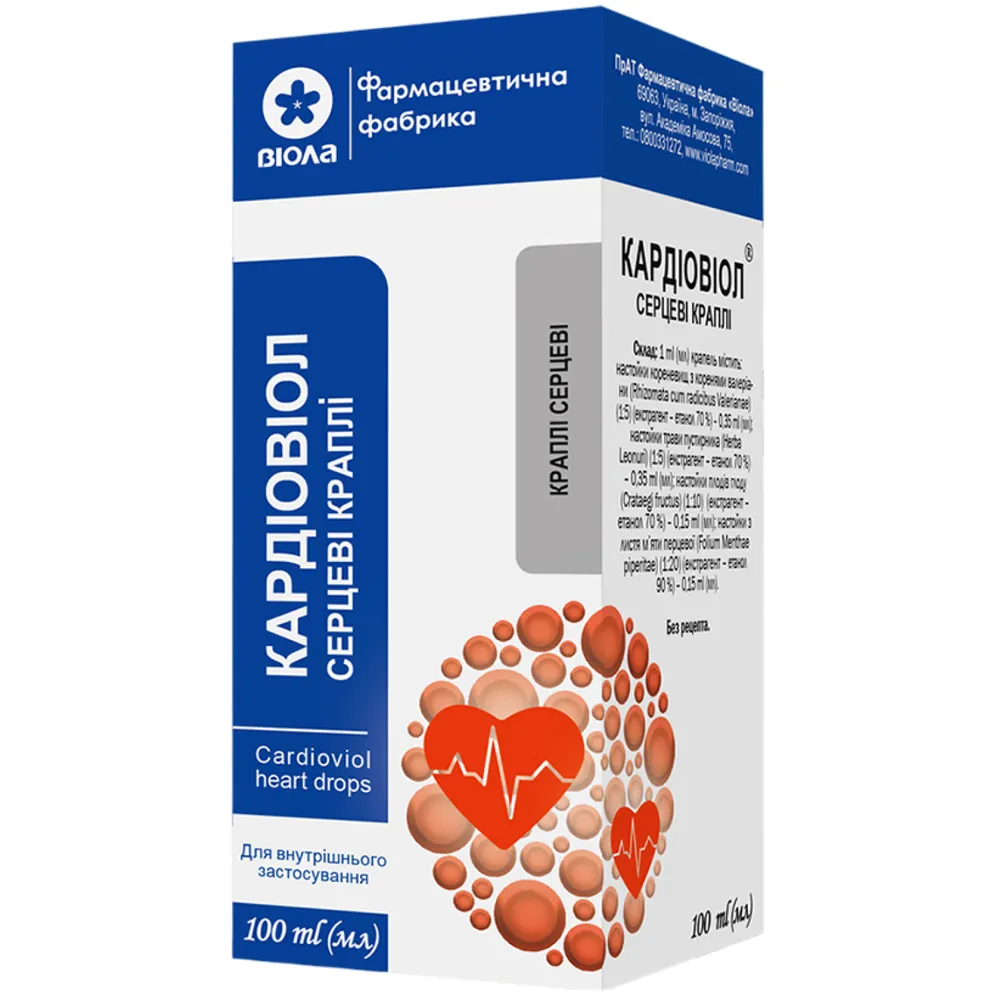
Table of Contents
INSTRUCTIONS FOR MEDICAL USE OF THE MEDICINAL PRODUCT CARDIOVIOL® Heart Drops (Cardioviol heart drops)
Composition:
Active substances: valerian rhizomes with roots tincture (Rhizomata cum radicibus Valerianae) (1 : 5) (extractant – 70% ethanol), motherwort herb tincture (Herba Leonuri) (1 : 5) (extractant – 70% ethanol), hawthorn fruit tincture (Crataegi fructus) (1 : 10) (extractant – 70% ethanol), peppermint leaf tincture (Folium Menthae piperitae) (1 : 20) (extractant – 90% ethanol).
1 ml of drops contains: valerian rhizomes with roots tincture (Rhizomata cum radicibus Valerianae) (1 : 5) (extractant – 70% ethanol) – 0.35 ml; motherwort herb tincture (Herba Leonuri) (1 : 5) (extractant – 70% ethanol) – 0.35 ml; hawthorn fruit tincture (Crataegi fructus) (1 : 10) (extractant – 70% ethanol) – 0.15 ml; peppermint leaf tincture (Folium Menthae piperitae) (1 : 20) (extractant – 90% ethanol) – 0.15 ml.
Pharmaceutical form. Oral drops.
Main physicochemical properties: liquid, ranging in color from yellowish-brown to reddish-brown, with a minty odor. Sediment formation may occur during storage.
Pharmacotherapeutic group. Cardiological agents. Various combined cardiological preparations. ATC code C01EX.
Pharmacological Properties
Pharmacodynamics
Cardiological and sedative agent. The therapeutic effect of the medicinal product CardioVio® heart drops is due to the action of a complex of biologically active substances derived from valerian roots and rhizomes, hawthorn fruits, wild thorn apple herb, and peppermint leaves.
Biologically active substances contained in hawthorn fruits (flavonoids, choline, acetylcholine, tannins, phytosterols) possess hypotensive, cardioprotective, and spasmolytic properties; they enhance blood circulation in the coronary vessels and cerebral vessels, increase myocardial sensitivity to cardiac glycosides, slightly strengthen myocardial contractions, and at the same time reduce myocardial excitability.
Biologically active substances contained in valerian roots and rhizomes (a complex ester of borneol and isovaleric acid, borneol, isovaleric acid, alkaloids, tannins, sugars) reduce excitability of the central nervous system (CNS), alleviate tension and irritability associated with mental overstrain and intellectual fatigue, exhibit sedative, hypnotic, and spasmolytic effects, and enhance the action of other agents that have a depressant effect on the CNS, namely sedatives, hypnotics, and tranquilizers. In addition, biologically active substances of valerian exert choleretic effects, slow heart rate, dilate coronary vessels of the heart, and enhance secretory activity of the gastric mucosa.
Biologically active substances contained in wild thorn apple herb (essential oil, saponins, tannins, alkaloids) reduce excitation processes in the central nervous system, promote normalization of arterial pressure and the onset of physiological sleep, and also enhance the effects of other sedative and hypnotic agents.
Peppermint oil (containing up to 70% menthol and its esters) and other biologically active substances present in peppermint leaves (ketone-menthone, oleanolic and ursolic acids, flavonoid glycosides), by stimulating sensory receptors of the oral and gastric mucosa, reflexively reduce nausea and prevent vomiting. They also exert a moderate spasmolytic, calming, and choleretic effect. Peppermint tincture enhances secretion of digestive glands, improves appetite, and exerts antimicrobial action due to its menthol content.
Pharmacokinetics
Not studied.
Clinical characteristics.
Indications.
Functional disorders of the cardiovascular system (neurocirculatory dystonia, vegetative neurosis) and the central nervous system (increased emotional excitability, irritability, sleep disturbances, etc.).
As an adjunctive medicinal agent in functional disturbances of heart rhythm (palpitations, tachycardia).
Contraindications.
History of alcoholism; concomitant use of alcohol-containing preparations; gastric and duodenal ulcer; liver cirrhosis; pregnancy or breastfeeding period; depression and other disorders accompanied by central nervous system depression; pronounced arterial hypotension and bradycardia; hypersensitivity to the components of the medicinal product; bronchial asthma and spasmophilia; children under 12 years of age.
Interaction with other medicinal products and other forms of interaction.
The preparation may enhance the effects of tranquilizers, neuroleptics, hypnotics, sedatives, analgesics, spasmolytics, cardiac agents, and antihypertensive drugs, as well as enhance the effect of alcohol. Concomitant use with alkaloid salts is not recommended due to the possibility of forming negative complexes. The preparation should not be used together with class III antiarrhythmic agents or cisapride. The preparation enhances the effects of cardiac glycosides. Concomitant use of the preparation with antacids should be avoided.
Inform your physician about the concurrent use of any other medicinal products.
Special precautions for use.
The medicine should not be taken during meals to avoid interaction with food components.
Patients with gastroesophageal reflux (heartburn) should avoid using this medicine, as heartburn may increase.
This medicinal product contains ethanol (alcohol) — approximately 0.5 mg/dose for children and 1 g/dose for adults.
It is harmful for patients suffering from alcoholism; therefore, alcohol intake should be avoided.
Caution is advised when using in children, patients with liver disorders, and patients with epilepsy.
If symptoms persist for more than 4 weeks or worsen during treatment, consult a physician.
Use during pregnancy or breastfeeding.
Use is contraindicated.
Ability to affect reaction speed when driving or operating machinery.
During treatment with this medicine, driving or operating machinery should be avoided.
Dosage and Administration
Cardiovil® cardiac drops are taken orally by adults in a dose of 20–30 drops three times daily before meals.
For children aged 12 years and older, the dose should be calculated as 1 drop per year of life, administered three times daily before meals.
The duration of treatment is determined individually for each patient, depending on the nature and severity of the pathological process, the course of the disease, individual tolerance to the drug, and the stability of the therapeutic effect achieved.
Children.
Do not administer to children under 12 years of age.
Overdose.
In case of a significant overdose, symptoms such as headache, dizziness, drowsiness, bradycardia, decreased arterial pressure, chest pain, cardiac arrhythmias, general weakness, abdominal pain, nausea, diarrhea, decreased hearing and visual acuity, palpitations, mental excitement, epileptic seizures, dyspnea, ataxia, and manifestations of hypersensitivity may occur. In such cases, the drug should be discontinued and symptomatic therapy initiated (gastric lavage, activated charcoal, etc.).
Side effects.
Cardiovascular system: hypotension, significant slowing of heart rate.
Nervous system: depression, suppression of emotional responses, dizziness, drowsiness.
Gastrointestinal system: nausea, spasmodic abdominal pain, heartburn, vomiting.
Immune system: allergic reactions, for example, redness, rash, itching, skin swelling, urticaria, contact dermatitis.
General disorders: feeling of fatigue, decreased mental and physical performance.
If any adverse events occur, it is necessary to consult a physician.
Shelf life.
4 years.
Storage conditions.
Store in the original packaging at a temperature not exceeding 25 °C.
Keep out of reach of children.
Packaging.
25 ml, 50 ml, 80 ml, or 100 ml in a bottle with dropper cap and lid, in a box or without a box.
Availability. Over-the-counter.
Manufacturer: JSC Pharmaceutical Factory "Viola".
Manufacturer's address and place of business.
75 Amosova Akademika Street, Zaporizhzhia, 69063, Ukraine.