Cardioarginine-zdorovya
Ukraine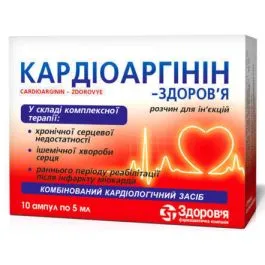
Table of Contents
INSTRUCTIONS FOR MEDICAL USE OF THE MEDICINAL PRODUCT CARDIOARGININ-ZDOROVYE (CARDIOARGININ-ZDOROVYE)
Composition:
Active substances: arginine aspartate, diarginine succinate, magnesium aspartate, potassium aspartate;
1 ml of solution contains arginine aspartate 170 mg, diarginine succinate 140 mg, magnesium aspartate 40 mg, potassium aspartate 45 mg;
Excipient: water for injections.
Pharmaceutical form. Solution for injection.
Main physicochemical properties: clear, slightly yellowish solution.
Pharmacotherapeutic group. Agents affecting the cardiovascular system. Various combined cardiac preparations. ATC code C01EX.
Pharmacological properties.
Pharmacodynamics.
A cardio- and endothelioprotective metabolic agent with antihypertensive and adaptogenic properties. The drug reduces myocardial ischemia, improves coronary circulation, normalizes functional state of the endothelium of coronary and peripheral vessels, and possesses anti-hypoxic, membrane-stabilizing, antioxidant, and free radical-scavenging properties. In arterial hypertension, it promotes normalization of arterial pressure and reduces total peripheral vascular resistance. The antihypertensive effect of the drug is mediated by the ability of arginine, as a nitric oxide donor, to enhance endothelium-dependent vasodilation, as well as by the capacity of this amino acid to regulate arterial pressure and maintain osmolarity of body fluids and blood volume through its involvement in the synthesis of the peptidergic hormone arginine vasopressin. The metabolic cardioprotective action of the drug is due to the ability of arginine, aspartate, and succinate to activate energy supply processes in cardiac muscle, restore cellular energy potential, normalize acid-base balance and intermediate metabolism, as well as protein metabolism in the myocardium, and stimulate the synthesis of amino acids, aminosugars, and nucleotides.
Aspartate acts as an intracellular carrier of K+ and Mg2+ ions. Due to potassium and magnesium aspartate, electrolyte imbalance in the body is corrected and coronary circulation is improved. Mg2+ ions activate Na+-K+-ATPase, thereby decreasing intracellular Na+ concentration and increasing K+ influx into the cell. Reduced intracellular Na+ concentration leads to inhibition of Na+/Ca2+ exchange in vascular smooth muscle, resulting in their relaxation. K+ ions stimulate ATP, glycogen, protein, and acetylcholine synthesis.
The drug exhibits adaptogenic and actoprotective effects through substrate-induced stimulation of cellular metabolism. Arginine, aspartate, and succinate activate enzymatic processes in the Krebs cycle, stimulate cellular utilization of fatty acids and glucose during physical exertion, exert a positive influence on aerobic energy production, and reduce lactic acidosis. Due to these effects, the drug accelerates adaptation under hypoxic conditions, enhances physical performance, and reduces acute fatigue.
Pharmacokinetics.
Not studied.
Clinical characteristics.
Indications.
In complex therapy of chronic heart failure, ischemic heart disease (stable angina due to vascular dysfunction or spasm, painless myocardial ischemia), arterial hypertension, atherosclerosis of the heart and cerebral vessels, diabetic angiopathy, hypercholesterolemia, in the early rehabilitation period after myocardial infarction and other somatic diseases, in obliterating endarteritis, cardiac arrhythmias caused by deficiency of potassium and magnesium in the body (mainly ventricular arrhythmias), including during treatment with cardiac glycosides.
Contraindications.
- Hypersensitivity to any component of the drug;
- hyperkalemia;
- acute and chronic renal failure;
- Addison's disease;
- atrioventricular block;
- cardiogenic shock (with systolic blood pressure < 90 mm Hg).
Interaction with other medicinal products and other types of interactions.
When using arginine aspartate, it should be taken into account that concomitant use of aminophylline with arginine may be accompanied by increased insulin levels in the blood, and concomitant use of spironolactone with arginine may lead to increased potassium levels in the blood.
The drug prevents the development of hypokalemia, thereby improving tolerance of cardiac glycosides and enhancing the effect of medicinal agents that stimulate trophic processes in the myocardium.
The drug also prevents hypokalemia induced by the use of diuretics, corticosteroids.
When used concomitantly with potassium-sparing diuretics and/or angiotensin-converting enzyme (ACE) inhibitors, beta-blockers, cyclosporine, heparin, nonsteroidal anti-inflammatory drugs, the risk of developing hyperkalemia increases (monitoring of plasma potassium levels is required).
Arginine is incompatible with thiopental.
Special precautions for use.
Rapid administration may cause facial hyperemia.
During prolonged use of the drug, it is necessary to monitor blood potassium and magnesium levels, as well as regularly monitor electrolyte balance parameters and ECG findings.
Use with caution in patients with myasthenia gravis; in conditions that may lead to hyperkalemia, such as electrolyte imbalances, impaired renal function, acute dehydration, extensive tissue damage, particularly in severe burns. In these patient groups, regular monitoring of serum electrolyte levels is recommended.
The drug should be used cautiously in patients with endocrine gland dysfunction. The drug may stimulate insulin and growth hormone secretion. If dry mouth occurs, blood glucose levels should be checked.
If symptoms of asthenia worsen during treatment, the drug should be discontinued.
The drug may be used in patients with diabetes mellitus.
In patients with cardiac arrhythmias caused by potassium and magnesium deficiency, the use of 0.9% sodium chloride solution is not recommended during intravenous infusion of the drug.
Use during pregnancy or breastfeeding.
The safety of using the drug during pregnancy or breastfeeding has not been established.
Breastfeeding should be discontinued during treatment with this drug.
Ability to influence reaction rate when driving or operating machinery.
No effect.
Method of Administration and Dosage
The medication should be administered to adults intravenously, either by drip infusion or bolus injection.
For intravenous drip infusion, administer 1–2 times daily, 5 mL diluted in 100–200 mL of 5% glucose solution or 0.9% sodium chloride solution, at a rate of 20–30 drops per minute.
For intravenous bolus injection, administer slowly (at a rate of no more than 5 mL/min) 5 mL 1–2 times daily.
The treatment course lasts 5–10 days. The maximum daily dose is 10 mL.
After completion of intravenous administration, if necessary, switch to oral administration of the medication in another pharmaceutical form—Cardioarginine-Health syrup.
Children. The efficacy and safety of the medication in children have not been established.
Overdose.
Due to the kidneys' ability to excrete large amounts of potassium, increased dosage of the medication may lead to hyperkalemia only if associated with acute or pronounced impairment of potassium excretion.
The therapeutic index of magnesium is wide, and in the absence of renal insufficiency, severe adverse effects are very rare.
In case of rapid intravenous administration, symptoms of hyperkalemia/hypermagnesemia may occur.
Symptoms of hyperkalemia: general weakness, paresthesia, bradycardia, paralysis. Extremely high plasma potassium concentration may lead to death due to cardiac depression, arrhythmia, or cardiac arrest.
Symptoms of hypermagnesemia: nausea, vomiting, drowsiness, hypotension, bradycardia, weakness, slurred speech, diplopia. With very high plasma magnesium concentration, hyporeflexia, neuromuscular blockade, respiratory depression, and cardiac arrest may develop.
Other symptoms: arterial hypotension, stomach pain, metallic taste in the mouth, muscle weakness, paresthesia, muscle stiffness; on electrocardiogram—increased amplitude of the T wave, decreased amplitude of the P wave, widening of the QRS complex.
Treatment: symptomatic therapy aimed at supporting vital functions, parenteral administration of calcium preparations.
Adverse Reactions
Gastrointestinal system: mild discomfort in the stomach and intestines, dry mouth, nausea, vomiting, diarrhea, abdominal pain, formation of ulcers and gastrointestinal bleeding, flatulence, dyspeptic symptoms, thirst immediately after administration, which resolve spontaneously.
Cardiovascular system: fluctuations in arterial pressure, disturbances in intraventricular conduction, tachycardia, chest pain.
Nervous system: headache, feelings of fear, general weakness, muscle weakness, hyporeflexia, disorientation, dizziness, paresthesia, hyperthermia, sensation of warmth, body aches, facial flushing, respiratory depression, seizures, tremor, increased sweating.
Skin: skin hyperemia, pallor, up to acrocyanosis.
Immune system: anaphylactic shock, possible hypersensitivity reactions including itching, rash, urticaria, angioneurotic edema.
Musculoskeletal system: joint pain.
Respiratory system, thoracic organs and mediastinum: dyspnea.
Other: myasthenia, asthenia, phlebitis, venous thrombosis, dyspnea, local reactions at the injection site.
With rapid intravenous administration – hyperkalemia, hypermagnesemia, muscle hypotonia, limb paresthesia, slowed atrioventricular conduction, arrhythmias, cardiac arrest.
Shelf life. 3 years.
Storage conditions. Store in the original packaging at a temperature not exceeding 25 °C.
Do not freeze. Keep out of reach of children.
Incompatibility. The drug should not be mixed with other medicinal products in the same container.
Packaging. 5 ml in ampoules, № 5, № 10 in a box; № 5, № 5 × 2 in blisters in a box.
Prescription status. Prescription only.
Manufacturer. LIMITED LIABILITY COMPANY "CORPORATION "ZDOROVIYA".
Manufacturer's address and place of business.
22, Shevchenka Street, Kharkiv, Kharkiv Oblast, 61013, Ukraine