Canespor
Ukraine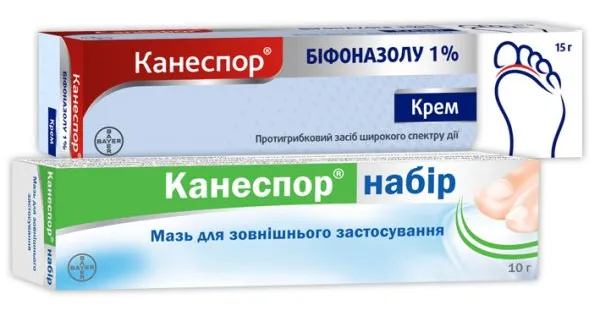
Table of Contents
INSTRUCTIONS FOR MEDICAL USE OF THE MEDICINAL PRODUCT KANESPOR® (CANESPOR®)
Composition:
Active substance: bifonazole;
1 g of cream contains 0.01 g of bifonazole;
Excipients: benzyl alcohol, cetyl stearyl alcohol, cetyl palmitate, octyldodecanol, polysorbate 60, sorbitan stearate, purified water.
Pharmaceutical form. Cream.
Main physicochemical properties: soft white cream.
Pharmacotherapeutic group. Antifungal agent for topical use. Bifonazole. ATC code D01AC10.
Pharmacological Properties
Pharmacodynamics
The active ingredient of Canespor® cream, bifonazole, is an imidazole derivative with a broad spectrum of antifungal activity. The drug is active against dermatophytes, yeasts, molds, and other fungi (Malassezia furfur, Corynebacterium minutissimum). Unlike other azoles and antifungal agents, bifonazole inhibits ergosterol biosynthesis at two different levels rather than one. Inhibition of ergosterol synthesis leads to structural and functional disturbances in the cytoplasmic membrane of pathogenic fungi.
The minimum inhibitory concentration (MIC) for the mentioned fungal species ranges from 0.062 to 16 µg/mL of substrate or lower. Bifonazole exhibits fungicidal activity against dermatophytes, particularly the causative agents of trichophytosis.
Bifonazole exerts pronounced fungicidal effects against dermatophytes at a concentration of 5 µg/mL over a 6-hour period. Against yeast fungi such as Candida species, bifonazole acts primarily in a fungistatic manner at concentrations of 1–4 µg/mL and fungicidally at 20 µg/mL. Furthermore, the active substance demonstrates fungistatic effects at concentrations 2–10 times lower than the minimum inhibitory concentration. Proliferating mycelium of Trichophyton mentagrophytes is rapidly inhibited even at a substrate concentration of 3 µg/mL.
For Gram-positive cocci, excluding enterococci, the minimum inhibitory concentration of bifonazole ranges from 4 to 16 µg/mL. For corynebacteria, the MIC ranges from 0.5 to 2 µg/mL.
Bifonazole remains effective even in cases where pathogens are resistant to other antifungal agents. Primary resistance to bifonazole in susceptible fungal species is very rare. To date, no development of secondary resistance has been observed in initially sensitive strains.
Pharmacokinetics
Bifonazole penetrates well into the affected layers of the skin. Six hours after application, concentrations range from 1000 µg/cm³ in the upper epidermal layer to 5 µg/cm³ in the papillary layer. All measured concentrations remain within the range proven to have antifungal activity.
The duration of retention on the skin, defined as the duration of protective effect, is at least 48–72 hours for Canespor® cream.
The prolonged retention of Canespor® cream on the skin at concentrations providing antifungal activity, combined with its fungicidal mode of action, forms the basis for once-daily application in topical therapy.
In studies assessing absorption following topical application to intact human skin, serum concentrations of bifonazole were consistently below the limit of detection (< 1 ng/mL). Only in inflamed skin has minor absorption been confirmed. No systemic effects are expected from such low concentrations of the active substance (typically less than 5 ng/mL).
Clinical characteristics.
Indications.
Treatment of fungal skin diseases caused by bifonazole-sensitive pathogens (dermatophytes; yeasts, molds, and other fungal infections; Malassezia furfur and Corynebacterium minutissimum):
- superficial candidiasis and cutaneous mycoses (including tinea pedis and interdigital mycoses, tinea manuum, cutaneous and cutaneous fold mycoses);
- pityriasis versicolor;
- erythrasma;
- treatment of the nail bed during the course of treatment of fungal nail infections (onychomycosis) after removal of the nail plate.
Contraindications.
Known hypersensitivity to the active substance or to any of the excipients. Hypersensitivity to antifungal agents of the imidazole group.
The medicinal product is contraindicated for treatment of diaper rash in children, treatment of infections of the scalp. The product is not for vaginal use. Do not use before removal of the affected part of the nail plate for treatment of fungal nail infections.
Interaction with other medicinal products and other forms of interaction.
There are data indicating a possible interaction between topically applied bifonazole and warfarin, leading to an increased international normalized ratio (elevated risk of bleeding). If bifonazole is prescribed to patients receiving warfarin therapy, appropriate monitoring should be performed.
Special precautions for use
Avoid contact with the eyes. Do not swallow.
Patients with allergic reactions to other antifungal agents of the imidazole group (e.g., econazole, clotrimazole, miconazole) should use Canespor® with caution.
If symptoms persist, consult a physician.
Antifungal treatment of the nail fold with Canespor® cream may be used as part of therapy for nail fungus only after prior keratolytic removal of the infected nail portion.
Some excipients in Canespor® cream may reduce the effectiveness of latex products such as condoms and diaphragms when applied to genital areas. This effect is temporary and occurs only during treatment.
Patients receiving concomitant bifonazole and warfarin should be appropriately monitored (see section "Interaction with other medicinal products and other forms of interaction").
Use during pregnancy or breastfeeding
Pregnancy. There is insufficient data on the use of bifonazole in pregnant women. The potential risk to humans is unknown. Since the active ingredient bifonazole is intended for topical use only, risk is not expected. As a precautionary measure, bifonazole should be used during pregnancy and breastfeeding only after careful benefit-risk assessment. Use of bifonazole is best avoided during the first trimester of pregnancy.
Breastfeeding period. It is unknown whether bifonazole passes into human breast milk. Pharmacodynamic and toxicological studies in animals indicate excretion of bifonazole and its metabolites into breast milk. Therefore, breastfeeding should be discontinued during treatment with bifonazole. During lactation, bifonazole should not be applied to the area of the chest.
Fertility. Previous clinical studies have not shown that bifonazole may impair male or female fertility.
Ability to influence reaction speed when driving or operating machinery
Bifonazole has no effect or has a negligible effect on the ability to drive or operate machinery.
Dosage and Administration
Apply Canespor® cream once daily, preferably in the evening before bedtime. Apply a thin layer to the affected skin area and rub in gently. To ensure a sustained therapeutic effect, treatment with Canespor® cream should be continued for the full recommended duration, even after symptoms have resolved. Typical treatment durations are as follows: tinea pedis and interdigital lesions – 3 weeks; tinea manuum, tinea of smooth skin and skin folds – 2–3 weeks; pityriasis versicolor, erythrasma – 2 weeks; superficial cutaneous candidiasis – 2–4 weeks. A small amount of cream is usually sufficient to treat an area of skin approximately the size of the palm.
Canespor® cream should be used following nail treatment with Canespor® kit. The nail bed should be treated with Canespor® cream once daily for 4 weeks.
Children
Based on available clinical data, there are no indications of toxic effects in children. However, in children under 3 years of age (including infants), the product should be used only under medical supervision.
Overdose
There have been no reports of overdose associated with the use of Canespor®.
There is no risk of acute intoxication following a single topical application. Overdose may occur if the cream is applied to large areas of skin or accidentally ingested orally.
Adverse Reactions.
General disorders and administration site conditions. May cause local skin reactions (e.g. contact dermatitis), pain and swelling of the skin at the application site.
Immune system disorders. Systemic hypersensitivity reactions are possible in rare cases.
Skin and subcutaneous tissue disorders. Contact dermatitis, allergic dermatitis, erythema, eczema, pruritus, rash, urticaria, blisters, desquamation, dryness, irritation, maceration, and sensation of warmth on the skin.
All adverse effects resolve after discontinuation of the medicinal product.
Cetostearyl alcohol may cause skin irritation at the application site (e.g. contact dermatitis). In individuals with hypersensitivity to cetostearyl alcohol, allergic skin reactions may occur.
Reporting of adverse reactions after marketing authorization is of great importance. It allows continued monitoring of the benefit-risk balance of the medicinal product. Medical and pharmaceutical professionals, as well as patients or their legal representatives, should report all suspected adverse reactions and lack of efficacy via the automated pharmacovigilance information system at the following link: https://aisf.dec.gov.ua.
Shelf life. 5 years.
Do not use after the expiry date stated on the packaging.
After opening the tube, the shelf life is 16 months.
Storage conditions.
No special storage conditions are required for this medicinal product. Keep out of reach of children.
Packaging. 15 g in aluminum tubes, 1 tube per cardboard box.
Supply classification. Over-the-counter (without prescription).
Manufacturer.
GP Grenzach Produktion GmbH /
GP Grenzach Produktions GmbH
Manufacturer's name and address.
Emil-Barell-Strasse 7, 79639 Grenzach-Wyhlen, Germany