Candiderm
Ukraine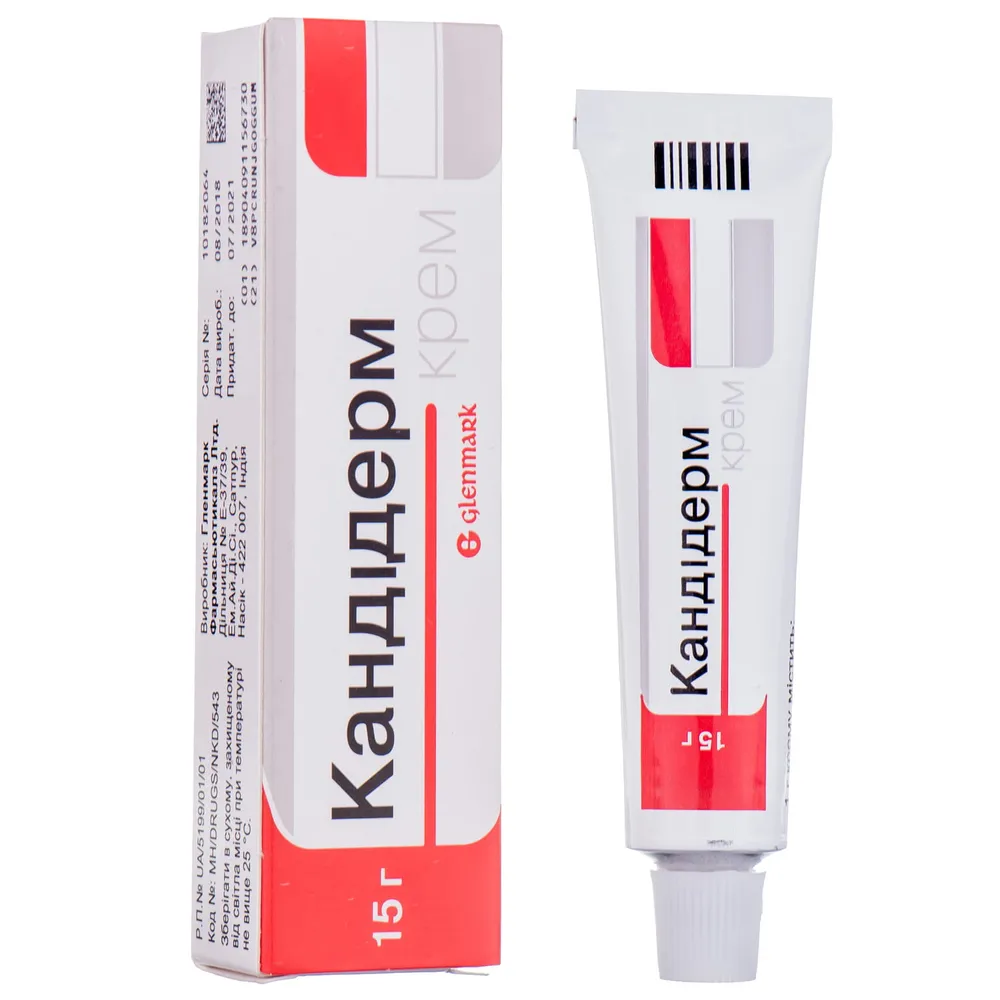
Table of Contents
INSTRUCTIONS FOR MEDICAL USE OF THE MEDICINAL PRODUCT KANDIDERM (CANDIDERM)
Composition:
Active substances: 1 g of cream contains clotrimazole 10 mg; anhydrous beclometasone dipropionate 0.25 mg; gentamicin sulphate equivalent to gentamicin 1 mg.
Excipients: propylene glycol; white soft paraffin; mineral oil; non-ionic emulsifying wax; benzyl alcohol; methyl hydroxybenzoate (E 218); propyl hydroxybenzoate (E 216); anhydrous sodium hydrogen phosphate; butylhydroxytoluene (E 321); sodium dihydrogen phosphate dihydrate; purified water.
Pharmaceutical form. Cream.
Main physicochemical characteristics: semi-solid, homogeneous white cream.
Pharmacotherapeutic group.
Topical antifungal agents.
ATC code D07CC04.
Pharmacological properties
Pharmacodynamics
Candiderm is a combined medication with antibacterial and anti-inflammatory effects for topical use. The pharmacological action of Candiderm is due to the properties of clotrimazole, gentamicin sulfate, and beclomethasone dipropionate contained in its formulation. Clotrimazole is a broad-spectrum antifungal agent from the imidazole derivatives group. Dermatophytes, yeasts (genera Candida, Torulopsis glabrata, Rhodotorula), molds, as well as causative agents of Pityriasis versicolor (tinea versicolor) and erythrasma are sensitive to clotrimazole. In addition, clotrimazole exhibits antimicrobial activity against Gram-positive (staphylococci, streptococci) and Gram-negative bacteria (Bacteroides, Gardnerella vaginalis), as well as against Trichomonas vaginalis, Malassezia furfur, and Corynebacterium minutissimum. The effect of clotrimazole is associated with disruption of ergosterol synthesis, a component of fungal cell membranes. As a result, the structure and properties of the membranes are altered, leading to cell lysis.
Gentamicin sulfate is an antibiotic from the aminoglycoside group. It has a broad spectrum of activity against most pathogens causing skin diseases.
Beclomethasone dipropionate is a synthetic analog of adrenal cortex hormones, exerting anti-inflammatory, antiallergic, anti-exudative, and antipruritic effects.
Pharmacokinetics
Specific pharmacokinetic studies of the drug have not been conducted.
Clotrimazole is practically not absorbed into the systemic circulation following topical (cutaneous) application.
Gentamicin sulfate is not absorbed through intact skin when applied locally. However, it is rapidly absorbed through large areas of damaged, burned, or granulating skin.
Beclomethasone dipropionate, similar to other corticosteroids, penetrates through intact skin into the systemic circulation. Absorption of topical corticosteroids is significantly increased during inflammatory skin processes and other skin disorders. The pharmacokinetic characteristics following topical application are similar to those observed after systemic administration. It binds to plasma proteins and is metabolized in the liver.
Clinical characteristics.
Indications.
Candiderm is indicated for topical use in inflammatory and infectious skin disorders associated with secondary bacterial or fungal infection.
Contraindications.
Hypersensitivity to the active substances, other imidazoles, or to any of the excipients. Skin tuberculosis, cutaneous manifestations of syphilis, post-vaccination skin reactions, generalized plaque psoriasis, varicose veins, perioral dermatitis, rosacea, chickenpox, herpes simplex, measles, other bacterial and fungal skin infections without appropriate antibacterial and antifungal therapy, acne vulgaris, primary viral skin infections, varicose ulcers or other ulcers due to stasis of different origin, herpes zoster, impetigo, perianal and genital pruritus.
Interaction with other medicinal products and other forms of interaction.
There is no information regarding interactions of the combination of clotrimazole, beclomethasone dipropionate, and gentamicin sulfate with other medicinal products. Since systemic absorption is minimal, interaction of the drug with concomitant systemically acting medicinal products is unlikely.
Laboratory studies have shown that clotrimazole may damage latex contraceptives when used concomitantly. Therefore, the effectiveness of such contraceptive methods may be reduced. Patients should use alternative contraceptive methods for at least five days after application of Candiderm.
It has been demonstrated that concomitant use of drugs capable of inhibiting CYP3A4 (e.g., cobicistat) inhibits the metabolism of corticosteroids, which may lead to systemic effects. The clinical significance of such an interaction depends on the dose of the drug, the route of administration of the corticosteroid, and the potency of the CYP3A4 inhibitor.
Special precautions for use
The drug is intended for dermatological use only and is not intended for ophthalmic use. Application near the eyes or on the eyelids may lead to glaucoma.
Prolonged use of the drug may result in overgrowth of non-susceptible microorganisms. In such cases, treatment should be discontinued and appropriate therapeutic measures should be taken. If irritation, sensitization, or superinfection develops during treatment, therapy should be stopped and appropriate treatment initiated.
Systemic absorption of beclometasone dipropionate and gentamicin may significantly increase when the drug is applied to large areas of skin, especially on open, damaged, burned, or granulating skin, or when occlusive dressings are used. In such cases, adverse effects associated with systemic administration of the active substances may occur.
Therefore, the drug should not be used on open wounds or damaged skin areas, and Candiderm should not be applied under occlusive dressings.
Any adverse effects associated with systemic corticosteroids, including adrenal cortex suppression, Cushing's syndrome, and increased intracranial pressure, may also occur with topical application of glucocorticosteroids. Prolonged use should be avoided due to the risk of adrenal suppression, even without the use of occlusive dressings.
The face is more susceptible than other body areas to atrophic changes following prolonged use of topical corticosteroids.
Cross-allergic reactions with aminoglycosides have been observed. In such cases, appropriate precautionary measures should be taken.
Topical corticosteroids may be hazardous in psoriasis for several reasons, including relapses, development of tolerance, risk of generalized pustular psoriasis, and risk of local or systemic toxicity due to impaired skin barrier function. If the drug is used in psoriasis, careful patient monitoring is essential.
For treatment of bacterial infection that may complicate inflammatory skin lesions, appropriate antimicrobial therapy should be used. Any spread of infection requires discontinuation of topical corticosteroid therapy and initiation of systemic antibacterial agents.
If signs of hypersensitivity to the drug appear, use should be discontinued immediately.
Visual disturbances may occur with both systemic and topical use of corticosteroids. If a patient develops symptoms such as blurred vision or other visual disturbances, they should be referred to an ophthalmologist to evaluate possible causes, including cataract, glaucoma, or rare conditions such as central serous chorioretinopathy, which has been reported following systemic and topical corticosteroid use.
Use during pregnancy or breastfeeding
The safety of using the drug in these patient categories has not been established. The drug should be avoided during the first trimester of pregnancy.
Ability to affect reaction speed when driving or operating machinery
The drug generally does not affect reaction speed when driving or operating machinery.
Dosage and Administration.
Apply Candermin externally to adults 2–3 times daily. Before application, wash and thoroughly dry the affected area. After that, completely cover the affected area with a thin layer of cream. On hairy areas of the skin, part the hair before applying the cream to ensure direct contact with the affected area.
Symptoms of the disease usually resolve within 2–4 weeks after starting treatment; however, therapy should be continued for several additional days after all symptoms have disappeared.
Children.
There is insufficient data on the use of the drug in children.
Overdose.
Acute overdose with topical application of Candermin is unlikely. However, topical application over large skin areas may lead to systemic absorption of beclomethasone and gentamicin. With prolonged or excessive use, suppression of the pituitary-adrenal function may occur, resulting in secondary adrenal insufficiency and symptoms of hypercorticism, including Cushing's syndrome. Overgrowth of antibiotic-resistant microorganisms is also possible.
Treatment. Provide appropriate symptomatic therapy. Symptoms of acute hypercorticism are usually reversible. If necessary, correct the electrolyte balance. In cases of chronic toxic effects, gradual withdrawal of corticosteroids is recommended. In case of excessive growth of resistant microorganisms, discontinue treatment with the drug and initiate appropriate therapy.
Adverse Reactions
Skin and subcutaneous tissue disorders: burning sensation, skin irritation, dry skin, peeling, folliculitis, hypertrichosis, acneiform (acne-like) eruptions, skin redness (erythema), exudation, vesicles, epidermal detachment, prickling sensation, swelling, itching, urticaria, pigmentation disorders, hypochromia (hypopigmentation), perioral dermatitis, allergic contact dermatitis, skin maceration, telangiectasias, development of secondary resistant flora, skin atrophy, striae, miliaria, superficial blood vessel dilation, discomfort/pain, hypersensitivity, exacerbation of psoriasis, photosensitivity.
Immune system disorders: allergic reactions, including syncope, hypotension, dyspnea, urticaria.
Reactions associated with systemic effects of beclometasone.
Endocrine system disorders: suppression of pituitary-adrenal function, Cushing's syndrome, hirsutism.
Metabolism and nutrition disorders: hyperglycemia, glucosuria.
Eye disorders: cataract.
Nervous system disorders: increased intracranial pressure.
Vascular disorders: arterial hypertension, edema.
Gastrointestinal disorders: gastric ulcer formation.
Eye disorders: visual blurring (frequency unknown) (see section "Special Warnings and Precautions for Use").
Shelf life.
3 years.
Storage conditions.
Store in a dry, light-protected place at a temperature not exceeding 25 °C.
Keep out of reach of children.
Packaging.
15 g in a tube, 1 tube in a cardboard package.
Prescription status.
Prescription only.
Manufacturer.
Glenmark Pharmaceuticals Ltd.
Manufacturer's address.
Plot No E-37/39, M.I.D.C., Industrial Estate, Satpur, Nasik – 422 007, India.