Canavit
Ukraine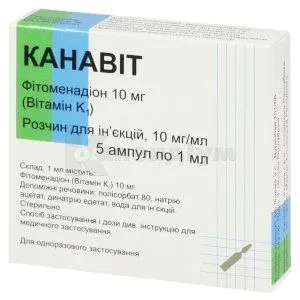
Table of Contents
INSTRUCTIONS FOR MEDICAL USE OF THE MEDICINAL PRODUCT KANAVIT (KANAVIT)
Composition:
active substance: phytomenadione (vitamin K1);
1 ml of injectable emulsion contains 10 mg of phytomenadione;
excipients: polysorbate 80, sodium acetate, edetate disodium, hydrochloric acid, water for injections.
Pharmaceutical form. Injection emulsion.
Basic physico-chemical properties: opalescent to slightly cloudy emulsion, greenish-yellow to yellow in color, without signs of phase separation.
Pharmacotherapeutic group. Vitamin K and other hemostatics, phytomenadione.
ATC code B02B A01.
Pharmacological properties.
Pharmacodynamics.
Prophylactic and therapeutic use of vitamin K1 is based on its essential role in the formation of coagulation factors in the liver and its beneficial effect on vitamin K1 deficiency following disruption of intestinal flora by antibiotics and chemotherapeutic agents. Vitamin K1 influences the biosynthesis of factor II (prothrombin), factor VII (proconvertin), factor IX (Christmas factor), and factor X (Stuart–Prower factor).
Pediatric use
A prospective, randomized, controlled study included 44 breastfed infants (aged 1–26 weeks) with conjugated hyperbilirubinemia (idiopathic neonatal hepatitis – 17 patients, biliary atresia – 13, parenteral nutrition-associated cholestasis – 3, Alagille syndrome – 2, alpha-1-antitrypsin deficiency – 2, bile thickening syndrome – 2, various diagnoses – 5; fructosemia, galactosemia, choledochal cyst, necrotizing enterocolitis, cytomegalovirus hepatitis).
Pharmacokinetics and efficacy of oral versus intravenous prophylactic administration of a micellar formulation of vitamin K were compared in infants with cholestatic liver disease.
Primary outcome measures were serum concentrations of vitamin K1 and of undercarboxylated prothrombin (PIVKA-II) before and 4 days after administration of a single dose of 1 mg micellar vitamin K1 intravenously or 2 mg orally. Serum vitamin K1 levels 24 hours after oral administration were also compared with levels in 14 healthy newborns who received the same dose.
Results: At baseline, 18 children (41%) had elevated serum PIVKA-II levels and eight children (18%) had low vitamin K1 concentrations, indicating subclinical vitamin K deficiency. Mean serum vitamin K1 concentration at baseline in the oral and intravenous vitamin K1 groups was 0.92 vs. 1.15 ng/mL, respectively. Six hours after intravenous administration, the concentration increased to 139 ng/mL, whereas after oral administration it increased only to 1.4 ng/mL.
In the latter group, the low mean serum vitamin K1 level (0.95 ng/mL) and wide range (<0.15–111 ng/mL), compared to significantly higher levels (mean 77, range 11–263 ng/mL) measured in healthy infants receiving the same oral dose, indicates inadequate and unpredictable intestinal absorption in infants with cholestasis.
The significance of malabsorption is such that only 4 out of 24 (17%) cholestatic infants achieved a gradual increase in serum vitamin K1 > 10 ng/mL.
Data from retrospective studies indicate that weekly oral prophylaxis is effective in preventing VKDB (Vitamin K Deficiency Bleeding). During the study period from November 1992 to June 2000, a total of 507,850 live births occurred; 78% of newborns received oral prophylaxis and 22% received intramuscular prophylaxis. Thus, 396,000 newborns received oral prophylaxis at birth. Weekly oral prophylaxis was recommended for all infants throughout the period during which they were predominantly breastfed. At birth, they received 2 mg of vitamin K orally as phytomenadione, followed by weekly prophylactic doses of vitamin K; parents administered 1 mg of phytomenadione until the infant reached three months of age. No cases of VKDB were observed, resulting in an incidence rate of 0–0.9:100,000 (95% CI).
Pharmacokinetics.
Distribution.
Vitamin K is completely absorbed after intramuscular administration. It concentrates in the liver but does not accumulate there, and its concentration decreases rapidly. Only very small amounts of vitamin K1 are stored in tissues, where it is slowly degraded.
Biotransformation.
Phytomenadione is rapidly metabolized into polar metabolites.
Elimination.
Phytomenadione is rapidly metabolized into polar metabolites, which are excreted in bile and urine (after conjugation as glucuronides).
Clinical Characteristics.
Indications.
- Prevention and treatment of hemorrhages caused by impaired blood coagulation due to vitamin K deficiency or avitaminosis K, as well as suppression of blood coagulation factors II, VII, IX, and X of various etiologies.
- Hemorrhagic complications during treatment with indirect coumarin-type anticoagulants (such as, for example, warfarin).
- Hypocoagulation following prolonged biliary tract obstruction and in early stages of liver cirrhosis. Intestinal diseases associated with malabsorption, following prolonged treatment with antibiotics, sulfonamides, and salicylates.
- Hemorrhagic manifestations in newborns, uterine bleeding.
- For prophylactic purposes prior to delivery, to protect both mother and newborn from bleeding; treatment of bleeding in newborns.
- In surgery, during prolonged biliary drainage and in preoperative preparation of patients with impaired blood coagulation.
Contraindications.
- Hypersensitivity to the components of the drug,
- glucose-6-phosphate dehydrogenase deficiency,
- hypercoagulability,
- thromboembolism,
- hemolytic disease of the newborn,
- severe hepatic insufficiency.
Interaction with other medicinal products and other forms of interaction.
Phenacetin, sulfonamides, quinine – concomitant use of Canavit may increase the risk of hemolytic effects.
Medicinal products capable of displacing bilirubin from protein complexes (e.g., sulfonamides) – concomitant use of Canavit in newborns with increased hemolysis may increase the risk of developing kernicterus.
Cholestyramine – reduces absorption of vitamin K1 from the intestine.
Antagonism with coumarin anticoagulants.
Special precautions for use.
Caution is required in patients with chronic liver disease.
For patients with known glucose-6-phosphate dehydrogenase deficiency, in whom vitamin K may cause hemolysis of red blood cells, the benefit-risk ratio should be carefully considered before administering the medicinal product.
Phytonadione may increase serum bilirubin levels in biochemical blood tests.
The use of Canavit for coagulation disorders caused by factors other than those specified above (e.g., treatment of gynecological bleeding) is inappropriate.
Intravenous administration to neonates with body weight less than 2.5 kg may increase the risk of developing bilirubin encephalopathy.
The solution in the ampoule must be clear. If precipitate, cloudiness, or phase separation of the emulsion occurs, the medicinal product must not be used.
Use during pregnancy or breastfeeding.
Pregnancy
Phytonadione crosses the placental barrier.
Since reproductive toxicity has been observed in animal studies and there are no adequate safety data in human pregnancy, phytonadione should be used only if the expected benefit to the mother outweighs the potential risk to the fetus.
Breastfeeding
Phytonadione passes into breast milk in small amounts.
In preterm infants and newborns, the hepatic enzyme system is poorly developed, which may lead to nuclear jaundice, jaundice, and hemolytic anemia due to slow biotransformation of phytonadione in the liver.
Fertility
The effect on fertility is unknown.
Ability to affect the reaction speed when driving or operating machinery.
Canavit has no effect or has negligible effect on the ability to drive vehicles or operate machinery.
Method of Administration and Dosage
Intravenous and intramuscular, as well as oral administration (for this purpose, after filling, use a needle-free syringe).
Infusion administration is not recommended.
Adults and elderly patients:
Hemorrhage following anticoagulant therapy:
In severe cases, administer 10 to 20 mg (1 to 2 vials) of Canavit, diluted in 5–10 mL of water for injections or 5% glucose solution, slowly (at least 30 seconds) by intravenous injection. If bleeding does not stop, repeat administration may be performed after 3–4 hours, but not more than 40 mg per day. In emergency situations, transfusion of fresh blood or fresh frozen plasma is mandatory. In milder cases, administer Canavit intramuscularly. It is essential to remember that vitamin K1 has a prolonged effect, especially when high doses are used; when anticoagulant therapy is discontinued concurrently, maximum effect may be achieved within 24 hours, potentially leading to undesirable increase in blood coagulation. For this reason, caution is advised; if possible, Canavit should be administered orally or intramuscularly in lower doses to avoid new thromboembolic complications in patients due to rapid increase in coagulation factors.
Continuous monitoring of blood coagulation parameters is required until they stabilize.
Prophylaxis and treatment of bleeding in biliary and liver diseases:
When there is a mild decrease in blood coagulation factors, administer 5 to 10 mg of the drug intramuscularly three times a week. In cases of more pronounced coagulation deficiency or active bleeding, administer 1–2 mL vials intramuscularly 1–2 times per week until normalization of prothrombin complex levels. In less advanced stages of liver cirrhosis, administer 20 to 30 mg of phytomenadione intramuscularly three times a week.
Prophylaxis of bleeding prior to surgical procedures in patients with reduced coagulation factor levels.
Prior to emergency surgery, administer half a vial to two vials intravenously; in less urgent cases, administer 5 mg intravenously. If surgery is planned, administer the drug 6–12 hours prior to the procedure.
Other hemorrhages.
In cases of reduced levels of factors II, VII, and X, and in hemorrhages of various origins, administer 1–2 vials intramuscularly until coagulation is corrected and bleeding is controlled.
The maximum single dose is 20 mg; the maximum daily dose of Canavit is 40 mg for both routes of administration.
Note. When administering intravenously, dilute the injectable emulsion 1:5 (with water for injections or 5% glucose solution) and inject slowly at a rate of approximately 1 mL per 20 seconds.
Elderly individuals are more sensitive to the drug's effects; therefore, the lowest recommended doses should be prescribed for this age group.
Pediatric use (under 18 years of age).
The drug may be administered intramuscularly, intravenously, or orally.
Do not mix with other medicinal products. However, the dose may be injected into the lower part of an infusion set containing 5% dextrose or 0.9% sodium chloride solution, at an infusion rate of ≥ 0.7 mL/min.
Healthy newborns with a gestational age of 36 weeks or more – 1 mg injection administered intramuscularly at birth or shortly after birth.
Or 2 mg orally at birth or shortly after birth. After the oral dose, an additional 2 mg dose should be administered at 4–7 days of age. Another 2 mg oral dose should be given one month after birth. In formula-fed infants, the third oral dose may be omitted.
Preterm newborns (less than 36 weeks gestational age, body weight 2.5 kg or more) and those particularly at risk of term birth complications (e.g., prematurity, birth asphyxia, obstructive jaundice, swallowing difficulties, maternal use of anticoagulants or antiepileptic drugs):
1 mg injection administered intramuscularly or intravenously at birth or shortly after birth. The number and frequency of subsequent doses should be determined based on coagulation status.
For treatment of overdose of coumarin-type anticoagulants, the recommended dose is 250–300 mcg/kg intravenously in children with body weight over 1.6 kg.
For patients continuing warfarin therapy, the recommended dose for partial reversal of anticoagulation is 30 mcg/kg administered by intravenous injection in children with body weight over 13 kg.
Preterm newborns (less than 36 weeks gestational age, body weight less than 2.5 kg):
0.4 mg/kg (equivalent to 0.04 mL/kg) injection administered intramuscularly or intravenously at birth or shortly after birth. This parenteral dose must not be exceeded. The number and frequency of subsequent doses should be determined based on coagulation status.
It has been demonstrated that in patients with cholestatic liver disease as the primary condition and malabsorption, oral prophylaxis is insufficient.
WARNING: Care must be taken in calculating and measuring doses according to body weight in children (frequent dosing errors occur, such as a 10-fold overdose).
Doses for preterm infants for prophylaxis of vitamin K deficiency bleeding are given in the table:
| Child's body weight |
Vitamin K dose at birth |
Injection volume |
| 1 kg |
0.4 mg |
0.04 ml |
| 1.5 kg |
0.6 mg |
0.06 ml |
| 2 kg |
0.8 mg |
0.08 ml |
| 2.5 kg |
1 mg |
0.1 ml |
| >2.5 kg |
1 mg |
0.1 ml |
An additional oral dose is recommended for infants, but data regarding the safety and efficacy of these subsequent doses are limited.
Recommended doses for children
| Age |
Dose |
| Newborns |
no more than 1 mg |
| Up to 1 year |
1-2.5 mg |
| 1-6 years |
2.5-5 mg |
| 6-15 years |
5-10 mg |
Children.
The medicinal product can be used in pediatric practice.
Overdose.
Phytomenadione has low toxicity, and overdose usually does not cause clinical problems. Intravenous administration of medicinal products containing phytomenadione may cause acute hypersensitivity or anaphylactic reactions, manifested by flushing, sweating, chest pain, dyspnea, cyanosis, bronchoconstriction, and cardiovascular collapse. These reactions are likely due to histamine release caused by excipients, not by the active substance itself.
In newborns, especially premature infants, high doses may lead to hemolytic anemia. There is also a risk of developing kernicterus due to displacement of bilirubin from albumin binding sites.
Treatment: in case of overdose, treatment is not required if there are no serious clinical symptoms, as the biological half-life of phytomenadione is short (1.2 to 3.5 hours).
Adverse reactions.
The following table lists adverse reactions grouped according to MedDRA terminology (Medical Dictionary for Regulatory Activities) with the incidence specified as follows: very common (≥1/10); common (≥1/100 to <1/10); uncommon (≥1/1000 to <1/100); rare (≥1/10000 to <1/1000); very rare (<1/10000), not known (cannot be estimated from the available data).
| MedDRA System Organ Classes |
Frequency |
Adverse Reaction |
| Skin and subcutaneous tissue disorders |
uncommon unknown |
rash hyperhidrosis |
| General disorders and administration site conditions |
uncommon |
reaction at injection site, inflammation at injection site, pain at injection site, phlebitis or venous inflammation |
| Cardiovascular system disorders |
unknown |
cyanosis, circulatory collapse |
| Respiratory, thoracic and mediastinal disorders |
unknown |
bronchospasm |
| Blood and lymphatic system disorders |
unknown |
hemolytic anemia* |
| Hepatobiliary disorders |
unknown |
jaundice in newborns |
| Immune system disorders |
very rare |
anaphylactoid reactions |
*in case of G-6-P-dehydrogenase deficiency
Shelf life. 3 years.
Storage conditions.
Store in a dry place protected from light and inaccessible to children. Keep in the original packaging at a temperature not exceeding 25°C. Do not refrigerate.
Incompatibility.
Canavit in emulsion is incompatible with dextrin, vitamin B12, hydantoins, and barbiturates.
Packaging.
1 ml of injectable emulsion in a brown glass ampoule. 5 or 10 ampoules in a PVC blister pack placed in a cardboard box.
Prescription status. Prescription only.
Manufacturer.
HBM Pharma s.r.o., Slovak Republic
Manufacturer’s address.
Sklabinska 30, 036 80 Martin, Slovak Republic
Marketing authorization holder.
BB Pharma a.s., Czech Republic
Address of the marketing authorization holder.
Durychova 101/66, Lhotka, 142 00, Praha 4, Czech Republic
Representative of the marketing authorization holder.
LLC Ecokids, 03134, Kyiv, Siamyi Sosninykh St., 3.
Tel: +38 044 273 57 48