Cameton
Ukraine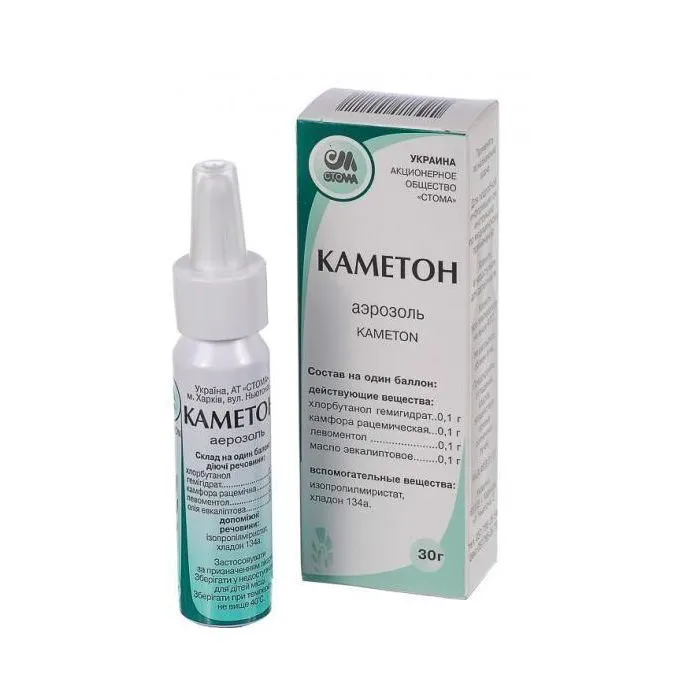
Table of Contents
INSTRUCTIONS FOR MEDICAL USE OF THE MEDICINAL PRODUCT KAMETON (Cametonum)
Composition:
Active substances: chlorobutanol hemihydrate; racemic camphor; menthol.
1 can contains chlorobutanol hemihydrate (calculated as 100% anhydrous substance) – 0.1 g; racemic camphor – 0.1 g; menthol – 0.1 g;
Excipients: eucalyptus oil, isopropyl myristate, tetrafluoroethane.
Pharmaceutical form. Aerosol.
Main physicochemical properties: a transparent, colorless liquid under pressure in a can equipped with a metered valve, forming a dispersed jet with a characteristic aromatic odor upon release from the can.
Pharmacotherapeutic group.
Respiratory system agents. Preparations used for throat disorders. Antiseptics. Other.
ATC Code R02AA20.
Pharmacological properties.
Pharmacodynamics.
Cameton exhibits antimicrobial, anti-inflammatory, and mild local anesthetic effects, and promotes normalization of patients' respiration. The medicinal product constricts blood vessels and reduces hyperemia and swelling of the affected area. The combination of these pharmacological properties provides comprehensive pathogenetic therapy for inflammatory diseases of the upper respiratory tract. Cameton does not exhibit ulcerogenic or general toxic effects on the body.
Pharmacokinetics.
Cameton is intended for local application and forms a therapeutic concentration primarily at the site of inflammation. Chlorobutanol hydrate and camphor are absorbed into the systemic circulation slowly and in insignificant amounts; they reversibly bind to blood proteins. During biotransformation, glucuronides are formed, which are excreted by the kidneys.
Clinical characteristics.
Indications.
Local treatment of acute and chronic (mainly in the stage of exacerbation) infectious and inflammatory diseases of the throat and nose: tonsillitis, pharyngitis, laryngitis, rhinitis.
Contraindications.
Hypersensitivity to the components of the drug. Children under 5 years of age.
Interaction with other medicinal products and other forms of interaction.
Not described. If it is necessary to use any other medicinal products simultaneously, consult a physician.
Special precautions for use.
-
Before using Kameton, rinse the oral cavity with warm boiled water. The medication should be used after eating. In cases of burns, remove the necrotic coating from affected areas with a sterile swab.
-
Do not disassemble the medication canister and keep it out of reach of children. Protect from impacts and do not spray near open flame.
-
After using the medication, place the protective cap back onto the spray nozzle to prevent contamination.
-
When spraying into the nose, do not tilt the head back or turn the canister upside down. It is not recommended for multiple individuals to use the same canister to avoid spreading infection. Avoid getting the medication into the eyes during spraying.
-
Individuals prone to allergies must consult a doctor before using this medication.
-
The medication should be used cautiously in children, as bronchospasm may develop. Treatment of children should be conducted under medical supervision.
-
Before administering the medication into the nasal cavity, clear the nose of mucus. When treating the throat mucosa, the medication should be used after eating.
Use during pregnancy or breastfeeding.
No contraindications for using the medication during pregnancy or breastfeeding have been identified; however, it should be used during these periods only under a physician's prescription.
Ability to affect reaction rate while driving or operating machinery.
No data available.
Dosage and Administration
For use in adults and children aged 5 years and older. Apply the preparation locally onto the mucous membranes and affected areas of the throat and nasal cavities. The single dose for adults and adolescents aged 15 years and older is 2–3 sprays into the throat cavity and 1–2 sprays into each nostril; for children aged 5 to 12 years – 1–2 sprays into the throat cavity and 1 spray into each nostril; for children aged 12 to 15 years – 2 sprays into the throat cavity and 1 spray into each nostril. Administer the preparation 3–4 times daily. The duration of treatment is determined individually by a physician and depends on the intensity of therapy (usually 3–10 days). The preparation should not be used for longer than 2 weeks.
Instructions for using the spray bottle
- Attach the spray nozzle onto the valve stem.
- Remove the protective cap from the spray nozzle.
- Insert the free end of the spray nozzle into the nasal cavity to a depth of 0.5 cm or direct it towards the affected area of the throat and press the spray nozzle. When spraying into the nose, do not invert the bottle.
- After completing the application, cover the spray nozzle with the protective cap to prevent contamination.
Children. Use in children aged 5 years and older under medical supervision.
Overdose.
Overdose may cause allergic reactions. Overdose may also intensify adverse effects. Treatment is symptomatic.
Management: discontinue the use of the preparation and provide symptomatic therapy.
Side effects.
The medicinal product is usually well tolerated, but sometimes reactions due to increased individual sensitivity to the components of the drug may occur, including burning sensation/irritation in the throat, swelling at the site of contact, dryness of the nasal/throat mucosa, shortness of breath, facial swelling, swelling of the tongue, skin rashes, urticaria, itching.
If any adverse reactions occur, discontinue use of the drug and consult a physician immediately.
Shelf life.
3 years. Do not use the drug after the expiry date stated on the package.
Storage conditions.
Store at a temperature not exceeding 25 °C.
Packaging.
30 g in an aerosol can; 1 can per carton.
Prescription status.
Over-the-counter.
Manufacturer.
MICROPHARM LLC.
Manufacturer's address.
20, Shevchenka Street, Kharkiv, Ukraine, 61013.