Calci-m
Ukraine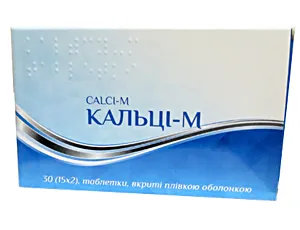
Table of Contents
INSTRUCTIONS FOR MEDICAL USE OF THE MEDICINAL PRODUCT CALCI-M
Composition:
Active substances:
One film-coated tablet contains calcium citrate malate equivalent to calcium 250 mg, magnesium hydroxide equivalent to magnesium 100 mg, zinc sulfate equivalent to zinc 4 mg, vitamin D3 (stabilized 20 IU/mg) 200 IU;
Excipients:
sodium croscarmellose, crospovidone, povidone K-30, corn starch, microcrystalline cellulose, colloidal anhydrous silicon dioxide, magnesium stearate, purified water, coating Colorcoat FC4S-A White (titanium dioxide [E 171]), isopropyl alcohol, dichloromethane.
Pharmaceutical form.
Film-coated tablets.
Main physico-chemical properties: white to almost white, capsule-shaped tablets, film-coated, with a break line on one side and smooth on the other.
Pharmacotherapeutic group.
Mineral supplements. Calcium in combination with vitamin D3 and/or other agents.
ATC code A12AX.
Pharmacological Properties
Pharmacodynamics.
CALCI-M is a combination drug containing the following active ingredients: calcium citrate malate, vitamin D3, magnesium hydroxide, and zinc sulfate. The active ingredients in CALCI-M help normalize calcium and phosphorus metabolism in the body, which are primarily found in bone tissue. The drug is used for the prevention and treatment of calcium deficiency states. Calcium citrate is a calcium salt that is better absorbed in the intestine compared to the most common natural form of calcium, i.e., calcium carbonate. Vitamin D3 is a fat-soluble sterol that plays a crucial role in regulating calcium-phosphorus homeostasis and bone tissue mineralization. Vitamin D3 regulates calcium absorption and excretion, especially when dietary calcium intake is low.
Low calcium levels lead to increased parathyroid hormone (PTH) secretion. PTH causes calcium release from bones, thereby increasing blood calcium levels.
Vitamin D3 is metabolized into its active metabolite, calcitriol. Calcitriol enhances calcium absorption in the small intestine, resulting in increased blood calcium levels and reduced PTH levels. Magnesium is essential for calcium utilization in the human body. In addition to improving the body's ability to absorb calcium, magnesium contributes to bone strengthening, making bones more flexible and thus less prone to fractures. This also helps reduce undesirable effects (such as bloating and constipation) associated with certain calcium salts.
Zinc exerts a stimulatory effect on bone formation and mineralization. It directly activates aminoacyl-tRNA synthetase in osteoblast cells, thereby stimulating cellular protein synthesis. Additionally, zinc inhibits osteoclastic bone resorption by suppressing osteoclast activity. Zinc may influence the bone resorption process and plays an important role in maintaining bone mass.
Pharmacokinetics.
Absorption.
Calcium. Approximately 30% of calcium is absorbed orally via active transport and passive diffusion in the small intestine. About 99% of calcium is concentrated in hard tissues (bones, teeth), while 1% remains in intracellular and extracellular fluids. Approximately 50% of calcium in the blood exists in the physiologically active ionized form. Nearly 10% is complexed with citrates, phosphates, and other anions, while the remaining 40% is bound to proteins, primarily albumins.
Vitamin D3. Well absorbed in the gastrointestinal tract in the presence of bile.
Zinc. About 20–30% of ingested zinc is absorbed following oral administration.
Magnesium. Typically, only 30–40% of magnesium is absorbed in the small intestine.
Distribution.
Calcium. Primarily distributed in bone tissue and breast milk. It also crosses the placenta.
Vitamin D3. Vitamin D3 and its metabolites bind to vitamin D-binding protein and circulate in the blood. Vitamin D3 can be stored in adipose and muscle tissues for prolonged periods.
Zinc. Zinc is widely distributed throughout the body but is concentrated in muscles, bones, skin, and prostatic fluid.
Magnesium. In the body, magnesium is distributed mainly in the intracellular space (about 99%): approximately two-thirds are found in bone tissue, and one-third in smooth and skeletal muscle tissues.
Metabolism.
Vitamin D3. It is oxidized in the liver to form 25-hydroxycholecalciferol, then further oxidized in the kidneys to produce the active metabolites 1,25-dihydroxycholecalciferol.
Excretion.
Calcium salts. Unabsorbed calcium is primarily excreted in feces. Excess calcium is excreted in urine.
Vitamin D3. Vitamin D3 and its metabolites are mainly excreted via bile and feces.
Zinc. Primarily excreted in feces (about 90%); small amounts are excreted in urine, and approximately 2% through sweat glands.
Magnesium. The kidneys are the main organs responsible for magnesium excretion, but they also play a role in magnesium retention by reabsorbing the majority of filtered magnesium in the proximal tubules (in the thick ascending limb of Henle’s loop).
Clinical characteristics
Indications.
CALCI-M is indicated in the following cases:
- Calcium and vitamin D3 deficiency associated with inadequate dietary intake of these substances, or conditions requiring their additional supplementation;
- Increased need for calcium and cholecalciferol during pregnancy;
- Prevention of osteoporosis and as an adjunct to specific osteoporosis therapy.
Contraindications.
- Hypersensitivity to the active substances or any of the excipients of the medicinal product;
- Severe renal impairment (glomerular filtration rate <30 mL/min/1.73 m²);
- Diseases and/or conditions associated with hypercalcemia and/or hypercalciuria;
- Urolithiasis (nephrolithiasis);
- Active tuberculosis;
- Hypervitaminosis D3;
- Hypermagnesemia;
- Decalcifying tumors such as myeloma, bone metastases, sarcoidosis.
Special precautions.
Potential hazard. Fatal encephalopathy may occur in patients with renal insufficiency receiving calcium citrate concomitantly with aluminum-containing drugs due to increased aluminum levels.
Interaction with other medicinal products and other forms of interaction.
When using CALCI-M concomitantly with other medicinal products, consultation with a physician is required.
Calcium and magnesium. Calcium and magnesium reduce the absorption of tetracyclines, fluoroquinolones, and oral bisphosphonates. The interval between administration of CALCI-M and tetracycline derivatives should be at least 3 hours.
Glucocorticoids and hormonal contraceptives impair the absorption of calcium ions.
There is an increased risk of hypercalcemia and metabolic alkalosis when used concomitantly with thiazide diuretics, and an increased risk of hyperkalemia when used with paricalcitol. Due to the increased risk of hypercalcemia when thiazide diuretics are used concomitantly, serum calcium levels should be monitored regularly.
Concomitant use with furosemide and other loop diuretics increases renal excretion of calcium.
Cardiac glycosides and calcium channel blockers. Hypercalcemia increases the risk of fatal arrhythmia during treatment with cardiac glycosides such as digoxin, and reduces the effectiveness of calcium channel blockers such as verapamil in atrial fibrillation. Monitoring of serum calcium levels, ECG, and clinical status of the patient is recommended.
The efficacy of erlotinib is reduced when used concomitantly with calcium. To prevent reduced absorption of bisphosphonates or sodium fluoride, CALCI-M should be taken no earlier than 2 hours after their administration.
Interaction with protease inhibitors. Concomitant use of medicinal products containing calcium or magnesium, including buffered preparations, leads to reduced plasma concentrations of these compounds. Therefore, it is recommended to administer protease inhibitors 2 hours before or 1 hour after products containing aluminum, calcium, or magnesium. Such effects have been observed with amprenavir, atazanavir, and tipranavir.
Levothyroxine should be administered at least 4 hours before or 4 hours after calcium intake, as calcium reduces its absorption, possibly due to formation of insoluble complexes.
Vitamin D3. Some medicinal products may reduce vitamin D absorption in the gastrointestinal tract. Enzyme-inducing antiepileptic drugs increase the metabolism of vitamin D3. The activity of vitamin D3 may be reduced when used concomitantly with rifampicin, phenytoin, or barbiturates. Concomitant use of medicinal products containing ion-exchange resins, such as cholestyramine, or laxatives such as liquid paraffin, may lead to decreased gastrointestinal absorption of vitamin D3. To minimize interaction, these products should be administered at least 2 hours before or 4–6 hours after vitamin D intake.
Concomitant use of CALCI-M with vitamin A reduces the toxicity of vitamin D3.
Zinc. Reduced zinc absorption occurs when taken concomitantly with penicillins and tetracyclines. Phosphate-containing preparations reduce zinc absorption. Zinc sulfate reduces the absorption of copper and fluoroquinolones, such as ciprofloxacin, levofloxacin, moxifloxacin, norfloxacin, ofloxacin. Reduced absorption of bisphosphonates occurs when used concomitantly with zinc. Calcium intake exceeding 2500 mg/day may affect the absorption of other minerals, including zinc, magnesium, and phosphorus.
Interaction of calcium with food and supplements. Oxalic acid present in spinach and rhubarb, and phytic acid present in whole grains, may inhibit calcium absorption. Therefore, it is not recommended to consume calcium-containing products within two hours after eating foods rich in oxalic and phytic acids.
Iron, zinc, magnesium. Calcium preparations may reduce the absorption of iron, zinc, and magnesium from food. However, for individuals with adequate body stores of iron, zinc, or magnesium, this has no clinical significance during long-term use. For individuals at risk of iron, zinc, or magnesium deficiency, to prevent inhibition of mineral absorption from food, calcium supplements are recommended to be taken at bedtime, rather than with meals.
Fiber. Some components of dietary fiber may reduce calcium absorption. Concomitant use of psyllium with calcium does not lead to a significant reduction in calcium absorption.
Special precautions for use.
When using the medicinal product CALCI-M in patients with impaired calcium absorption and achlorhydria, which are commonly observed in elderly individuals, precautionary measures should be taken. During prolonged treatment with the drug, serum calcium and creatinine levels should be monitored, especially in elderly patients receiving concomitant therapy with cardiac glycosides or thiazide diuretics, and in patients with a high predisposition to dental calculus formation. If signs of hypercalcemia or impaired renal function occur, the dose should be reduced or treatment discontinued. Use with caution in pregnant women and in patients with kidney stones.
Dose adjustment is not required in patients with impaired liver function. This medicinal product should not be used in patients with impaired renal function, nephrolithiasis, or a tendency to form calcium deposits.
Toxicity monitoring should be performed in patients with impaired renal function. Precautions are necessary in patients with hypoparathyroidism, since a high dose of vitamin D3 increases the risk of developing hypercalcemia and hypercalciuria. The risk of soft tissue calcification should be considered. In patients with severe renal insufficiency, vitamin D3 in the form of cholecalciferol cannot be normally metabolized; therefore, other forms of vitamin D3 should be used.
Concomitant use of high doses of vitamin D3 and/or medicinal products or food products containing calcium, magnesium, or zinc (e.g., milk) may lead to hypermagnesemia, hypercalcemia, and milk-alkali syndrome, resulting in impaired renal function. Additional doses of the drug should be taken under medical supervision.
Consumption of food products containing oxalates (rhubarb, spinach) and phytates (cereals) reduces calcium absorption; therefore, CALCI-M should not be taken within 2 hours after consuming rhubarb, spinach, or cereals.
Use the medicinal product with caution in patients with sarcoidosis due to the risk of increased metabolism of vitamin D3 into its active form. Monitoring of serum and urinary calcium levels should be performed in such patients.
CALCI-M, film-coated tablets, should be used with caution in patients who have undergone colostomy or ileostomy, and in patients with electrolyte imbalance. Complete blood count and serum cholesterol levels should be monitored to detect early signs of copper deficiency, especially if zinc is used in high doses over a prolonged period.
This medicinal product contains 45 mg of sodium. Caution should be exercised when administering to patients on a sodium-restricted diet.
Use during pregnancy or breastfeeding.
The medicinal product may be used during pregnancy and breastfeeding under medical supervision and within the recommended dosage regimen. Use of the drug at recommended doses is considered safe. Recommended doses should not be exceeded, as chronic overdose may be harmful to the fetus and newborn.
The daily dose should not exceed 1500 mg of calcium and 600 IU of vitamin D3.
In animal studies, vitamin D overdose during pregnancy has been associated with teratogenic effects. There are no data indicating a possible teratogenic effect of vitamin D in humans when used at recommended doses.
Pregnant women should avoid overdosing on calcium and vitamin D3, as prolonged hypercalcemia during pregnancy may lead to adverse effects in the newborn, including suppression of parathyroid hormone, hypocalcemia, tetany, epileptic seizures, and aortic stenosis syndrome, which may manifest as retinopathy, delayed mental development, or growth impairment; hypercalcemia in the newborn is also possible.
Vitamin D and calcium are excreted in breast milk. This should be taken into account if the infant is receiving any supplements containing vitamin D and calcium.
Fertility. Currently, there are no data indicating an adverse effect of vitamin D or calcium on human fertility.
Ability to affect reaction speed when driving or operating machinery.
There is no information available regarding the effect of the medicinal product CALCI-M on the ability to drive or operate machinery. The effect on reaction speed is unlikely.
Dosage and Administration.
It is recommended to take 1−3 tablets daily for 4−6 weeks. Tablets should be taken after meals with a large amount of liquid. The duration of treatment is determined individually by a physician.
Children.
There is no experience with use in children.
Overdose.
When used at recommended doses, cases of overdose have not been observed. The majority of reported overdose cases are associated with concomitant use of high doses of single-component or multivitamin preparations.
Acute or chronic overdose of calcium and vitamin D may cause vitamin D toxicity, hypercalcemia, hypercalciuria, hyperphosphatemia, and increased calcium absorption. Consequences include renal failure, milk-alkali syndrome—especially in patients with impaired renal function—vascular and soft tissue calcification, including nephrocalcinosis and nephrolithiasis, particularly in patients predisposed to nephrolithiasis.
Non-specific initial symptoms such as sudden onset of headache, muscle weakness, depressed consciousness, and gastrointestinal disturbances (abdominal pain, constipation, diarrhea, nausea, and vomiting) may indicate acute overdose.
If such symptoms occur, the drug should be discontinued immediately and medical advice should be sought without delay.
Laboratory and clinical manifestations of poisoning and hypercalcemia may include: anorexia, weight loss, increased fatigue, thirst, polyuria, bone pain, cardiac arrhythmias, and impaired absorption of other minerals. Laboratory parameters may change: increased plasma levels of aspartate aminotransferase (AST) and alanine aminotransferase (ALT). Chronic overdose may lead to vascular and organ calcification due to hypercalcemia. Extremely high hypercalcemia may result in coma and fatal outcomes.
Milk-alkali syndrome may develop following administration of high doses of calcium and readily absorbable alkalinizing agents. Symptoms of milk-alkali syndrome are described in the section "Adverse Reactions."
Treatment. Symptomatic and supportive therapy. The drug should be discontinued. If therapy with thiazide diuretics and cardiac glycosides has been administered, these should also be discontinued. Gastric lavage should be performed in patients with impaired consciousness, and large amounts of fluid should be administered. Depending on the severity of overdose, treatment may require loop diuretics, bisphosphonates, calcitonin, corticosteroids—used alone or in combination. Serum electrolyte levels, renal function, and diuresis should be monitored. In severe cases, continuous monitoring of electrocardiogram (ECG) and central venous pressure (CVP) is required.
Adverse Reactions
Undesirable effects are classified by frequency of occurrence into the following categories: uncommon (> 1/1000, < 1/100), rare (> 1/10000, < 1/1000), very rare (< 1/10000), unknown (frequency cannot be estimated from available data).
Immune system disorders (allergic reactions, anaphylactic reactions, anaphylactic shock). Hypersensitivity reactions, accompanied by corresponding laboratory and clinical manifestations, have been rarely reported, including asthma syndrome, and mild to moderate reactions affecting the skin and/or respiratory system, gastrointestinal tract and/or cardiovascular system. Symptoms may include rash, urticaria, swelling, skin redness, itching, non-cardiogenic pulmonary edema. Very rare cases of severe reactions, including anaphylactic shock, have been reported.
Metabolism and nutrition disorders.
Uncommon: hypercalcemia, hypercalciuria.
Very rare: milk-alkali syndrome (frequent urge to urinate, persistent headache, persistent loss of appetite, nausea or vomiting, unusual tiredness or weakness, hypercalcemia, alkalosis, renal failure). Occurs only in cases of overdose.
Gastrointestinal disorders.
Rare: constipation, dyspepsia, flatulence, nausea, abdominal pain, diarrhea.
Skin and subcutaneous tissue disorders.
Very rare: itching, rash, urticaria.
Other.
Patients with renal insufficiency: potential risk of hyperphosphatemia, nephrolithiasis, and nephrocalcinosis. Magnesium may cause gastrointestinal irritation, hypermagnesemia (in patients with renal insufficiency), and a condition resembling paralytic ileus. Prolonged use of zinc may cause copper deficiency.
If adverse reactions occur, consult a physician.
Reporting of adverse reactions after drug registration is highly important. It allows continuous monitoring of the benefit-risk balance of the medicinal product. Healthcare professionals, pharmacists, patients, and their legal representatives should report all suspected adverse reactions and lack of efficacy via the Automated Pharmacovigilance Information System at the following link: https://aisf.dec.gov.ua.
Shelf life
2 years.
Storage conditions
Store in the original packaging, in a place inaccessible to children, at a temperature not exceeding 25 °C.
Packaging
15 tablets per blister, 2 blisters per cardboard box with labeling in Ukrainian.
Availability category
Over-the-counter.
Manufacturer
Tulip Lab Pvt. Ltd.
Tulip Lab Pvt. Ltd.
Manufacturer's address and location of business operations
F-20/21, Ranjangaon MIDC, Tal. Shirur, Dist - Pune, India
F-20/21, Ranjangaon MIDC, Tal. Shirur, Dist - Pune, India