Potassium permanganate
Ukraine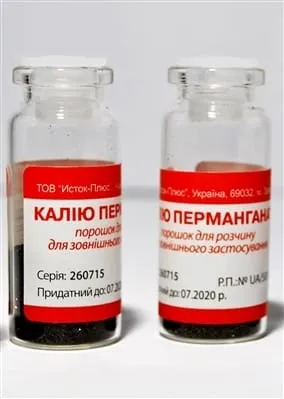
Table of Contents
INSTRUCTIONS FOR MEDICAL USE OF THE MEDICINAL PRODUCT POTASSIUM PERMANGANATE
Composition:
Active substance: potassium permanganate;
1 jar contains 3 g or 5 g of potassium permanganate.
Pharmaceutical form. Powder.
Main physicochemical properties: granular powder of dark violet or brownish-black color, or crystals of dark violet or almost black color, usually with a metallic luster.
Pharmacotherapeutic group. Antiseptics and disinfectants. ATC code D08A X06. Antidotes. ATC code V03A B18.
Pharmacological properties.
Pharmacodynamics.
Potassium permanganate is a strong oxidizing agent. In the presence of organic substances that are easily oxidized (tissue components, purulent excretions), it readily releases oxygen and is converted into manganese dioxide, which, depending on the solution concentration, exhibits astringent, irritant, and caustic effects. The released oxygen provides antimicrobial and deodorizing action. Used as an antidote in poisoning with phosphorus, opioids.
Pharmacokinetics.
Not studied.
Clinical characteristics.
Indications.
Infected wounds, burns, skin ulcers, dermatomycoses, vaginitis, urethritis, cystitis, balanoposthitis, pharyngitis, laryngitis, tonsillitis.
Poisoning with opioids, alkaloids, phosphorus, nicotine, hydrocyanic acid, quinine; for gastric lavage; in case of aniline exposure to the skin; for cauterizing insect and snake bite sites.
Contraindications.
Hypersensitivity to potassium permanganate.
Special precautions.
Skin irritation may occur when used in high concentrations. Oxidation of cyanides in the presence of potassium permanganate occurs only in an alkaline environment.
Interaction with other medicinal products and other forms of interaction.
Explosion may occur when the drug interacts with certain organic substances (tannin, sugar, charcoal, alcohol, glycerol, organic acids) or easily oxidizable substances (sulfur, sodium thiosulfate, sodium nitrate, reduced iron).
When interacting with bromides, iodides, and chlorides, free halogens are released.
Usage features.
Use during pregnancy or breastfeeding.
There are no data on use during pregnancy or breastfeeding; therefore, the drug should be prescribed only when the expected benefit to the mother outweighs the potential risk to the fetus or infant.
Ability to affect reaction rate while driving or operating machinery.
Does not affect.
Method of Administration and Dosage
Potassium permanganate is used externally in the form of aqueous solutions for rinsing and irrigation. It may also be administered into the stomach for gastric lavage.
For rinsing and irrigation in surgical, gynecological, urological, otolaryngological, and dental practice, use 0.01–0.02–0.1% solutions; for wound irrigation, use 0.1–0.5% solutions; for application (moistening) of ulcerative and burned surfaces, use 2–5% solutions.
In cases of poisoning – for gastric lavage, use a 0.01–0.1% solution.
Children
The efficacy and safety of the drug in children have not been established; therefore, its use is possible only under medical supervision or upon a physician's prescription.
Overdose
When ingested, potassium permanganate causes severe pain in the oral cavity and along the esophagus, vomiting, and diarrhea. The mucous membranes of the mouth and pharynx become swollen and appear dark brown or purple. Laryngeal edema, mechanical asphyxia, burn shock, motor agitation, and seizures may develop. Severe pneumonia, hemorrhagic colitis, nephropathy, hepatopathy, and parkinsonism may occur. In cases of reduced gastric acidity, methemoglobinemia may develop, manifesting as pronounced cyanosis and dyspnea. The lethal dose is approximately 3 g for children and 0.3–0.5 g/kg for adults.
As an antidote, administer methylene blue (50 ml of a 1% solution for adults), ascorbic acid (30 ml of a 5% solution intravenously for adults), vitamin B12 up to 1000 mcg, and vitamin B6 (3 ml of a 5% solution intramuscularly for adults). Orally administer milk with egg white, followed by induction of vomiting.
Hemodialysis and exchange transfusion are indicated.
Side effects.
Potassium permanganate in high-concentration solutions may cause tissue irritation; in case of increased tissue sensitivity, it may cause burns. If ingested by individuals with reduced gastric acidity, it may produce hematotoxic effects (methemoglobinemia).
Shelf life. 5 years.
Storage conditions.
Store in the original packaging at a temperature not exceeding 25 °C. Keep out of reach of children.
Packaging. 3 g or 5 g in jars.
Supply category. Over-the-counter.
Manufacturer. JSC Pharmaceutical Factory "Viola".
Manufacturer's location and address of business activity.
75 Amosova Akademika Street, Zaporizhzhia, Ukraine, 69063.
Marketing Authorization Holder. JSC Pharmaceutical Factory "Viola".
Address of the Marketing Authorization Holder.
75 Amosova Akademika Street, Zaporizhzhia, Ukraine, 69063.