Potassium orotate
Ukraine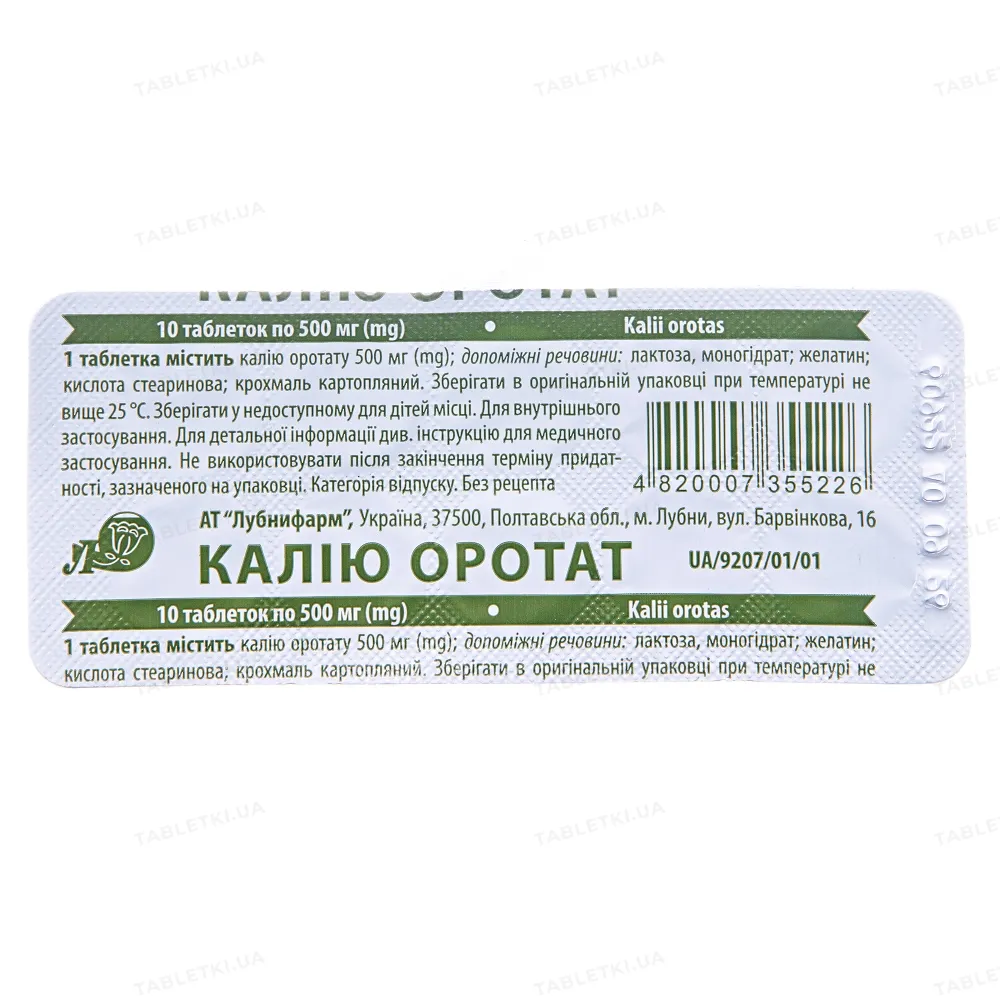
Table of Contents
INSTRUCTION FOR MEDICAL USE OF THE MEDICINAL PRODUCT POTASSIUM OROTATE
Composition:
Active substance: potassium orotate;
1 tablet contains potassium orotate 500 mg;
Excipients: lactose monohydrate; gelatin; stearic acid; potato starch.
Pharmaceutical form. Tablets.
Main physico-chemical properties: intact, regular, round cylinders with flat upper and lower surfaces, beveled edges, a dividing score line, white in color.
Pharmacotherapeutic group.
Anabolic agents for systemic use. Non-steroidal anabolic agents. ATC code A14B.
Pharmacological Properties
Pharmacodynamics
Potassium orotate has a general stimulating effect on metabolic processes and participates in protein and carbohydrate metabolism. The main structural component of potassium orotate is orotic acid.
Orotic acid ensures the synthesis of pyrimidine bases (uracil, thiamine, cytosine) during the synthesis of nucleic acids, which are involved in the synthesis of protein molecules. By participating in carbohydrate metabolism, orotic acid normalizes galactose metabolism.
Potassium orotate, as an anabolic agent, is used to restore impaired protein metabolism and to stimulate metabolic processes.
Pharmacokinetics
Not studied.
Clinical characteristics.
Indications.
Complex therapy of liver and biliary tract diseases caused by acute and chronic intoxications (except liver cirrhosis with ascites), myocardial dystrophy, myocardial infarction, chronic heart failure stage II-III, arrhythmias (extrasystoles), alimentary and alimentary-infectious hypotrophy in children, progressive muscular dystrophy, anemia, galactosemia, and dermatoses.
Also used under conditions of increased physical exertion and during the recovery period after severe illnesses.
Contraindications.
Hypersensitivity to the active substance and other components of the drug. Liver cirrhosis with ascites, acute and severe chronic renal insufficiency, lymphogranulomatosis, malignant diseases of the hematopoietic organs, hyperkalemia.
Interaction with other medicinal products and other types of interactions.
The efficacy of potassium orotate is enhanced when used concomitantly with folic acid and cyanocobalamin.
Potassium orotate improves tolerance of cardiac glycosides (e.g., digoxin, celanide).
When used concomitantly with potassium-sparing diuretics and angiotensin-converting enzyme (ACE) inhibitors, hyperkalemia may develop.
The drug may be used simultaneously with vitamins and cardiotonic agents.
Astringent and coating agents (e.g., De-Nol, sucralfate, algeldrate, magnesium hydroxide, bismuth preparations) may slightly reduce gastrointestinal absorption of potassium orotate.
The efficacy of orotic acid is reduced when used concomitantly with glucocorticosteroids, insulin, muscle relaxants, and oral contraceptives.
Special precautions for use.
Potassium orotate cannot be used for potassium replacement therapy.
Potassium orotate should not be taken during meals due to the possibility of interaction with food components.
The preparation contains lactose and therefore should not be used in patients with rare hereditary conditions such as galactose intolerance, lactase deficiency, or glucose-galactose malabsorption syndrome.
If you have been diagnosed with intolerance to certain sugars, consult your doctor before taking this medicinal product.
Use during pregnancy or breastfeeding.
The use of this drug during pregnancy is possible only if the expected benefit to the mother outweighs the potential risk to the fetus.
If it is necessary to use the drug, breastfeeding should be discontinued.
Ability to influence reaction rate while driving or operating machinery.
No influence.
Dosage and Administration
Potassium orotate is taken orally, 1 hour before meals or 4 hours after meals. Tablets should be swallowed whole, without chewing, with 150–200 ml of water.
For adults, the recommended dose is 250–500 mg 2–3 times daily. The daily dose ranges from 0.5 g to 1.5 g. In individual cases, if a stronger therapeutic effect is required, the daily dose for adults may be increased up to 3 g.
The treatment course lasts 3–5 weeks; if necessary, the course may be repeated after a one-month interval.
For children aged 5 years and older, potassium orotate is prescribed at a daily dose of 10–20 mg/kg body weight. This daily dose is divided into 2–3 administrations.
Children.
Not recommended for children under 5 years of age.
Overdose.
With prolonged use, allergic dermatoses may occur, requiring desensitizing therapy; hyperkalemia, which requires discontinuation of the drug.
When used in high doses along with a low-protein diet, hepatic dystrophy may develop, requiring discontinuation of the drug and appropriate therapy.
An increase in adverse effects is possible.
Side effects.
The drug is usually well tolerated. In individual cases, allergic reactions (including dermatitis, skin rashes) and dyspeptic reactions (including nausea, vomiting, diarrhea) may occur, which quickly resolve after discontinuation of the drug.
When used in high doses along with a low-protein diet, hepatic fatty dystrophy may develop.
Hyperkalemia may occur, manifested by paresthesias and changes in ECG readings.
Shelf life. 4 years.
Storage conditions.
Store in the original packaging at a temperature not exceeding 25 °C.
Keep out of reach of children.
Packaging.
10 tablets per blister pack.
Prescription status. Over-the-counter.
Manufacturer.
JSC "Lubnypharm".
Manufacturer's address and location of its business activities.
Ukraine, 37500, Poltava region, Lubny, Barvinkova St., 16.
INSTRUCTION
for medical use of medicinal product
POTASSIUM OROTATE
Composition:
Active ingredient: potassium orotate;
1 tablet contains 500 mg of potassium orotate;
Excipients: lactose monohydrate; gelatin; stearic acid; potato starch.
Pharmaceutical form. Tablets.
Main physico-chemical properties: intact, regular, round cylinders with flat upper and lower surfaces, beveled edges, a division mark, white in color.
Pharmacotherapeutic group.
Anabolic agents for systemic use. Non-steroidal anabolic agents.
ATC code: A14B.
Pharmacological properties.
Pharmacodynamics.
Potassium orotate exerts a general stimulatory effect on metabolic processes and participates in protein and carbohydrate metabolism. The main structural component of potassium orotate is orotic acid.
Orotic acid ensures the synthesis of pyrimidine bases (uracil, thiamine, cytosine) during nucleic acid synthesis, which are involved in protein molecule synthesis. By participating in carbohydrate metabolism, orotic acid normalizes galactose metabolism.
Potassium orotate, as an anabolic agent, is used to restore impaired protein metabolism and stimulate metabolic processes.
Pharmacokinetics.
Not studied.
Clinical characteristics.
Indications.
Complex therapy of liver and biliary tract diseases caused by acute and chronic intoxications (except liver cirrhosis with ascites), myocardial dystrophy, myocardial infarction, chronic heart failure stage II-III, arrhythmias (extrasystoles), alimentary and alimentary-infectious hypotrophy in children, progressive muscular dystrophy, anemia, galactosemia, and dermatoses.
Also used under conditions of increased physical exertion and during recovery period after severe illnesses.
Contraindications.
Hypersensitivity to the active substance or any of the excipients. Liver cirrhosis with ascites, acute or pronounced chronic renal failure, lymphogranulomatosis, malignant hematopoietic disorders, hyperkalemia.
Interaction with other medicinal products and other types of interactions.
The efficacy of potassium orotate is enhanced when used concomitantly with folic acid and cyanocobalamin.
Potassium orotate improves tolerance of cardiac glycosides (e.g., digoxin, celanid).
When used concomitantly with potassium-sparing diuretics and angiotensin-converting enzyme (ACE) inhibitors, hyperkalemia may develop.
The drug may be used simultaneously with vitamins and cardiotonic agents.
Astringent and coating agents (e.g., De-Nol, sucralfate, algeldrate, magnesium hydroxide, bismuth preparations) may slightly reduce the absorption of potassium orotate in the gastrointestinal tract.
The efficacy of orotic acid may be reduced when used concomitantly with glucocorticosteroids, insulin, myorelaxants, and oral contraceptives.
Special precautions.
Potassium orotate should not be used for potassium replacement therapy.
Potassium orotate should not be taken with food due to possible interaction with food components.
The product contains lactose; therefore, it is contraindicated in patients with rare hereditary conditions such as galactose intolerance, lactase deficiency, or glucose-galactose malabsorption syndrome.
If you have a known sugar intolerance, consult your doctor before taking this medicine.
Use during pregnancy or breastfeeding.
The use of the drug during pregnancy is possible only when the expected benefit to the mother outweighs the potential risk to the fetus.
If use is necessary, breastfeeding should be discontinued.
Effect on ability to drive or operate machinery.
No effect.
Method of administration and dosage.
Potassium orotate is taken orally, 1 hour before meals or 4 hours after meals. Tablets should be swallowed whole, without chewing, with 150–200 ml of water.
Adults: 250–500 mg 2–3 times daily. Daily dose: 0.5 mg – 1.5 g. In individual cases, if a higher therapeutic effect is needed, the daily dose for adults may be increased up to 3 g.
Treatment duration: 3–5 weeks; if necessary, the course may be repeated after one month.
For children aged 5 years and older: daily dose of potassium orotate is 10–20 mg/kg body weight. The daily dose should be divided into 2–3 doses.
Children.
Not recommended for children under 5 years of age.
Overdose.
With prolonged use, allergic dermatoses may occur, requiring desensitizing therapy; hyperkalemia, which requires discontinuation of the drug.
When used in high doses with a low-protein diet, liver dystrophy may develop, requiring discontinuation of the drug and appropriate therapy.
Side effects may be intensified.
Side effects.
The drug is usually well tolerated. In individual cases, allergic reactions (including dermatitis, skin rashes) and dyspeptic reactions (including nausea, vomiting, diarrhea) may occur, which quickly resolve after discontinuation of the drug.
When used in high doses with a low-protein diet, hepatic fatty dystrophy may develop.
Hyperkalemia may occur, manifested by paresthesias and changes in ECG readings.
Shelf life. 4 years.
Storage conditions.
Store in the original packaging at a temperature not exceeding 25 °C.
Keep out of reach of children.
Packaging.
10 tablets per blister pack.
Prescription status. Over-the-counter.
Manufacturer.
JSC "Lubnypharm".
Manufacturer's address and location of its business activities.
Ukraine, 37500, Poltava region, Lubny, Barvinkova St., 16.