Izofra
Ukraine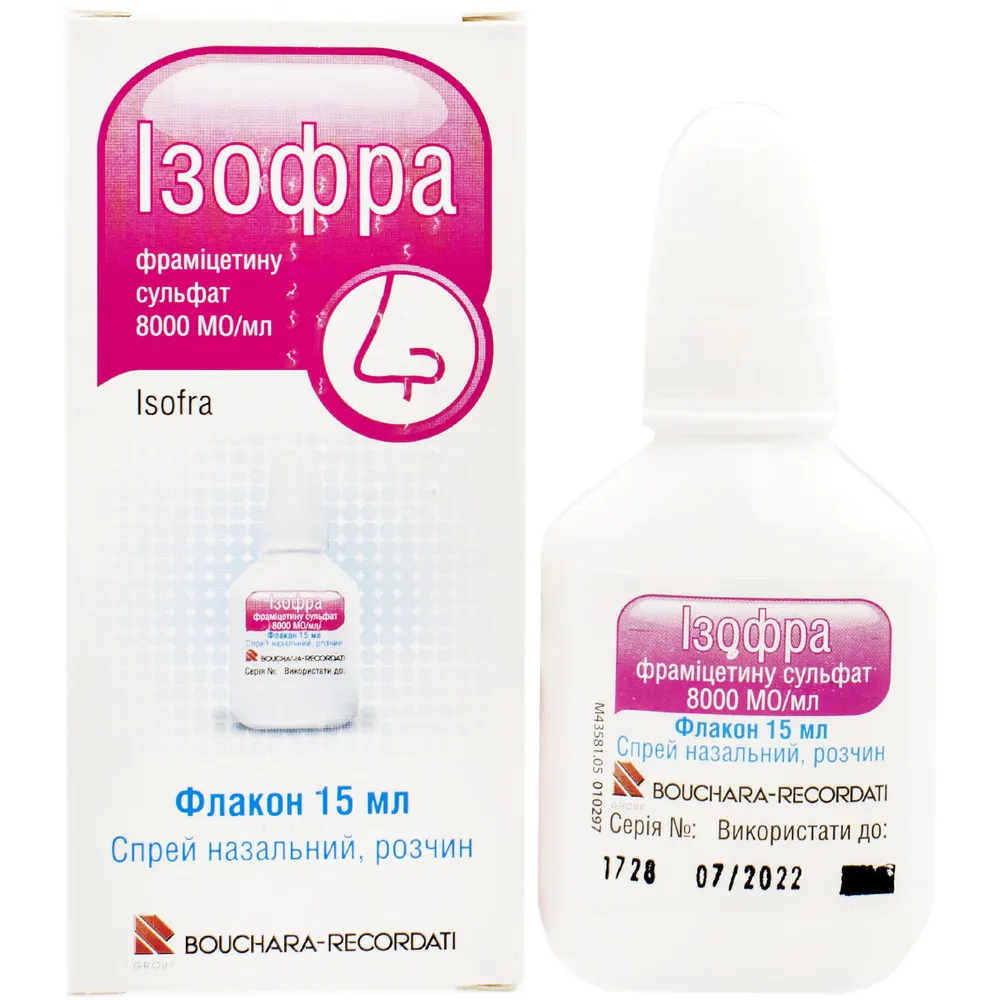
Table of Contents
- INSTRUCTIONS FOR MEDICAL USE OF THE MEDICINAL PRODUCT ISOFRA (ISOFRA)
- Composition:
- Pharmacological properties.
- Clinical characteristics.
- Special precautions for use.
- Method of Administration and Dosage
- Side effects.
- Composition:
- Pharmacological Properties
- Clinical characteristics.
- Special precautions for use.
- Method of Administration and Dosage.
- Side effects.
INSTRUCTIONS FOR MEDICAL USE OF THE MEDICINAL PRODUCT ISOFRA (ISOFRA)
Composition:
Active substance: framycetin;
1 ml of solution contains framycetin sulfate 12.5 mg (8000 IU);
Excipients: methylparaben (E 218), sodium chloride, sodium citrate, citric acid monohydrate, purified water.
Pharmaceutical form. Nasal spray, solution.
Main physicochemical properties: clear liquid.
Pharmacotherapeutic group.
Anti-inflammatory and other agents for local application in nasal cavity diseases. ATC Code R01AX08.
Pharmacological properties.
Pharmacodynamics.
Framycetin is an aminoglycoside antibiotic intended for topical use. The concentration of framycetin achieved with local application provides its bactericidal activity against gram-positive and gram-negative microorganisms causing infectious processes in the upper respiratory tract.
Framycetin is active against Corynebacterium, Listeria monocytogenes, Staphylococcus meti-S, Acinetobacter (predominantly Acinetobacter baumannii), Branhamella catarrhalis, Campylobacter, Citrobacter freundii, Citrobacter koseri, Enterobacter aerogenes, Enterobacter cloacae, Escherichia coli, Haemophilus influenzae, Klebsiella, Morganella morganii, Proteus mirabilis, Proteus vulgaris, Providencia rettgeri, Salmonella, Serratia, Shigella, Yersinia.
Pasteurella species shows moderate sensitivity to framycetin.
Bacteria resistant to framycetin include Enterococci, Nocardia asteroides, Staphylococcus meti-R* (resistance is about 30–50%, with higher prevalence in hospital settings), Streptococcus, Alcaligenes denitrificans, Burkholderia, Flavobacterium sp., Providencia stuartii, Pseudomonas aeruginosa, Stenotrophomonas maltophilia, resistant anaerobic bacteria, Chlamydia, Mycoplasma, Rickettsia.
Pharmacokinetics.
Pharmacokinetic studies of the drug have not been conducted due to its low systemic absorption.
Clinical characteristics.
Indications.
As part of combination therapy for infectious-inflammatory diseases of the upper respiratory tract, including rhinitis, rhinopharyngitis, and sinusitis in the absence of nasal sinus wall damage; prevention and treatment of inflammatory processes following surgical interventions.
Contraindications.
Hypersensitivity (allergy) to any component of the drug, including framycetin and other antibiotics of the aminoglycoside group.
Children under 1 year of age.
Interaction with other medicinal products and other forms of interaction.
Not known.
When using any other locally applied medicinal products, it is essential to inform the physician.
Special precautions for use.
The drug should not be used for irrigation of the nasal sinuses. Prolonged use of the drug may lead to the development of resistant microbial strains. If there is no therapeutic effect within 7 days of treatment, the drug should be discontinued.
Use during pregnancy or breastfeeding.
The efficacy and safety of the drug during pregnancy have not been sufficiently studied.
Potential toxic effects on the fetal cochleovestibular apparatus are possible. Systemic penetration through the mucous membrane is possible; therefore, the drug should not be prescribed to patients in this category.
The use of the drug during breastfeeding is not recommended, as aminoglycosides penetrate into breast milk.
Ability to affect reaction rate while driving or operating machinery.
No cases of influence on reaction speed during driving or operating machinery have been reported.
Method of Administration and Dosage
For adults: administer 1 spray into each nostril 4–6 times daily.
For children aged 1 year and older: administer 1 spray into each nostril 3 times daily. To perform spraying, press the container. During administration, hold the container vertically and slightly tilt the head forward to ensure the solution is sprayed into the nasal passage as a mist, not as a stream of liquid.
The duration of treatment is up to 10 days.
Children
Use only as directed by a physician for treatment of children aged 1 year and older.
Overdose
No cases of overdose have been reported.
Side effects.
Spontaneous reports of the following adverse reactions with the specified frequency in patients treated with framycetin during the post-marketing period and in scientific literature (very common (≥ 1/10); common (≥ 1/100, < 1/10); uncommon (≥ 1/1000, < 1/100); rare (≥ 1/10000, < 1/1000); very rare (< 1/10000)).
Rare: allergic skin reactions (urticaria, pruritus).
Shelf life. 3 years.
Storage conditions.
Keep out of reach and sight of children. Store at a temperature not exceeding 25 °C.
Packaging.
15 ml in a bottle with a spray pump, in a cardboard box.
Prescription status. Prescription only.
Manufacturer.
RECORDATI ILLICHE SANAYI VE TIC. A.S., Turkey.
Manufacturer's address.
Cerkezkoy Organize Sanayi Bolgesi, Karaagac Mah. Ataturk Cad. No 36, Kapakli-Tekirdag, Turkey.
Marketing authorization holder.
Laboratoires Bouchard Recordati, France.
INSTRUCTION
for medical use of the medicinal product
ISOFRA
(ISOFRA)
Composition:
Active ingredient: framycetin;
1 ml of solution contains framycetin sulfate 12.5 mg (8000 IU);
Excipients: methylparaben (E 218), sodium chloride, sodium citrate, citric acid monohydrate, purified water.
Pharmaceutical form. Nasal spray, solution.
Main physicochemical properties: clear liquid.
Pharmacotherapeutic group.
Anti-inflammatory and other locally acting drugs for nasal cavity diseases. ATC Code R01A X08.
Pharmacological Properties
Pharmacodynamics
Framycetin is an antibiotic from the aminoglycoside group intended for topical use. The concentration of framycetin achieved with local application provides its bactericidal activity against both gram-positive and gram-negative microorganisms responsible for infectious processes in the upper respiratory tract.
Framycetin is active against Corynebacterium, Listeria monocytogenes, Staphylococcus meti-S, Acinetobacter (predominantly Acinetobacter baumannii), Branhamella catarrhalis, Campylobacter, Citrobacter freundii, Citrobacter koseri, Enterobacter aerogenes, Enterobacter cloacae, Escherichia coli, Haemophilus influenzae, Klebsiella, Morganella morganii, Proteus mirabilis, Proteus vulgaris, Providencia rettgeri, Salmonella, Serratia, Shigella, Yersinia.
Pasteurella species shows moderate sensitivity to framycetin.
Bacteria resistant to framycetin include Enterococci, Nocardia asteroides, Staphylococcus meti-R * (resistance is about 30–50%, with higher prevalence in hospital settings), Streptococcus, Alcaligenes denitrificans, Burkholderia, Flavobacterium sp., Providencia stuartii, Pseudomonas aeruginosa, Stenotrophomonas maltophilia, resistant anaerobic bacteria, Chlamydia, Mycoplasma, Rickettsia.
Pharmacokinetics
Pharmacokinetic studies of the drug have not been conducted due to its low systemic absorption.
Clinical characteristics.
Indications.
In combination therapy for infectious-inflammatory diseases of the upper respiratory tract, including rhinitis, rhinopharyngitis, and sinusitis in the absence of nasal sinus wall damage; prevention and treatment of inflammatory processes after surgical interventions.
Contraindications.
Hypersensitivity (allergy) to any component of the drug, including framycetin and other antibiotics of the aminoglycoside group.
Children under 1 year of age.
Interaction with other medicinal products and other types of interactions.
Not known.
If using any other locally applied medicinal products, it is essential to inform the physician.
Special precautions for use.
The drug should not be used for irrigation of the nasal accessory sinuses. Prolonged use of the drug may lead to the development of resistant microbial strains. If there is no therapeutic effect within 7 days of treatment, the drug should be discontinued.
Use during pregnancy or breastfeeding.
The efficacy and safety of the drug during pregnancy have not been sufficiently studied.
Possible toxic effects on the fetal cochleovestibular apparatus. Systemic penetration through the mucous membrane is possible; therefore, the drug should not be prescribed to patients in this category.
Use of the drug during breastfeeding is not recommended, as aminoglycosides penetrate into breast milk.
Ability to affect reaction rate while driving or operating machinery.
No cases of influence on reaction rate while driving or operating machinery have been reported.
Method of Administration and Dosage.
For adults: administer 1 spray into each nostril 4-6 times daily.
For children aged 1 year and older: administer 1 spray into each nostril 3 times daily. To perform spraying, press the bottle. During administration, hold the bottle vertically and slightly tilt the head forward to ensure the solution is sprayed into the nasal passage as a mist, not as a liquid stream.
The duration of treatment is up to 10 days.
Children.
Use only as prescribed by a physician for treatment of children aged 1 year and older.
Overdose.
No cases of overdose have been reported.
Side effects.
Spontaneous reports of the following adverse reactions with the specified frequency in patients treated with framycetin during the post-marketing period and in scientific literature (very common (≥ 1/10); common (≥ 1/100, < 1/10); uncommon (≥ 1/1000, < 1/100); rare (≥ 1/10000, < 1/1000); very rare (< 1/10000)).
Rare: allergic skin reactions (urticaria, pruritus).
Shelf life. 3 years.
Storage conditions.
Keep out of reach and sight of children. Store at a temperature not exceeding 25 °C.
Packaging.
15 ml in a bottle with spray dispenser in a cardboard box.
Prescription status. Prescription only.
Manufacturer.
Sofartex, France.
Manufacturer's address.
21, rue du Pressoir, 28500 Vernouillet, France.
Marketing Authorisation Holder.
Laboratoires Bouchara-Recordati, France.