Ismigen
Ukraine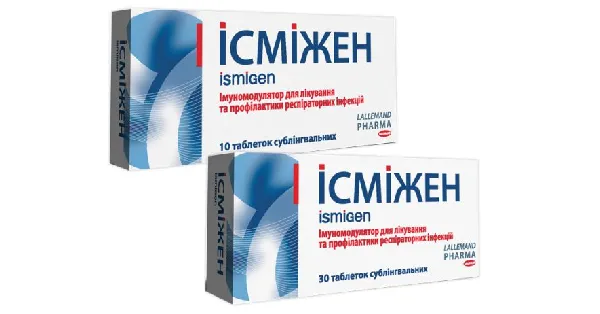
Table of Contents
INSTRUCTIONS for medical use of the medicinal product ISMIGEN
Composition:
Active ingredient: 1 tablet contains 50 mg of lyophilized bacterial lysate, consisting of 7 mg of bacterial lysate from: Staphylococcus aureus 6×10⁹ CFU, Streptococcus pyogenes 6×10⁹ CFU, Streptococcus viridans 6×10⁹ CFU, Klebsiella pneumoniae 6×10⁹ CFU, Klebsiella ozaenae 6×10⁹ CFU, Haemophilus influenzae B 6×10⁹ CFU, Neisseria catarrhalis 6×10⁹ CFU, Streptococcus pneumoniae 6×10⁹ CFU (containing 1×10⁹ CFU each of the following serotypes: TY1, TY2, TY3, TY5, TY8, TY47), and 43 mg of glycine used in the lyophilization process;
Excipients: colloidal hydrated silicon dioxide; microcrystalline cellulose; calcium hydrogen phosphate dihydrate; magnesium stearate; ammonium glycyrrhizinate; menthol powder flavor.
Pharmaceutical form. Sublingual tablets.
Main physicochemical properties: white tablets with a score line on one side, containing brown specks and a mild characteristic odor.
Pharmacotherapeutic group. Immunostimulants. ATC code L03AX.
Immunological and biological properties:
ISMIGEN is a bacterial lysate-based immunostimulant that enhances the body's resistance to infections by increasing the levels of serum and secretory antibodies, and by activating cellular and humoral factors of non-specific immunity. This reduces the frequency and severity of respiratory infections and helps prevent the need for antibiotic use.
ISMIGEN has a dual mechanism of action:
- Enhances non-specific resistance through membrane antigens present in the formulation by activating dendritic cells, neutrophils, macrophages, and NK cells; induces phagocytosis and cellular lysis by stimulating macrophage adhesion to bacteria;
- Activates specific immunity by increasing the production of IL-2, specific serum IgA, IgG, IgM, and sIgA, and by activating effector CD4 and CD8 T-lymphocytes and B-lymphocytes.
ISMIGEN is well absorbed through the oral mucosa.
Clinical characteristics.
Indications. Prevention of recurrent respiratory tract infections.
Contraindications. Hypersensitivity to the components of the drug.
Autoimmune diseases.
Acute intestinal infections.
Interaction with other medicinal products and other forms of interaction. No interactions with other medicinal products, including antibiotics and mucolytic agents, have been observed.
The response may be suppressed in patients with congenital or acquired immunodeficiency who are undergoing immunosuppressive or corticosteroid therapy.
Special precautions for use.
Use during pregnancy or breastfeeding. Although no toxic effects of Ismigen in animals have been observed, the use of Ismigen is not recommended during pregnancy or breastfeeding.
Due to its immunomodulatory action, Ismigen reduces the frequency and severity of recurrent respiratory tract infections in children who suffer frequently and for prolonged periods, as well as reduces the number of exacerbations caused by recurrent respiratory tract infections per year and the severity of their course.
If a significant increase in body temperature occurs at the beginning of treatment, administration of the drug should be discontinued.
The drug should not be used concomitantly with other immunostimulants.
In patients with a history of adverse reactions to bacterial lysates, asthma attacks may occur.
There are no clinical data demonstrating that the use of the drug can prevent pneumonia. Therefore, its use for pneumonia prevention is not recommended.
Ability to influence reaction rate when driving or operating machinery.
The drug does not affect the ability to drive or operate machinery.
Method of Administration and Dosage
For adults and children from 2 years of age.
Prophylactic treatment: the drug is administered sublingually. Take 1 tablet daily, allowing it to dissolve completely under the tongue within 1–2 minutes. Avoid eating for at least 30 minutes after administration. Treatment course: 10 consecutive days. After a 20-day break, repeat the 10-day treatment course. After another 20-day break, repeat the 10-day course once again. Prophylactic treatment may be initiated during the acute phase of respiratory tract infections, in combination with other therapeutic methods.
Ismegeen should be taken in three 10-day courses over a period of three months, with two 20-day intervals between them. For younger children, it is recommended to crush the tablet beforehand, moisten it with boiled room-temperature water, and place the resulting paste-like mixture into the oral cavity.
A total of 30 tablets should be taken over the entire course.
Children. The drug can be administered to children aged 2 years and older.
Overdose. Isolated cases of overdose have been reported, with symptoms including insomnia and abdominal pain. Treatment is symptomatic.
Adverse Reactions
Gastrointestinal disorders: vomiting, stomatitis, abdominal pain, nausea, and diarrhea.
Skin and subcutaneous tissue disorders: allergic reactions, including urticaria, pruritus, rash, and edema.
Infections and infestations: rhinitis, bacterial tonsillitis, influenza-like illness.
General disorders: fever, fatigue, and headache.
Respiratory, thoracic and mediastinal disorders: cough, throat pain.
Reporting of adverse reactions:
Reporting of adverse reactions following registration of the medicinal product is important. Healthcare professionals are requested to report any suspected adverse reactions via the national reporting system.
Shelf life: 3 years.
Storage conditions: Store in the original packaging, in a place inaccessible to children, at a temperature not exceeding +25 °C.
Packaging: 10 tablets in a blister; 1 or 3 blisters per cardboard box.
Availability category: Over-the-counter (without prescription).
Manufacturer:
Bruschettni s.r.l. / Bruschettini S.R.L.
Address: Via Isonzo, 6, 16147 Genova, Italy / Via Isonzo, 6, 16147 Genoa, Italy.
Marketing Authorization Holder:
Lallemand Pharma AG
Address: Via Selva, 2, 6900-Massagno, Switzerland / Via Selva, 2, 6900-Massagno, Switzerland.