Ionika
Ukraine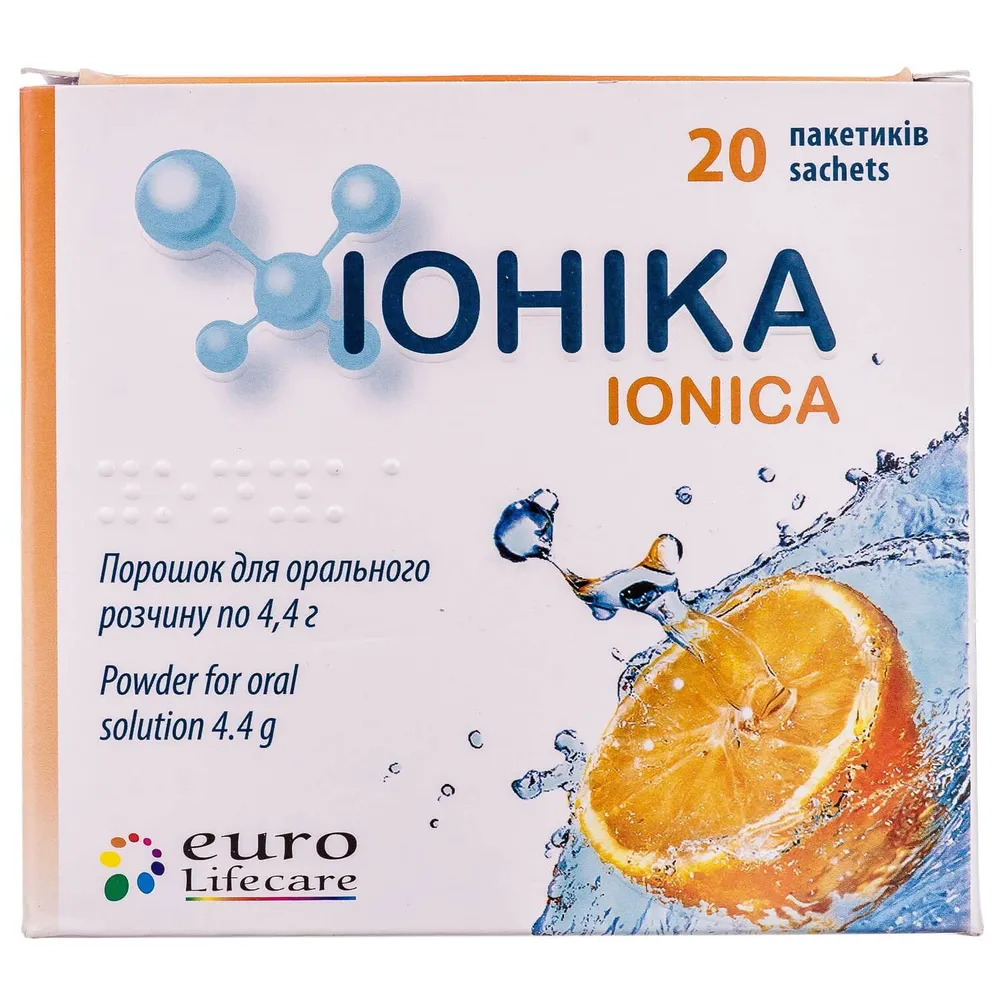
Table of Contents
INSTRUCTIONS for medical use of the medicinal product IONICA (IONICA)
Composition:
Active substances: 1 sachet contains: anhydrous glucose 2.7 g, sodium citrate 0.58 g, sodium chloride 0.52 g, potassium chloride 0.3 g;
Excipients: sucralose, anhydrous citric acid, orange flavoring.
Pharmaceutical form. Oral rehydration powder.
Main physicochemical properties: granular powder, white or almost white.
Pharmacotherapeutic group. Oral rehydration salts.
ATC code A07C A.
Pharmacological properties.
Pharmacodynamics.
The solution of the drug Ionika, according to WHO recommendations, has reduced osmolarity of 245 mOsm/L and weakly alkaline pH. The drug solution is used to correct electrolyte and fluid losses in diarrhea. Glucose facilitates salt absorption; citrates help correct the balance in metabolic acidosis.
Pharmacokinetics.
The pharmacokinetics of water, electrolytes, and glucose contained in the drug Ionika corresponds to the natural pharmacokinetics of these substances in the body.
Clinical characteristics.
Indications.
Restoration of water-electrolyte balance and correction of acidosis in acute diarrhea (including cholera), diarrhea with mild to moderate dehydration, and heat injuries accompanied by disturbances in water-electrolyte metabolism.
For prophylactic purposes: heat and physical stress leading to excessive sweating.
Contraindications.
Hypersensitivity to the active substances or to any other component of the medicinal product, severe dehydration, loss of consciousness, hemodynamic shock, intestinal obstruction, intractable vomiting, ileus.
Interaction with other medicinal products and other forms of interaction.
There is no information regarding interactions between the medicinal product Ionika and other drugs. The absorption of medicinal products may be altered during diarrhea, particularly drugs absorbed in the small or large intestine, or those undergoing enterohepatic circulation.
The pH of the solution is weakly alkaline; therefore, it may affect medicinal products whose absorption depends on the pH of intestinal contents.
Special precautions for use
The drug should be taken orally, dissolving it in water. The contents of 1 sachet of Ionika should be dissolved in 0.2 L of water. Overdosing may lead to hypernatremia in patients. Sugar must not be added to the solution. Food intake is allowed immediately after rehydration. In case of vomiting, wait 10 minutes and then administer the solution slowly, in small sips.
Severe dehydration (weight loss exceeding 9% in children, anuria) should be primarily treated with intravenous rehydration solutions. After that, Ionika may be prescribed for continuation of therapy.
Recommended doses of the drug should not be exceeded unless the patient's need for additional electrolyte supplementation is confirmed by laboratory tests.
Patients in whom dehydration developed against a background of renal impairment, diabetes, or other chronic conditions affecting acid-base, electrolyte, or carbohydrate balance require careful monitoring during treatment with Ionika and may require hospitalization.
The drug should not be used in children under 6 months of age without prior medical consultation.
In infants, acute diarrhea may cause dehydration and electrolyte disturbances, leading to rapid deterioration of the patient's condition. All cases of diarrhea and dehydration in infants must be reported to a physician as soon as possible.
Caution should be exercised when treating patients with liver disorders, as well as patients on a diet restricted in sodium or potassium, with Ionika. Diarrhea may significantly affect fluid and glucose balance in patients with diabetes, renal impairment, or certain other chronic conditions. Therefore, such patients require closer monitoring, including laboratory assessments and hospital-based rehydration therapy, while diarrhea symptoms persist.
Ionika should be used with caution in cases of renal impairment during periods of oliguria or anuria, or when parenteral rehydration therapy is being administered.
Situations during Ionika use requiring physician intervention:
- the patient experiences slowed speech, drowsiness, rapid fatigue, or inability to respond to questions;
- urine output stops;
- changes in the patient's mental status (irritability, apathy, lethargy);
- fever (temperature above 39 °C);
- blood in stool;
- persistent vomiting;
- diarrhea lasting more than 2 days;
- sudden cessation of diarrhea accompanied by severe pain;
- if home treatment is unsuccessful or impossible;
- severe abdominal pain.
When treating diarrhea caused by cholera bacteria and certain other bacterial pathogens, the amount of salt in the drug may be insufficient to replace excessive salt losses associated with the disease.
Ionika contains potassium, which must be taken into account when administering the solution to patients with impaired renal function who are on a potassium-controlled diet.
Ionika contains glucose. The drug should not be administered to patients with glucose-galactose malabsorption.
Ionika contains sodium, which must be taken into account when administering the solution to patients with impaired renal function who are on a sodium-controlled diet.
Use during pregnancy or breastfeeding
The drug is permitted for use in recommended doses during pregnancy or breastfeeding. Breastfeeding can be continued for as long as necessary, even during oral rehydration. It can also be resumed immediately after rehydration.
Effect on ability to drive or operate machinery
The drug does not affect the speed of reaction when driving or operating machinery.
Dosage and Administration
Solution preparation: dissolve the powder from one sachet in 0.2 L of boiled water cooled to room temperature. The resulting solution should be taken orally or administered via nasogastric tube under medical supervision.
Treatment of mild to moderate dehydration (replacement therapy): the dose depends on the patient's body weight and degree of dehydration and amounts to 50–100 mL of the solution per kg of body weight. To correct fluid deficit, Ionik should be administered within 4 hours.
For adults and children with mild to moderate dehydration, the drug should be administered according to the following table:
| Volume of Ionika solution for replacement therapy |
||||||
| Body weight |
< 5 kg |
5‒7.9 kg |
8‒10.9 kg |
11‒15.9 kg |
16‒29.9 kg |
> 30 kg |
| mL of solution |
200‒400 |
400‒600 |
600‒800 |
800‒1200 |
1200‒2200 |
2200‒4000 |
If diarrhea persists after replacement therapy, Ionika solution should be used as maintenance therapy.
In cases of nausea and vomiting, it is advisable to take the cooled solution in small, repeated doses. If necessary, start with a small amount of solution (e.g., using a teaspoon or syringe), gradually increasing the dose depending on tolerance. Rapid administration of the drug is safe, but there is a possibility of inducing vomiting.
Other fluids may be consumed during treatment with the drug; however, fluids high in sugar should be avoided, as high sugar concentration may exacerbate diarrhea.
Prevention of dehydration (maintenance therapy).
To prevent fluid loss and for maintenance therapy, smaller doses should be used. Treatment with Ionika should be initiated at the onset of diarrhea. Usually, the drug should be taken for no more than 3–4 days and discontinued after diarrhea resolves.
The dose of the drug depends on body weight:
- Children with body weight up to 10 kg: 50–100 mL of the drug solution after each loose stool;
- Adults and children with body weight over 10 kg: 100–200 mL of the drug solution after each loose stool.
Other fluids and food may be consumed during Ionika administration.
Children.
Ionika can be used in children. There are no age restrictions regarding when this medicinal product can be used in children.
Overdose.
Hypernatremia and hyperkalemia may occur in patients with impaired renal function.
Administration of a very large amount or a highly concentrated solution of Ionika may lead to hypernatremia. Metabolic alkalosis may occur in patients with impaired renal function. Symptoms of hypernatremia include weakness, neuromuscular irritability, drowsiness, confusion, coma, and sometimes even respiratory arrest. Metabolic alkalosis may manifest as decreased lung ventilation, neuromuscular excitability, and tetanic seizures.
In case of severe overdose with pronounced adverse effects, administration of Ionika should be discontinued immediately. Medical consultation is required. Correction of fluid and electrolyte balance should be based on laboratory test results.
Side effects
When recommended doses are used, the development of adverse reactions is unlikely.
Potential development of allergic reactions is possible.
In patients with normal kidney function, the risk of hypernatremia or hyperhydration with the use of Ionika is low. Vomiting may occur, indicating that the product is being administered too rapidly.
Results of a meta-analysis of clinical trials indicate an association between the use of rehydration solutions with reduced osmolarity (less than 270 mOsm/L) and the development of hyponatremia and hypokalemia.
Shelf life. 2 years.
Storage conditions.
Store in the original packaging at a temperature not exceeding 30 °C. Keep out of reach of children.
The prepared solution should be stored in a refrigerator at 2–8 °C for up to 24 hours.
Packaging. 4.4 g of powder in a sachet; 5 or 20 sachets in a cardboard box.
Availability. Over-the-counter (without prescription).
Manufacturer.
FDS Limited.
Manufacturer's address and place of business.
Plot No. B-8, MIDC, Industrial Area, Waluj, 431 136, Dist. Aurangabad, India.