Inosine pranobex 1000
Ukraine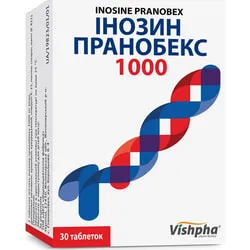
Table of Contents
- INSTRUCTIONS FOR MEDICAL USE OF THE MEDICINAL PRODUCT INOSINE PRANOBEX 1000 (INOSINE PRANOBEX 1000)
- Reporting of adverse reactions following registration of the medicinal product is of significant importance. It enables continuous monitoring of the benefit-risk balance of the medicinal product. Medical and pharmaceutical professionals, as well as patients or their legal representatives, are advised to report all suspected adverse reactions and lack of efficacy of the medicinal product via the Automated Information System for Pharmacovigilance at the following link: https://aisf.dec.gov.ua.
INSTRUCTIONS FOR MEDICAL USE OF THE MEDICINAL PRODUCT INOSINE PRANOBEX 1000 (INOSINE PRANOBEX 1000)
Composition:
Active substance: inosine pranobex;
1 tablet contains inosine pranobex 1000 mg;
Excipients: maize starch, povidone K-25, magnesium stearate, mannitol (E 421).
Pharmaceutical form. Tablets.
Main physicochemical properties:
Oval elongated tablets with a biconvex surface, with notches on both sides, from almost white to yellowish-white in color, with a slight specific odor.
Pharmacotherapeutic group.
Antimicrobial agents for systemic use.
Antiviral agents for systemic use.
Direct-acting antiviral agents.
ATC code: J05AX05.
Pharmacological properties.
Pharmacodynamics.
INOSINE PRANOBEX 1000 is an antiviral agent with immunomodulatory properties. The drug eliminates deficiency or dysfunction of cellular immunity by inducing maturation and differentiation of T-lymphocytes and T1-helper cells, potentiating the induction of lymphoproliferative response in mitogen- or antigen-activated cells. Inosine pranobex modulates cytotoxicity of T-lymphocytes and natural killer cells, function of T8-suppressors and T4-helpers, and also increases the amount of immunoglobulin G and complement surface markers. The medicinal product increases synthesis of interleukin-1 (IL-1) and interleukin-2 (IL-2), regulates expression of IL-2 receptors. Inosine pranobex significantly increases secretion of endogenous gamma-interferon and reduces formation of interleukin-4 in the body. Inosine pranobex enhances the activity of neutrophilic granulocytes, chemotaxis and phagocytosis of monocytes and macrophages. Inosine pranobex inhibits viral synthesis by incorporating inosinic acid into polyribosomes of virus-infected cells and inhibits attachment of adenylic acid to viral mRNA.
Pharmacokinetics.
After oral administration of the drug at a dose of 1.5 g, maximum plasma concentration of inosine pranobex is reached within 1 hour and amounts to 600 μg/ml. Inosine pranobex is metabolized in the liver to form uric acid. The elimination half-life of 4-(acetylamino)benzoate is 50 minutes, and that of 1-(dimethylamino)-2-propanol is 3.5 hours. It is excreted by the kidneys in the form of metabolites.
Clinical characteristics.
Indications.
INOSINE PRANOBEX 1000 is indicated for treatment in cases of reduced or dysfunctional cell-mediated immunity and clinical symptoms associated with the following conditions:
- Viral respiratory infections, primary and secondary, and immunosuppressive states;
- Infections caused by herpesviruses: herpes simplex virus types 1 and 2, varicella-zoster virus; infections caused by cytomegalovirus and Epstein-Barr virus;
- Genital warts (anogenital condylomata acuminata) — external lesions (excluding perianal areas and areas inside the anal canal) — as monotherapy or as adjunctive therapy in combination with local or surgical treatment;
- Papillomavirus infections of skin and mucous membranes, vulva and vagina (subclinical) or cervix;
- Viral hepatitis;
- Severe or complicated measles;
- Subacute sclerosing panencephalitis.
Contraindications.
Hypersensitivity to the active substance or to any of the excipients of the medicinal product, acute gout, urolithiasis, severe renal insufficiency (stage III), hyperuricemia.
Interaction with other medicinal products and other forms of interaction.
The medicinal product should be used with caution when administered concomitantly with xanthine oxidase inhibitors (e.g., allopurinol) or agents promoting excretion of uric acid, including diuretics, particularly thiazide diuretics (such as hydrochlorothiazide, chlorthalidone, indapamide) or loop diuretics (e.g., furosemide, torasemide, ethacrynic acid). INOSINE PRANOBEX 1000 may be used after, but not simultaneously with immunosuppressants, due to a possible pharmacokinetic impact on desired therapeutic effects. When used concomitantly with zidovudine (azidothymidine), formation of azidothymidine nucleotide is enhanced through multiple mechanisms, including increased bioavailability of zidovudine in plasma and increased intracellular phosphorylation in human blood monocytes. This results in enhanced zidovudine activity.
Special precautions for use.
During treatment with inosine pranobex, transient increase in serum and urinary uric acid levels may occur, particularly in men and elderly individuals; however, these values usually remain within normal limits (up to 8 mg/dl or 0.420 mmol/L, respectively). The cause of increased uric acid levels is catabolic metabolism of inosine in humans. This occurs not due to a drug-induced fundamental change in enzymatic function or renal clearance function. Therefore, the medicinal product should be used with particular caution in patients with gout, hyperuricemia, history of urolithiasis, and in patients with impaired renal function. During treatment, uric acid levels should be monitored in these patients. In some individuals, acute hypersensitivity reactions (angioedema, anaphylactic shock, urticaria) may occur. In such cases, therapy with inosine pranobex should be discontinued. With prolonged use of the drug, there is a risk of kidney and gallbladder stone formation. In case of long-term treatment, serum and/or urinary uric acid levels, liver function, blood count, and renal function should be regularly monitored in all patients.
Use during pregnancy or breastfeeding.
Pregnancy.
Studies on the risk of fetal abnormalities and fertility impairment in humans have not been conducted. INOSINE PRANOBEX 1000 should not be used during pregnancy except in cases where the physician determines that potential benefit outweighs potential risk.
Breastfeeding.
It is unknown whether inosine pranobex passes into breast milk. Risk to infants cannot be excluded. Breastfeeding should be discontinued during treatment.
Fertility.
There are no data on the effect of the medicinal product on fertility in humans. Animal studies have shown no effect on fertility.
Ability to influence reaction rate when driving or operating machinery.
INOSINE PRANOBEX 1000 has no effect or negligible effect on the ability to drive or operate machinery.
Method of administration and dosage.
The medicinal product should be administered orally. The daily dose depends on body weight and severity of the disease; the dose should be evenly distributed throughout the day. For easier swallowing, the tablet may be crushed and dissolved in a small amount of liquid.
Adults and elderly patients:
Recommended dose is 50 mg/kg body weight (1 tablet per 20 kg), usually 3 g/day (3 tablets), maximum dose — 4 g/day (4 tablets); administered orally, divided evenly into 3–4 doses per day.
Children with body weight above 20 kg:
Administer INOSINE PRANOBEX 1000 at the same dose as for adults — 50 mg/kg body weight per day.
Children with body weight up to 20 kg and aged from 1 year:
Administer inosine pranobex at an appropriate dosage — 50 mg/kg body weight per day (1 tablet of 500* mg per 10 kg body weight).
Duration of treatment.
Acute conditions:
For diseases with short duration, treatment course lasts from 5 to 14 days. After reduction of disease symptoms, treatment should be continued for another 1–2 days or longer, depending on the physician's decision.
Chronic viral diseases:
Treatment should be continued for 1–2 weeks after reduction of disease symptoms or longer, depending on the physician's decision.
Recurrent conditions:
At the initial stage of treatment, the same recommendations apply as for acute conditions. During maintenance therapy, the dose may be reduced to 500*–1000 mg per day. At the first signs of recurrence, the daily dose recommended for acute conditions should be resumed and continued for 1–2 days after symptom disappearance. The treatment course may be repeated several times if necessary, according to the physician's recommendation based on clinical assessment.
Chronic diseases:
The medicinal product should be prescribed at a daily dose of 50 mg/kg body weight according to the following regimens:
- Asymptomatic conditions: take for 30 days with a 60-day break;
- Conditions with moderately expressed symptoms: take for 60 days with a 30-day break;
- Conditions with severe symptoms: take for 90 days with a 30-day break.
This treatment may be repeated if necessary; the patient's condition should be monitored as in recurrent conditions.
Dosage in special indications.
External genital warts (anogenital condylomata acuminata) or papillomavirus infection of cervical canal:
Administer 1 tablet 3 times daily (3 g) as monotherapy or as adjunct to local therapy or surgical treatment according to the following regimens:
- Low-risk patients (patients with normal immunity or low risk of recurrence): the medicinal product is administered continuously for 14–28 days within a 3-month period, followed by a 2-month treatment break; continue until lesions decrease or disappear;
- High-risk patients ** (patients with immunodeficiency or high risk of recurrence): the medicinal product is administered 5 days per week for 2 consecutive weeks each month, or 5 days per week every other week, over a 3-month period.
This treatment may be repeated several times if necessary.
Subacute sclerosing panencephalitis:
Daily dose is 100 mg/kg body weight, maximum dose — 3–4 g/day. Treatment is long-term, continuous, with regular assessment of the patient's condition and need for continued therapy.
* Use inosine pranobex at an appropriate dosage.
** High-risk factors for recurrence or cervical dysplasia in patients with genital papillomavirus infection, as in other similar conditions, include:
-
Genital papillomavirus infection lasting more than 2 years or with 3 or more recurrences in history;
-
Immunodeficiency caused by:
- Recurrent or chronic infections;
- Sexually transmitted diseases;
- Anticancer chemotherapy;
- Chronic alcoholism;
-
Poorly controlled diabetes mellitus;
-
Atopy (hereditary predisposition to hypersensitivity);
-
Long-term use of contraceptives (longer than 2 years);
-
Erythrocyte folate levels ≤ 660 nmol/L;
-
Presence of multiple sexual partners or change of steady sexual partner;
-
Frequent vaginal intercourse (≥ 2–6 times per week);
-
Anal intercourse;
-
History of childhood skin warts;
-
Age > 20 years;
-
Chronic smoking.
Children.
The medicinal product is used in children with body weight from 20 kg.
Overdose.
Cases of overdose have not been reported. Serious adverse effects, apart from increased serum uric acid levels, are unlikely based on animal toxicity studies. Treatment is symptomatic and supportive.
Adverse reactions.
The only adverse effect most commonly observed during treatment with inosine pranobex in both adults and children is increased serum and urinary uric acid levels (usually remaining within normal limits), which typically return to baseline values within a few days after treatment ends. Adverse reactions are classified by frequency as follows: very common (≥ 1/10); common (≥ 1/100, < 1/10); uncommon (≥ 1/1000, < 1/100); frequency not known (cannot be estimated from available data).
Body systems |
Frequency |
Adverse reactions |
Immune system disorders |
Frequency unknown |
Angioedema, hypersensitivity, urticaria, anaphylactic reaction. |
Psychiatric disorders |
Uncommon |
Nervousness. |
Nervous system disorders |
Common |
Headache, vertigo. |
Gastrointestinal disorders |
Common |
Vomiting, nausea, epigastric discomfort. |
Skin and subcutaneous tissue disorders |
Common |
Rash, pruritus. |
Musculoskeletal and connective tissue disorders |
Common |
Arthralgia. |
Renal and urinary disorders |
Uncommon |
Polyuria. |
General disorders |
Common |
Fatigue, discomfort. |
Laboratory investigations |
Very common |
Elevated levels of uric acid in blood and urine. |
Reporting of adverse reactions following registration of the medicinal product is of significant importance. It enables continuous monitoring of the benefit-risk balance of the medicinal product. Medical and pharmaceutical professionals, as well as patients or their legal representatives, are advised to report all suspected adverse reactions and lack of efficacy of the medicinal product via the Automated Information System for Pharmacovigilance at the following link: https://aisf.dec.gov.ua.
Shelf life: 3 years.
Storage conditions: Store in the original packaging at a temperature not exceeding 25 °C. Keep out of reach and sight of children.
Packaging: 6 tablets per blister, 5 blisters per carton; or 10 tablets per blister, 3 or 4 blisters per carton.
Prescription status: Prescription only.
Manufacturer: LLC "DKP "Pharmaceutical Factory".
Address of the manufacturer and location of its business activities: Koroleva St., b. 4, Stanishivka village, Zhytomyr district, Zhytomyr region, 12430, Ukraine.