Inoseda
Ukraine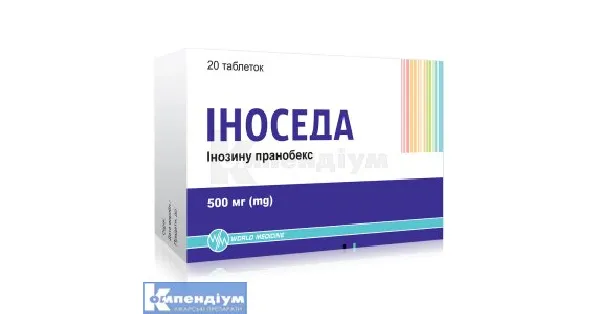
Table of Contents
INSTRUCTIONS FOR MEDICAL USE OF THE MEDICINAL PRODUCT INOSEDA (INOSEDA)
Composition:
Active substance: inosine pranobex;
1 tablet contains inosine pranobex 500 mg;
Excipients: maize starch, povidone K90, microcrystalline cellulose, stearic acid, magnesium stearate.
Pharmaceutical form. Tablets.
Main physicochemical properties: white, round, biconvex tablets with "INO" engraved on one side.
Pharmacological Properties
Pharmacodynamics
Inosine pranobex is a synthetic purine derivative (a molecular complex of inosine and the salt of 4-acetamidobenzoic acid with N,N-dimethylamino-2-propanol in a molar ratio of 1:3).
It belongs to immunomodulating and antiviral agents and has the ability to suppress replication of many strains of both RNA- and DNA-viruses (direct antiviral action). The indirect antiviral effect is associated with enhancement of cell-mediated immunity.
Pharmacokinetics
After oral administration, inosine pranobex is rapidly and well absorbed from the gastrointestinal tract. Maximum plasma concentration is reached within 3 hours. Pharmacological effect manifests approximately within 30 minutes and persists up to 6 hours.
It is well distributed in tissues.
Metabolized in the liver, mainly to uric acid, and excreted from the body via the kidneys.
Clinical Characteristics
Indications
In herpes virus infection and other viral diseases associated with confirmed immune system disorders.
Contraindications
Hypersensitivity to the active substance and/or to any of the excipients of the medicinal product, gout, urolithiasis, severe renal insufficiency of grade III, hyperuricemia.
Interaction with other medicinal products and other forms of interaction
The medicinal product should not be used concomitantly with corticosteroids, immunoglobulins, cytostatics, or anti-lymphocyte immunoglobulins (due to negative impact on the pharmacological activity of inosine).
The medicinal product should not be taken concomitantly with immunosuppressants. The medicinal product should be prescribed with caution when used together with xanthine oxidase inhibitors (e.g., allopurinol) or agents promoting uric acid excretion, including diuretics – thiazide diuretics (such as hydrochlorothiazide, chlorthalidone, indapamide) or loop diuretics (e.g., furosemide, torasemide, ethacrynic acid).
Inosine pranobex may be used after, but not simultaneously with immunosuppressants, due to a possible pharmacokinetic effect on desired therapeutic outcomes.
When used concomitantly with zidovudine (azidothymidine), increased formation of azidothymidine nucleotide occurs via multiple mechanisms, including increased bioavailability of azidothymidine in blood plasma and enhanced intracellular phosphorylation in human blood monocytes. As a result, the effect of zidovudine is potentiated.
Special precautions for use
The medicinal product should be used with caution in patients with gout, hyperuricemia, history of urolithiasis, and in patients with impaired renal function (due to possible increase in plasma and urinary uric acid levels, especially in men and elderly individuals; however, these values usually remain within normal limits (up to 8 mg/dL or 0.420 mmol/L, respectively)). The reason for increased uric acid levels is the catabolic metabolism of inosine in humans. This is not due to drug-induced fundamental changes in enzyme function or renal clearance. During treatment, regular monitoring of plasma and urinary uric acid levels in these patients is recommended.
Acute hypersensitivity reactions (angioneurotic edema, anaphylactic shock, urticaria) may occur in some individuals. In such cases, treatment with the medicinal product should be discontinued.
With prolonged use of the medicinal product, there is a risk of kidney and gallbladder stone formation.
With prolonged use of the medicinal product (3 months or longer), monthly monitoring of serum and urinary uric acid concentrations, liver function, peripheral blood count, and renal function parameters is advisable.
Elderly patients. Dose adjustment is not necessary; the medicinal product should be administered at the adult dose. Elevated levels of uric acid in serum and urine are observed more frequently in elderly individuals than in middle-aged individuals.
Use during pregnancy or breastfeeding
Pregnancy
Studies on the risk of fetal abnormalities and effects on fertility in humans have not been conducted. The medicinal product should not be used during pregnancy, except when the physician decides that the potential benefit outweighs the potential risk.
Breastfeeding period
It is unknown whether inosine pranobex is excreted in breast milk. Risk to infants cannot be excluded. Breastfeeding should be discontinued during treatment.
Fertility
There are no data on the effect of the medicinal product on human fertility. Animal studies showed no effect on fertility.
Ability to influence reaction speed when driving or operating machinery
Inosine has no effect or has a negligible effect on reaction speed when driving or operating machinery. However, patients should be aware that the medicinal product may cause dizziness or other adverse reactions affecting the nervous system.
Administration and Dosage
The medicinal product is intended for oral administration.
Adults
The medicinal product should be administered at a dose of 6–8 tablets per day, divided into 4–8 doses.
Administration of the medicinal product according to the above dosage regimen is usually sufficient for the treatment of most viral infections. The duration of treatment varies depending on the type of disease.
Administration of the medicinal product should generally be continued for 1 or 2 days after the symptoms have disappeared.
Children
This medicinal product in this pharmaceutical form is not intended for use in children. The medicinal product should be administered in syrup form to children from 1 year of age.
Overdose
Cases of overdose have not been observed. Serious adverse effects, apart from increased serum uric acid levels, are unlikely based on toxicity studies in animals. Treatment includes gastric lavage and symptomatic therapy. The median lethal dose (LD50) exceeds the therapeutic dose of inosine by more than 40 times.
Side effects
The only consistent adverse reaction during inosine treatment is a temporary increase in plasma and urinary uric acid levels, which return to initial normal values within a few days after completion of treatment.
Immune system disorders: Frequency unknown – angioneurotic edema, hypersensitivity, urticaria, anaphylactic reaction.
Psychiatric disorders: Uncommon – nervousness.
Nervous system disorders: Common – headache, vertigo; uncommon – somnolence, insomnia; frequency unknown – dizziness.
Gastrointestinal disorders: Common – vomiting, nausea, epigastric discomfort; uncommon – diarrhea, constipation; frequency unknown – abdominal pain (in the upper part of the abdomen), loss of appetite.
Skin and subcutaneous tissue disorders: Common – rash, pruritus; frequency unknown – erythema.
Musculoskeletal and connective tissue disorders: Common – arthralgia.
Renal and urinary disorders: Uncommon – polyuria.
General disorders and administration site conditions: Common – fatigue, malaise; frequency unknown – malaise, sleep disorders.
Investigations: Very common – increased levels of uric acid in blood and urine;
Common – increased levels of urea, transaminases, alkaline phosphatase, or blood urea nitrogen.
Reporting suspected adverse reactions
Reporting of suspected adverse reactions after marketing authorization is important. It allows continued monitoring of the benefit-risk balance of the medicinal product. Healthcare professionals and pharmacists, as well as patients or their legal representatives, should report all suspected adverse reactions and lack of efficacy via the Automated Pharmacovigilance Information System at: https://aisf.dec.gov.ua.
Shelf life
3 years.
Storage conditions
Store at a temperature not exceeding 25 °C, in a place inaccessible to children.
Packaging
10 tablets in a blister; 2 or 5 blisters per cardboard box.
Prescription status
Prescription only.
Manufacturer
UORLД MEDICIN ILAC SAN. VE TIC. A.S. /
WORLD MEDICINE ILAC SAN. VE TIC. A.S.
Manufacturer's address and location of its business activity
15 Temmuz Mahallesi Cami Yolu Caddesi No:50 Gunesli Bagcilar/ Istanbul, Turkey /
15 Temmuz Mahallesi Cami Yolu Caddesi No:50 Gunesli Bagcilar/Istanbul, Turkey.