Infugan
Ukraine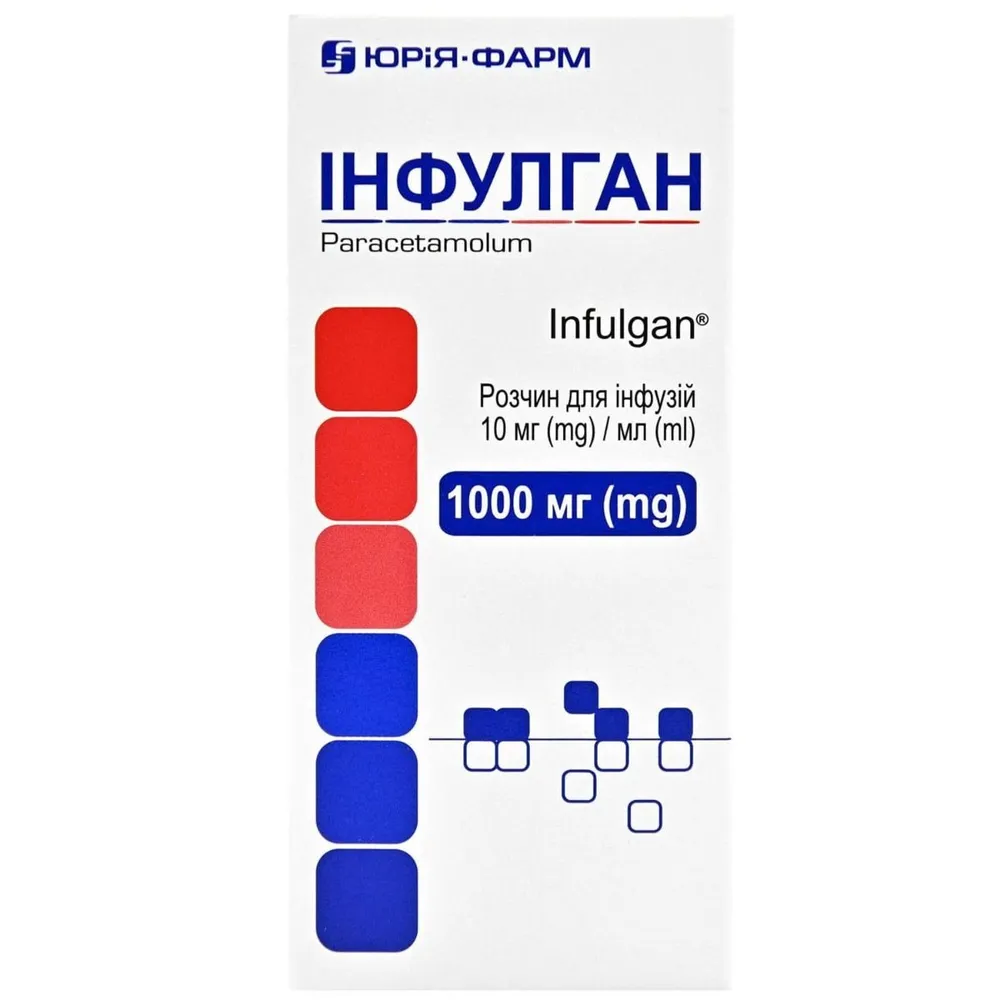
Table of Contents
INSTRUCTIONS FOR MEDICAL USE OF THE MEDICINAL PRODUCT INFULGAN® (INFULGAN)
Composition:
Active substance: paracetamol;
1 ml of solution contains 10 mg of paracetamol;
Excipients: sodium metabisulfite (E 223); sodium citrate, citric acid monohydrate; mannitol (E 421); propylene glycol; water for injections.
Pharmaceutical form. Infusion solution.
Main physicochemical properties: clear, colorless or slightly yellowish solution.
Pharmacotherapeutic group. Analgesics and antipyretics. ATC code N02BE01.
Pharmacological Properties.
Pharmacodynamics.
The exact mechanism of the analgesic and antipyretic effects of paracetamol is not fully established; it may have both central and peripheral actions.
Infugan provides pain relief within 5–10 minutes after administration. The peak analgesic effect is achieved within 1 hour, and the duration of this effect usually lasts 4–6 hours.
Infugan reduces body temperature within 30 minutes after administration, and the antipyretic effect persists for at least 6 hours.
Pharmacokinetics.
Adults
Absorption
After single doses of up to 2 g of the drug and repeated dosing within 24 hours, the pharmacokinetics of paracetamol are linear.
The bioavailability after intravenous infusion of 500 mg and 1 g of paracetamol is equivalent to that after administration of 1 g and 2 g of propacetamol (containing 500 mg and 1 g of paracetamol, respectively). The maximum plasma concentration (Cmax) is reached at the end of a 15-minute infusion of 500 mg or 1 g of paracetamol, and amounts to 15 µg/mL or 30 µg/mL, respectively.
Distribution
The volume of distribution of paracetamol is approximately 1 L/kg. Paracetamol is weakly bound to plasma proteins. A significant concentration (approximately 1.5 µg/mL) was detected in cerebrospinal fluid 20 minutes after infusion of 1 g of paracetamol.
Metabolism
Paracetamol is extensively metabolized in the liver via two main pathways: conjugation with glucuronic acid and conjugation with sulfuric acid. The latter pathway becomes rapidly saturated at doses exceeding therapeutic levels. A small fraction (less than 4%) is metabolized by cytochrome P450 to form a reactive intermediate metabolite (N-acetylbenzoquinoneimine), which under normal conditions is rapidly detoxified by reduced glutathione and excreted in urine after conjugation with cysteine and mercapturic acid. However, in cases of massive overdose, the amount of this toxic metabolite increases.
Elimination
Paracetamol metabolites are primarily excreted in urine. Approximately 90% of the administered dose is eliminated within 24 hours, mainly as glucuronide conjugates (60–80%) and sulfate conjugates (20–30%). Less than 5% is excreted unchanged. The elimination half-life is 2.7 hours, and total clearance is 18 L/hour.
Children
The pharmacokinetics of paracetamol in infants and children is practically similar to that in adults, except for a shorter plasma elimination half-life (1.5–2 hours). In neonates, the elimination half-life is longer than in infants—approximately 3.5 hours. Compared to adults, children under 10 years of age have significantly reduced glucuronidation and increased sulfation.
Table 1
Pharmacokinetic parameters by age (standardized clearance, * CLstd/Foral (L•h⁻¹•70 kg⁻¹))
| Age |
Body weight (kg) |
CLstd/Foral (L·h⁻¹·70 kg⁻¹) |
| 40 weeks postconceptional age |
3.3 |
5.9 |
| 3 months postnatal age |
6 |
8.8 |
| 6 months postnatal age |
7.5 |
11.1 |
| 1 year postnatal age |
10 |
13.6 |
| 2 years postnatal age |
12 |
15.6 |
| 5 years postnatal age |
20 |
16.3 |
| 8 years postnatal age |
25 |
16.3 |
*CLstd – estimate of the patient group regarding CL (clearance).
Special patient groups
Patients with renal impairment
In severe renal impairment (creatinine clearance 10–30 mL/min), elimination of paracetamol is somewhat prolonged, and the elimination half-life ranges from 2 to 5.3 hours. The elimination rate of glucuronides and sulfates in patients with severe renal impairment is three times slower than in healthy volunteers. Therefore, in patients with severe renal impairment, the minimum interval between doses should be at least 6 hours (see section "Dosage and administration").
Elderly patients
Pharmacokinetics and metabolism of paracetamol in elderly patients are not altered. Dose adjustment is not required (see section "Dosage and administration").
Preclinical safety data
No studies using currently accepted standard methods for assessing reproductive and embryotoxic potential have been conducted.
Clinical characteristics.
Indications.
Short-term treatment of moderate-intensity pain, particularly in the postoperative period, and short-term treatment of hyperthermic reactions, when intravenous administration is clinically justified or other routes of administration are not acceptable.
Contraindications.
Hypersensitivity to paracetamol, propacetamol hydrochloride (a paracetamol precursor), or to any of the excipients. Severe hepatocellular insufficiency.
Interaction with other medicinal products and other forms of interactions.
Probenecid reduces paracetamol clearance by half by blocking its conjugation with glucuronic acid; therefore, when used concomitantly with probenecid, the dose of paracetamol should be reduced.
Salicylates may prolong the elimination half-life of paracetamol.
Caution should be exercised when co-administering the medicinal product with enzyme-inducing agents (barbiturates, isoniazid, carbamazepine, rifampicin, ethanol, and others) (see section "Overdose").
Concomitant use of paracetamol (4 g daily for at least 4 days) with oral anticoagulants may lead to minor changes in the International Normalized Ratio (INR). In such cases, INR should be monitored during treatment and for 1 week after discontinuation of Infugan.
Caution should be exercised when administering the medicinal product concomitantly with flucloxacillin, as co-administration has been associated with metabolic acidosis with a high anion gap due to pyroglutamic acidosis, particularly in patients with risk factors (see section "Special precautions for use").
Special precautions for use.
Extreme caution must be exercised when prescribing and administering Infugan to avoid dosing errors due to confusion between milligrams (mg) and milliliters (ml), which may lead to accidental overdose and fatal outcomes. Ensure that the correct dose has been prescribed and administered. Prescriptions must clearly state the total dose in milligrams and the volume of the total dose in milliliters.
Oral formulations of paracetamol are recommended as soon as oral administration becomes feasible.
To avoid the risk of overdose, ensure that other prescribed medications do not contain paracetamol or propacetamol.
The risk of hepatotoxicity increases when Infugan is administered in doses exceeding the recommended ones.
Clinical signs of liver injury (including fulminant hepatitis, hepatic failure, cholestatic hepatitis, and cytolytic hepatitis) typically first appear approximately two days after administration, reaching a peak at 4–6 days. Antidote treatment should be initiated as early as possible.
Paracetamol may cause severe skin reactions. Patients should be informed about early signs of serious skin reactions, and if a rash or any other signs of hypersensitivity occur, the drug should be discontinued immediately.
Cases of high anion gap metabolic acidosis (HAGMA) due to pyroglutamic acidosis have been reported in patients with severe conditions such as severe renal failure and sepsis, or in patients with poor nutrition or glutathione deficiency for other reasons (e.g., chronic alcoholism), who were treated with therapeutic doses of paracetamol over a prolonged period or in combination with flucloxacillin. In suspected cases of HAGMA due to pyroglutamic acidosis, immediate discontinuation of paracetamol and careful monitoring of the patient are recommended. Measurement of urinary 5-oxoproline levels may be important in identifying pyroglutamic acidosis as the underlying cause of HAGMA in patients with multiple risk factors.
If flucloxacillin treatment continues after discontinuation of paracetamol, it is advisable to monitor for signs of HAGMA, as the clinical picture of HAGMA may persist (see section "Interaction with other medicinal products and other forms of interaction").
As with all intravenous solutions in glass vials (bottles), monitoring of the administration procedure is essential, particularly towards the end of the infusion (see section "Method of administration and dosage").
Use with caution in patients with:
- Hepatocellular insufficiency, Gilbert’s disease;
- Severe renal impairment (see sections "Pharmacokinetics" and "Method of administration and dosage");
- Chronic alcoholism;
- Reduced hepatic glutathione reserves due to chronic undernutrition, anorexia, bulimia, or cachexia;
- Dehydration;
- Glucose-6-phosphate dehydrogenase deficiency (which may cause hemolytic anemia).
Content of excipients
This medicinal product contains 0.011 mmol (or 0.25 mg) of sodium per 1 ml dose.
This medicinal product contains 1.1 mmol (or 25 mg) of sodium per 100 ml dose. Caution is advised when administering to patients on a sodium-controlled diet.
This medicinal product contains sodium metabisulfite (E 223), which may cause hypersensitivity reactions and bronchospasm.
Use during pregnancy or breastfeeding.
Pregnancy
Clinical experience with intravenous administration of paracetamol is limited. A large body of data in pregnant women indicates no fetal malformations or fetotoxic/neonatal toxicity. Epidemiological studies on neurodevelopment in children exposed to paracetamol in utero have shown inconclusive results.
Paracetamol may be used during pregnancy if clinically necessary, but only after careful assessment of the benefit-risk ratio. In such cases, the recommended dosage and duration of treatment must be strictly followed.
Breastfeeding period
After oral administration, paracetamol is excreted in breast milk in small amounts. No adverse effects have been reported in infants exposed to paracetamol during breastfeeding. Therefore, the medicinal product may be used during breastfeeding.
Ability to affect reaction speed when driving or operating machinery.
No effect.
Administration and Dosage
Infugan is administered intravenously.
For adults, adolescents, and children with body weight above 33 kg, the solution in 100 ml vials is used.
For children with body weight below 33 kg, the solution in 20 ml and 50 ml vials is used.
The dosage depends on the patient's body weight.
Table 2
| Body weight of patient |
Single dose |
Volume per administration |
Maximum volume of Infuflan (10 mg/mL) per administration according to upper body weight limits for the group (mL)** |
Maximum daily dose*** |
| ≤ 10 kg* |
7.5 mg/kg |
0.75 mL/kg |
7.5 mL |
30 mg/kg |
| > 10 kg – ≤ 33 kg |
15 mg/kg |
1.5 mL/kg |
49.5 mL |
60 mg/kg, not exceeding 2 g |
| > 33 kg – ≤ 50 kg |
15 mg/kg |
1.5 mL/kg |
75 mL |
60 mg/kg, not exceeding 3 g |
| Body weight of patient |
Single dose |
Volume per administration |
Maximum volume per administration** |
Maximum daily dose*** |
| > 50 kg, in presence of risk factors for hepatotoxicity development |
1 g |
100 mL |
100 mL |
3 g |
| > 50 kg, in absence of risk factors for hepatotoxicity development |
1 g |
100 mL |
100 mL |
4 g |
- Premature newborns: safety and efficacy data in premature newborns are lacking (see section "Pharmacokinetics").
** Patients with lower body weight require smaller volumes.
The minimum interval between administrations should be 4 hours. The treatment course usually does not exceed 4 infusions within 24 hours.
The minimum interval between doses in patients with severe renal impairment should be at least 6 hours.
*** Maximum daily dose: the maximum daily dose is intended for patients who are not receiving other medicinal products containing paracetamol and should be appropriately adjusted when such products are taken.
Patients with renal impairment
For patients with renal impairment, the minimum interval between each dose of the medicinal product should be established according to Table 3:
Table 3
| Creatinine clearance (CLcr) |
Interval between administration of the medicinal product |
| CLcr ≥ 50 mL/min |
4 hours |
| CLcr 10–50 mL/min |
6 hours |
| CLcr < 10 mL/min |
8 hours |
Patients with hepatic impairment
Patients with chronic hepatic insufficiency or compensated active liver disease, hepatocellular insufficiency, chronic alcoholism, patients who are chronically undernourished (low hepatic glutathione stores), dehydrated patients, patients with Gilbert's disease, and patients with body weight less than 50 kg – the maximum daily dose should not exceed 3 g (see section "Special precautions").
Elderly patients
Elderly patients generally do not require dose adjustment.
Method of administration
Paracetamol solution is administered as a 15-minute intravenous infusion.
Patients with body weight ≤ 10 kg
- The Infugan vial should not be hung for infusion due to the small volume of medication to be administered.
- The required volume of the drug is drawn from the vial using a syringe and administered either undiluted or diluted in 0.9% sodium chloride solution or 5% glucose solution at a ratio of one part drug to nine parts diluent, infused over 15 minutes.
- A 5 mL or 10 mL syringe should be used to measure the required dose according to the child's body weight. However, this dose should not exceed 7.5 mL.
- Dosing recommendations must be strictly followed.
For all infusion solutions in glass vials (bottles), it is important to remember the need for monitoring the procedure, especially at the end of the infusion, regardless of the route of administration. Monitoring at the end of the infusion is particularly important in the case of central intravenous administration to avoid air embolism.
For 20 mL and 50 mL volumes
If necessary, the drug may be diluted in 0.9% sodium chloride solution or 5% glucose solution at a ratio of one part drug to nine parts diluent.
The diluted solution must be used within 1 hour after preparation (including infusion time).
Before administration, the medicinal product should be visually inspected for the presence of particulate matter and discoloration. For single use only. Any unused solution should be discarded.
The diluted solution should be visually inspected before administration; do not use if particulate matter or precipitate is observed.
Children
Can be used from the first days of life. Not recommended for premature newborns.
Overdose
Risk of liver damage (including fulminant hepatitis, hepatic failure, cholestatic hepatitis, cytolytic hepatitis) increases in elderly individuals, young children, patients with liver disease, chronic alcoholism, malnutrition, and in those taking enzyme-inducing drugs. In these cases, overdose may be fatal.
Symptoms appear within the first 24 hours and include nausea, vomiting, anorexia, pallor, and abdominal pain.
Overdose in adults may occur after a single dose of 7.5 g or more; in children, after a dose of 140 mg/kg body weight. This leads to hepatic cytolysis, which may result in complete and irreversible necrosis, leading to hepatic failure, metabolic acidosis, encephalopathy, potentially progressing to coma and death. Within 12–48 hours, levels of liver transaminases (alanine aminotransferase, aspartate aminotransferase), lactate dehydrogenase, and bilirubin increase, while prothrombin levels decrease.
Clinical signs of liver damage appear after two days and peak at 4–6 days.
Emergency measures
- Immediate hospitalization;
- Plasma paracetamol concentration should be determined as soon as possible after overdose, prior to initiating treatment;
- Intravenous or oral administration of the antidote N-acetylcysteine (NAC), preferably within 10 hours of overdose. NAC may still be administered later than 10 hours after overdose, but treatment duration should be extended;
- Symptomatic treatment;
- Liver function tests should be performed before starting treatment and repeated every 24 hours;
- In most cases, liver transaminase levels return to normal within one to two weeks, with complete recovery of liver function. In some cases, liver transplantation may be required.
Side effects
As with the use of other medicinal products containing paracetamol, adverse reactions occurred frequently (≥ 1/100 to < 1/10), rarely (≥ 1/10,000 to < 1/1,000), very rarely (< 1/10,000), and frequency unknown (cannot be estimated from the available data).
Table 4
| Body systems |
Frequency |
Adverse reactions |
| Blood and lymphatic system disorders |
Very rare |
Thrombocytopenia, leukopenia, neutropenia |
| Immune system disorders |
Very rare |
Anaphylactic shock*, hypersensitivity reactions* |
| Metabolism and nutrition disorders |
Frequency unknown |
Metabolic acidosis with high anion gap (HAGMA)** |
| Cardiac disorders |
Uncommon |
Arterial hypotension |
| Frequency unknown |
Tachycardia |
|
| Hepatobiliary disorders |
Uncommon |
Elevated liver transaminase levels |
| Skin and subcutaneous tissue disorders |
Very rare |
Rash*, urticaria*, severe skin reactions*** |
| General disorders and administration site conditions |
Common |
Injection site reactions (pain and burning) |
| Uncommon |
Malaise |
|
| Frequency unknown |
Erythema, redness, itching |
* Very rare cases of hypersensitivity reactions such as anaphylactic shock, urticaria, and rashes requiring discontinuation of treatment have been reported.
** During the post-marketing period, when paracetamol was used concomitantly with floxacillin; usually in the presence of risk factors.
*** Cases of serious skin reactions requiring discontinuation of treatment have been reported.
Description of selected adverse reactions
Metabolic acidosis with high anion gap
Cases of metabolic acidosis with high anion gap as a result of pyroglutamic acidosis have been observed in patients with risk factors who were treated with paracetamol (see section "Special precautions for use"). Pyroglutamic acidosis may occur due to low glutathione levels in such patients.
Reporting of adverse reactions
Reporting of adverse reactions after marketing authorization of the medicinal product is important. This enables ongoing monitoring of the benefit-risk balance of the medicinal product. Healthcare professionals are requested to report any suspected adverse reactions via the national reporting system.
Shelf life.
2 years. Do not use after the expiry date stated on the packaging.
Storage conditions.
Keep out of reach and sight of children.
Store in a light-protected place at a temperature not exceeding 25 °C. Do not freeze.
Incompatibilities.
Infugan should not be mixed with other solutions except those specified in the section "Directions for use and dosage".
Packaging.
100 ml in a glass bottle or 100 ml in a polymer bottle. 1 bottle in a cardboard box.
Prescription status.
Prescription only.
Manufacturer.
LLC "Yuria-Pharm"
Manufacturer's address and location of its business operations.
108, Kobzarska Street, Cherkasy, Cherkasy region, 18030, Ukraine. Tel. (044) 281-01-01.