Inflarax
Ukraine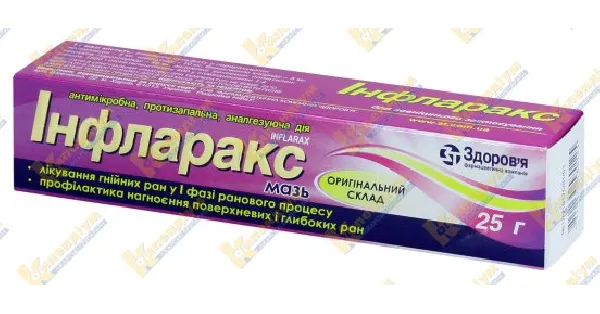
Table of Contents
INSTRUCTION FOR MEDICAL USE OF THE MEDICINAL PRODUCT INFLARAX
Composition:
active substances: amikacin, nimesulide, benzalkonium, lidocaine;
1 g of ointment contains amikacin sulfate equivalent to amikacin 5 mg, nimesulide 10 mg, benzalkonium chloride 5 mg, lidocaine hydrochloride 40 mg;
excipients: polyethylene glycol 1500 and polyethylene glycol 400 in a ratio of 1:4.
Pharmaceutical form. Ointment.
*Main physicochemical characteristics: ointment of yellowish-green color, of uniform consistency.
Pharmacotherapeutic group. Dermatologicals. Antibiotics and chemotherapeutics, combinations. ATC code D06C.
Pharmacological Properties.
Pharmacodynamics. The ointment exerts anti-inflammatory, analgesic, and antimicrobial effects.
Amikacin is a semi-synthetic antibiotic of the broad-spectrum aminoglycoside group. It has a bactericidal effect. By actively penetrating the bacterial cell membrane, it binds irreversibly to the 30S subunit of bacterial ribosomes, thereby inhibiting pathogen protein synthesis.
Highly active against aerobic gram-negative bacteria: Pseudomonas aeruginosa, Escherichia coli, Shigella spp., Salmonella spp., Klebsiella spp., Enterobacter spp., Serratia spp., Providencia stuartii.
Also active against certain gram-positive bacteria: Staphylococcus spp. (including strains resistant to penicillin, methicillin, and some cephalosporins), and some strains of Streptococcus spp.
Inactive against anaerobic bacteria.
Benzalkonium chloride has a broad antimicrobial spectrum of activity against both gram-positive and gram-negative microorganisms, including staphylococci, Pseudomonas aeruginosa, and Escherichia coli. Its mechanism of action is due to binding to ribosomes, leading to irreversible inhibition of protein synthesis, and to fixation on bacterial cytoplasmic membranes, disrupting their permeability. As a result, the cell loses potassium ions, amino acids, and nucleotides.
Nimesulide exerts anti-inflammatory (by suppressing the inflammatory phase through reduced activity of inflammatory mediators, thereby decreasing vascular wall permeability) and analgesic effects (reduction of tissue edema is accompanied by decreased pain sensations).
Lidocaine inhibits sensory nerve endings in the skin and mucous membranes, thus causing reversible suppression of conduction in neural tissue elements (neurons, axons, synapses). Lidocaine inhibits stimulus-induced transient increases in sodium ion permeability and, to a lesser extent, reduces passive permeability of potassium and sodium ions, thereby stabilizing neuronal membranes. Lidocaine reduces the degree of depolarization occurring in response to physiological stimuli, decreases the amplitude of the action potential, and suppresses nerve conduction. Lidocaine absorbed after local application may cause excitation or depression of the central nervous system (CNS). Its effects on the cardiovascular system may manifest as conduction disturbances and peripheral vasodilation.
The water-soluble ointment base—polyethylene oxide—enhances and prolongs its antibacterial and anti-inflammatory effects and produces a pronounced and sustained osmotic effect. Thus, application of the ointment leads to resolution of perifocal edema and cleansing of the wound from purulent-necrotic contents. Therapeutic activity persists for 20–24 hours.
Pharmacokinetics. Not studied.
Data on the topical use of amikacin are lacking. If absorbed following topical application, amikacin is expected to distribute uniformly into extracellular fluid (abscess contents, pleural effusion, ascitic, pericardial, synovial, lymphatic, and peritoneal fluids); it is found in high concentrations in urine, and in lower concentrations in bile, breast milk, aqueous humor of the eye, bronchial secretions, sputum, and cerebrospinal fluid. It readily penetrates all body tissues, where it accumulates intracellularly. High concentrations are found in organs with intensive blood supply: lungs, liver, myocardium, spleen, and especially in the renal cortex; lower concentrations are found in muscles, adipose tissue, and bones. In adults, when used at standard therapeutic doses (under normal conditions), amikacin does not cross the blood-brain barrier. Amikacin crosses the placental barrier and is found in fetal blood and amniotic fluid. It is not metabolized. It is excreted by the kidneys via glomerular filtration (65–94%) predominantly in unchanged form. It is removed during hemodialysis and peritoneal dialysis.
After topical application, lidocaine penetrates tissues and exerts local anesthetic action. Lidocaine is rapidly absorbed when applied to mucous membranes and damaged skin, but poorly absorbed when applied to intact skin. The rate of absorption and the amount of active substance entering the systemic circulation depend on the dose, type, size, and condition of the surface to which the preparation is applied (skin or mucous membrane), as well as on the duration of exposure. It is metabolized in the liver. It is initially dealkylated and then hydrolyzed. Both unchanged drug and metabolites are excreted primarily by the kidneys.
Clinical Characteristics.
Indications. In surgical practice, the drug is indicated for the treatment of purulent wounds in phase I (suppurative-necrotic phase) of the wound process, for the prevention of suppuration of superficial and deep wounds, and for postoperative complications (postoperative wound infections, phlegmon, fistula, abscess). In burn care – for the prevention and treatment of infected burn wounds. In dermatology – for the treatment of purulent-inflammatory skin diseases (pyoderma).
Contraindications. Hypersensitivity to any component of the drug or to amide-type local anesthetics, psoriasis, eczema, fungal skin infections. The drug must not be used in patients who have experienced allergic reactions (such as rhinitis, urticaria, or bronchospasm) to acetylsalicylic acid or other drugs that inhibit prostaglandin synthesis.
Interaction with other medicinal products and other forms of interaction. No interactions with other drugs have been established following topical application of the drug. However, it should be noted that when used concomitantly, amikacin may mutually enhance the effect of carbenicillin, benzylpenicillin, and cephalosporins; nimesulide may enhance the effect of sulfonamides and agents that reduce blood coagulation; lidocaine may enhance the effect of procaine and bupivacaine.
The drug should be administered with caution concomitantly with anticoagulants, digoxin, phenytoin, lithium-containing drugs, diuretics, antihypertensive agents, nonsteroidal anti-inflammatory drugs (NSAIDs), cyclosporine, methotrexate, oral hypoglycemic agents, and antiarrhythmic drugs. Simultaneous topical use of multiple NSAIDs may lead to local irritation such as urticaria, skin redness, or desquamation.
Glucocorticoids and disease-modifying antirheumatic drugs (gold preparations, aminoquinolones) enhance the anti-inflammatory effect of nimesulide.
Benzalkonium chloride is chemically incompatible with soaps and other anionic surfactants, as well as with iodine-containing preparations. Non-ionic surfactants may reduce or abolish the antimicrobial activity of benzalkonium chloride.
Special precautions for use. The drug should be applied only to damaged areas of the skin. Avoid contact with intact skin, eyes, and mucous membranes.
The drug must not be used in patients with known hypersensitivity to NSAIDs. If hypersensitivity reactions occur, treatment should be discontinued.
During treatment with the drug, photosensitivity reactions may occur.
Use with caution and under physician supervision in elderly patients with impaired renal or hepatic function, congestive heart failure, blood dyscrasias, gastrointestinal bleeding, active-stage ulcers, or severe coagulation disorders.
Use during pregnancy or breastfeeding. The safety of using the drug during pregnancy or breastfeeding has not been established.
Effect on ability to drive or operate machinery. Unknown.
Method of administration and dosage. Apply a thin layer of ointment to affected areas once or twice daily, or apply ointment-soaked sterile gauze dressings to the wound. The required amount of the drug depends on the wound surface area and the degree of purulent exudation. The ointment should cover the entire affected area.
For treatment of purulent wounds and purulent-inflammatory skin diseases, apply the ointment daily.
For treatment of burns – daily or 2–3 times per week, depending on the amount of purulent discharge.
The duration of treatment is determined individually, based on therapeutic efficacy and the size of the lesion. Dressings with the ointment should be continued until complete debridement of the wound from purulent-necrotic tissue.
Children. Safety and efficacy of the drug in children have not been established.
Overdose. Due to minimal penetration of the drug through mucous membranes and skin, overdose is unlikely. However, systemic adverse effects characteristic of amikacin, nimesulide, and lidocaine (see section "Adverse Reactions") may occur when the ointment is applied to large damaged areas, in doses exceeding recommendations, or during prolonged use.
In case of overdose, discontinue the drug. Treatment is symptomatic.
Adverse reactions. Allergic and local irritant reactions (including skin rash, pruritus, desquamation, edema, burning sensation, erythema), photosensitivity reactions; rarely, in sensitive patients, anaphylactic reactions such as angioedema, vasomotor rhinitis, urticaria, or bronchospasm may occur.
When used according to instructions, the incidence of systemic effects is extremely low, as the amount of active substance reaching systemic circulation is minimal. However, with high doses, rapid absorption of lidocaine, increased sensitivity, idiosyncrasy, or reduced tolerance, adverse reactions typical of systemically administered amide-type local anesthetics may develop.
Shelf life. 2 years.
Storage conditions. Store in the original packaging at a temperature not exceeding 25 °C.
Keep out of reach of children.
Packaging. 15 g, 25 g, 50 g, or 100 g in a tube, in a carton.
Prescription status. Prescription only.
Manufacturer. LIMITED LIABILITY COMPANY "CORPORATION "ZDOROV'YA".
Manufacturer's address and place of business. 22 Shevchenka Street, Kharkiv, Kharkiv Oblast, 61013, Ukraine.