Indometacin sofarma
Ukraine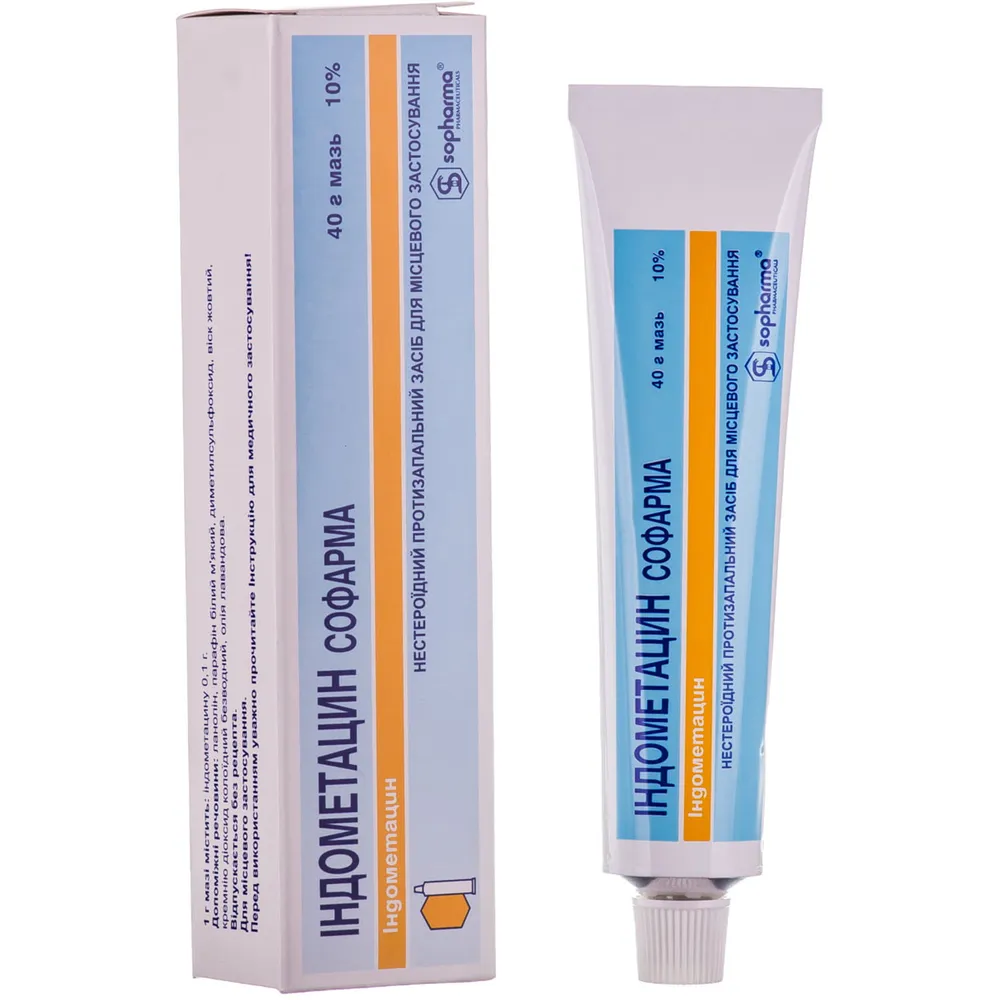
Table of Contents
INSTRUCTIONS FOR MEDICAL USE OF THE MEDICINAL PRODUCT INDOMETACIN SOPHARMA (INDOMETACIN SOPHARMA)
Composition:
Active substance: indometacin;
1 g of ointment contains 0.1 g of indometacin;
Excipients: lavender oil, lanolin, white soft paraffin, dimethyl sulfoxide, yellow wax, colloidal anhydrous silicon dioxide.
Pharmaceutical form. Ointment.
Main physicochemical properties: homogeneous yellow ointment with a characteristic odor.
Pharmacotherapeutic group.
Non-steroidal anti-inflammatory drugs for topical use. Indometacin.
ATC code M02A A23.
Pharmacological properties.
Pharmacodynamics.
Indomethacin is a derivative of indole acetic acid belonging to the group of nonsteroidal anti-inflammatory drugs. Indomethacin strongly inhibits prostaglandin synthesis by suppressing the enzyme cyclooxygenase, which plays a significant role in reducing inflammatory processes, pain, and hyperthermia. It has antipyretic properties and reversibly inhibits platelet aggregation. When applied locally, indomethacin exerts a direct anti-inflammatory and analgesic effect on inflamed tissues.
Pharmacokinetics.
The ointment is well absorbed through the skin and accumulates in subcutaneous tissues at therapeutic concentrations, including joints and synovial fluid. It is excreted by the kidneys as metabolites and in insignificant amounts unchanged, even with local application; a small amount is excreted via the biliary tract into the intestine.
Clinical characteristics.
Indications.
- An adjunctive agent in the complex treatment of acute and chronic rheumatoid arthritis, osteoarthritis, osteoarthrosis, ankylosing spondylitis, psoriatic polyarthritis, gouty arthritis;
- Localized forms of extra-articular rheumatism of the musculoskeletal system: tendinitis, synovitis, tenosynovitis, fasciitis, inflammation of joint ligaments, bursitis;
- Local symptomatic treatment of inflammation, pain, and swelling in post-traumatic injuries of the musculoskeletal system – sprains, dislocations, contusions.
Contraindications.
Hypersensitivity to the active substance or to any of the excipients of the medicinal product. Hypersensitivity to acetylsalicylic acid (aspirin) or to other nonsteroidal anti-inflammatory drugs (NSAIDs), manifested clinically by asthma attacks, urticaria, or allergic rhinitis.
Interaction with other medicinal products and other forms of interactions.
Due to minimal systemic absorption, interactions with other medicinal products are unlikely when indomethacin is applied topically.
Concomitant use of indomethacin with other NSAIDs, including selective COX-2 inhibitors, should be avoided due to increased risk of adverse reactions.
Concomitant administration of indomethacin with aspirin or corticosteroids increases the risk of gastrointestinal complications.
Nonsteroidal anti-inflammatory drugs may interact with medicinal products that lower blood pressure, although this possibility is extremely low with topical application.
Special precautions for use.
Occasionally, the use of nonsteroidal anti-inflammatory drugs (NSAIDs) may lead to gastrointestinal tract injury; worsening of cardiac function in patients with cardiovascular insufficiency; or impairment of liver and kidney function.
Although systemic absorption of indomethacin after topical application to the skin is minimal, patients with active gastric or duodenal ulcer, or with a history of kidney disease and heart failure, should use the ointment only after consultation with a physician.
Treatment with this medicinal product should be administered with special caution and only after consultation with a physician in patients with hypersensitivity to food products or drugs, or with allergic conditions such as hay fever, bronchial asthma, or nasal polyps.
Cross-sensitivity to other NSAIDs may occur; therefore, patients who have shown hypersensitivity to any drug in this group may also exhibit hypersensitivity reactions to indomethacin.
During prolonged treatment (more than 10 days), laboratory monitoring of leukocyte and platelet counts is recommended.
When used concomitantly with antibiotics, anticoagulants, or antidiabetic agents, appropriate laboratory parameters should be monitored.
The ointment should be applied only to healthy, intact skin (in the absence of open wounds or skin lesions). If skin eruptions occur after topical application, treatment should be discontinued immediately.
The ointment must not be applied to mucous membranes or eyes.
The product contains dimethyl sulfoxide, which may cause skin irritation.
The product contains lanolin, which may cause skin reactions (e.g., contact dermatitis).
Use during pregnancy or breastfeeding.
Pregnancy
Controlled clinical studies in pregnant women have not been conducted; therefore, the use of indomethacin is not recommended during pregnancy.
Breastfeeding
Indomethacin is excreted in small amounts in breast milk; therefore, its use is not recommended in women who are breastfeeding.
Ability to affect reaction rate when driving or operating machinery.
Does not affect the ability to drive or operate machinery.
Method of Administration and Dosage
Route of administration: topical, to the skin.
Apply the ointment to the affected area 3–4 times daily, gently rubbing it into the skin until completely absorbed. The amount of ointment required for a single application depends on the size of the affected area and is approximately 4–5 cm. The interval between applications should be at least 6 hours.
Topical forms of indomethacin are recommended to be used as part of a comprehensive treatment regimen, including oral tablets.
Treatment duration: 7–10 days. If no improvement in symptoms is observed within this period, the treatment should be reevaluated.
Children
Not recommended for use in children under 15 years of age.
Overdose
Overdose is unlikely with topical application due to low systemic absorption.
Overdose symptoms (mainly gastrointestinal effects, hepatotoxicity) may very rarely occur only after prolonged application over large skin areas.
Monitoring of leukocyte and platelet counts is required.
Symptoms of accidental ingestion: burning sensation of oral mucosa, salivation, nausea, vomiting.
Treatment: rinse the mouth and stomach; symptomatic treatment if necessary.
There is no specific antidote.
Symptoms of contact with eyes, mucous membranes, or open wounds: local irritation such as lacrimation, redness, burning, and pain.
Treatment: thoroughly rinse the affected area with distilled water or physiological saline until symptoms subside and disappear.
Side effects.
Side effects are related to the route of administration.
The likelihood of systemic side effects with topical application of indomethacin is low compared to the frequency of side effects associated with oral administration.
Immune system
Rarely, local swelling and vesicular rash may develop, and in individual cases – angioneurotic edema and urticaria.
Gastrointestinal tract
When applied to large skin areas, absorptive (systemic) side effects may occur, for example, gastrointestinal disturbances (loss of appetite, nausea, vomiting, diarrhea, abdominal pain, bleeding and ulcers), increased liver enzyme levels.
Skin and subcutaneous tissues
Occasionally, with topical application in susceptible patients, burning at the application site, erythema, pruritus, rash, desquamation, and dry skin may occur.
In such cases, the use of the product should be discontinued.
Shelf life. 3 years.
Shelf life after opening the tube – 6 months.
Storage conditions.
Keep out of reach of children.
Store in the original packaging at a temperature not exceeding 25 °C.
Packaging.
40 g of ointment in aluminum tubes with a membrane; 1 tube per cardboard box.
When using the tube for the first time, the seal in the aluminum membrane must be pierced!
Supply classification.
Over-the-counter.
Manufacturer.
JSC "Sofarma".
Manufacturer's name and address of manufacturing site.
Batch release authorization:
JSC "Sofarma", Iliensko Shose str., 16, Sofia, 1220, Bulgaria.