Indocollyr® 0.1 %
Ukraine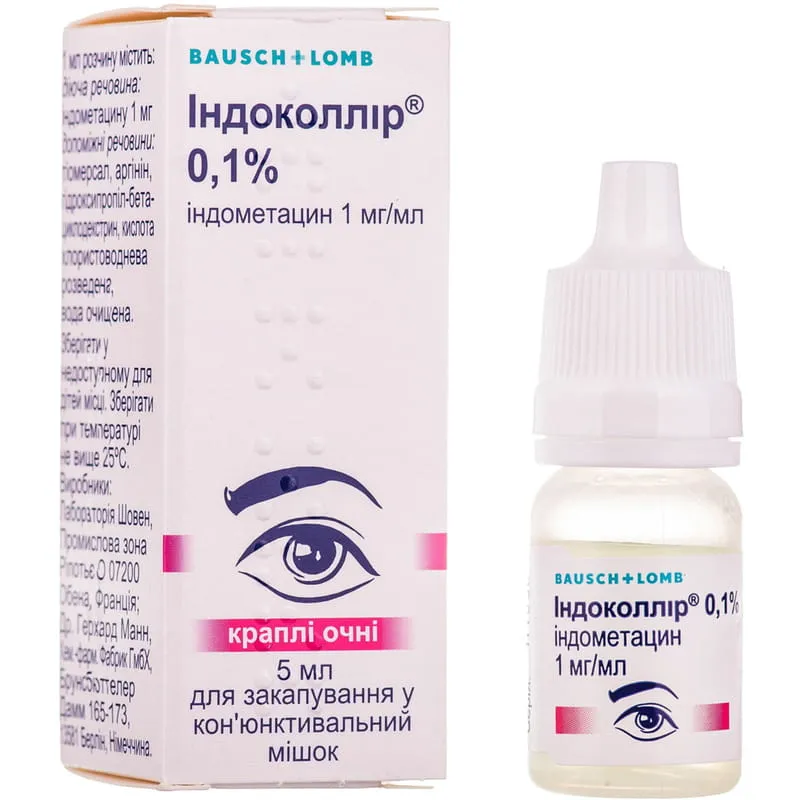
Table of Contents
INSTRUCTIONS FOR MEDICAL USE OF THE MEDICINAL PRODUCT INDOKOLLIR® 0,1% (INDOCOLLYRE® 0,1%)
Composition:
Active substance: indometacin;
1 ml of solution contains 1 mg of indometacin;
Excipients: thimerosal, arginine, hydroxypropyl-beta-cyclodextrine, hydrochloric acid diluted, purified water.
Pharmaceutical form. Eye drops.
Main physicochemical properties: clear solution.
Pharmacotherapeutic group.
Medicinal products used in ophthalmology. Non-steroidal anti-inflammatory agents.
ATC code S01BC01.
Pharmacological properties.
Pharmacodynamics. The drug belongs to the group of non-steroidal anti-inflammatory analgesic agents for topical use.
Indomethacin inhibits prostaglandin synthetase and belongs to the indole group of agents.
Pharmacokinetics. No data available.
Clinical characteristics.
Indications.
- Inhibition of miosis during surgical procedures.
- Prevention of inflammation following cataract surgery or surgery of the anterior chamber of the eye.
- Relief of ocular pain during the first few days after photorefractive keratectomy.
Contraindications.
- Third trimester of pregnancy (see section "Use during pregnancy or breastfeeding");
- Known hypersensitivity to indomethacin or drugs with similar action, e.g., other nonsteroidal anti-inflammatory drugs (NSAIDs) or aspirin;
‒ history of asthma attacks induced by aspirin or other NSAIDs;
- active peptic ulcer of the stomach or duodenum;
- severe hepatocellular dysfunction;
- severe renal insufficiency.
Interaction with other medicinal products and other forms of interaction.
To avoid mixing and interaction of active substances, the interval between instillation of different eye drops should be 15 minutes.
If necessary, indomethacin in the form of eye drops may be combined with eye drops containing corticosteroids.
Although only a negligible amount of indomethacin reaches the systemic circulation after ocular instillation, drug interactions may still occur. Therefore, interactions observed with systemic use of NSAIDs should be taken into consideration.
Combinations not recommended
Oral anticoagulants: increased risk of bleeding associated with oral anticoagulant use (due to inhibition of platelet function and gastrointestinal mucosal damage by NSAIDs).
If such combination is necessary, close clinical and laboratory monitoring is required.
Other NSAIDs (including salicylates at doses exceeding 3 g/day in adults): increased risk of gastrointestinal ulceration and bleeding (synergism).
Diclofenac: fatal gastrointestinal bleeding associated with increased plasma concentration of indomethacin (competitive interaction with glucuronide-conjugating enzymes).
Heparins: increased risk of bleeding (due to inhibition of platelet function and gastrointestinal mucosal damage by NSAIDs).
If such combination is necessary, close clinical monitoring (and laboratory monitoring of unfractionated heparins) should be performed.
Lithium: serum lithium levels may increase to toxic levels (reduced renal excretion of lithium). If such combination is necessary, careful monitoring of serum lithium levels and dose adjustments during and after discontinuation of indomethacin are required.
Methotrexate at doses of 15 mg per week or higher: hematotoxic effects of methotrexate are enhanced due to reduced renal clearance under the influence of anti-inflammatory agents.
Thienopyridines (e.g., ticlopidine): increased risk of bleeding (synergistic antiplatelet activity).
If such combination is necessary, careful monitoring of clinical and laboratory parameters, including bleeding time, is required.
Combinations requiring caution
Diuretics, angiotensin-converting enzyme (ACE) inhibitors: acute renal failure in patients with documented dehydration (due to decreased glomerular filtration caused by inhibition of vasodilatory prostaglandins by NSAIDs). In addition, attenuation of antihypertensive effect.
Adequate hydration of patients and monitoring of renal function at the beginning of treatment are necessary.
Methotrexate at doses less than 15 mg per week: hematotoxic effects of methotrexate are enhanced due to reduced renal clearance under the influence of anti-inflammatory agents. Complete blood count should be performed weekly during the first few weeks of combined therapy. Close monitoring of patients, especially elderly patients, is required even with minor changes in renal function.
Pentoxifylline: increased risk of bleeding. Enhanced monitoring of clinical parameters and more frequent assessment of bleeding time are required.
Locally acting gastrointestinal agents (salts, oxides, and hydroxides of magnesium, aluminum, and calcium): reduced gastrointestinal absorption of indomethacin. Antacids should be administered separately from indomethacin (if possible, with an interval of at least 2 hours).
Zidovudine: increased risk of erythrocyte toxicity (effect on reticulocytes), leading to severe anemia, occurring 8 days after initiation of NSAID therapy.
Complete blood count and reticulocyte count should be performed 8 and 15 days after initiation of NSAID therapy.
Combinations with warnings
Beta-blockers: reduced antihypertensive effect (NSAIDs inhibit vasodilatory prostaglandins).
Cyclosporine: increased risk of nephrotoxicity, particularly in elderly patients.
Desmopressin: potentiation of antidiuretic activity.
Intrauterine contraceptives (IUCs): possible reduction in contraceptive efficacy (association not proven).
Thrombolytics: increased risk of bleeding.
Special precautions for use.
This product contains an organic mercury compound that may cause an allergic reaction.
− If symptoms of hypersensitivity develop, treatment with the drug should be discontinued.
− If there is a risk of eye infection, appropriate treatment should be prescribed.
− NSAIDs may slow down or delay corneal healing. Topical corticosteroids are also known to delay or impair corneal healing. The use of topical NSAIDs together with topical corticosteroids increases this risk. Therefore, indomethacin eye drops should be used with particular caution and care when administered concomitantly with corticosteroids, especially in patients at increased risk of corneal adverse effects described below. Post-marketing experience with topical NSAIDs indicates that the risk of sight-threatening corneal adverse effects is increased in patients undergoing complicated ocular surgery, or in patients with corneal denervation, corneal epithelial defects, diabetes mellitus, ocular surface diseases (e.g., dry eye syndrome), rheumatoid arthritis, or in cases of repeated ophthalmic surgeries within a short period of time. Topical NSAIDs should be used cautiously in such patients. Prolonged use of topical NSAIDs may increase their negative impact on the cornea.
− In patients sensitive to nonsteroidal anti-inflammatory analgesics, the use of topical NSAIDs may cause keratitis. Prolonged use of topical NSAIDs in such patients may lead to corneal epithelial defects, corneal thinning, corneal erosion, corneal ulceration, or corneal perforation. These events may be sight-threatening. Patients who develop a corneal epithelial defect should immediately discontinue use of indomethacin eye drops and undergo close monitoring of corneal status.
− NSAIDs may increase bleeding in ocular tissues during surgery, particularly in patients with a tendency to bleed or in patients receiving other medications that may prolong bleeding.
− Wearing contact lenses is not recommended during treatment with this medication.
− If other eye drops are used concurrently with Indocollir**®**, an interval of at least 15 minutes should be maintained between instillations.
− When instilling the medication, avoid touching the eye with the dropper tip.
Use during pregnancy or breastfeeding.
Pregnancy
There have been no reports on the teratogenic effects of the drug in humans. However, additional epidemiological studies are needed to confirm the absence of any risk.
During the third trimester of pregnancy, the use of prostaglandin synthesis inhibitors may result in the following effects on the fetus:
− toxic effects on the cardiovascular and pulmonary systems (pulmonary hypertension due to premature closure of the ductus arteriosus);
− impaired renal function, which may lead to renal failure associated with oligohydramnios.
At the end of pregnancy, prolonged bleeding time may occur in both mother and child.
Therefore, indomethacin may be used during the first 5 months of pregnancy only if the expected benefit to the mother outweighs the potential risk to the fetus.
From the 6th month of pregnancy onwards, the use of indomethacin is contraindicated.
Breastfeeding period
NSAIDs are known to pass into breast milk; therefore, their use in breastfeeding women should be avoided.
Ability to affect reaction speed when driving or operating machinery.
Patients who experience blurred vision immediately after instillation should temporarily refrain from driving or operating machinery.
Method of Administration and Dosage
The medicinal product is intended for topical ophthalmic use in adults. The dosage, frequency, and duration of administration are determined individually by a physician.
Inhibition of miosis during surgery:
administer 1 drop 4 times daily the day before surgery and 1 drop 4 times 3 hours before surgery.
Prevention of inflammation after cataract surgery or surgery on the anterior chamber of the eye:
1 drop 4–6 times daily until complete resolution of disease symptoms, starting instillation 24 hours before surgery.
Relief of ocular pain after photorefractive keratectomy:
1 drop 4 times daily for the first few days after surgery.
Instructions for Use
To instill the solution, gently pull down the lower eyelid and administer 1 drop into the conjunctival sac while the patient looks upward.
Children
Specific studies in pediatric populations have not been conducted; therefore, the drug is not recommended for use in pediatric practice.
Overdose
In case of overdose, side effects may be intensified.
In the event of local overdose, rinse the eyes with sterile 0.9% sodium chloride solution.
Adverse reactions.
Adverse reactions observed either during clinical trials or during post-marketing use are listed below according to frequency: very common (≥ 1/10), common (≥ 1/100 to < 1/10), uncommon (≥ 1/1000 to < 1/100), rare (≥ 1/10,000 to < 1/1000), very rare (< 1/10,000), not known (cannot be estimated from the available data).
| System organ classes |
Frequency |
Adverse reaction |
| Eye disorders |
uncommon |
sensation of pain, burning |
| rare |
photophobia, punctate keratitis |
|
| unknown |
epiphora, visual disturbance, keratitis*, conjunctival hyperemia, ocular hyperemia, corneal edema, eyelid edema, corneal perforation*, ulcerative keratitis* |
|
| Immune system disorders |
rare |
hypersensitivity reactions accompanied by itching and redness |
* Adverse reactions such as keratitis or corneal ulceration, which may progress to corneal perforation, have been reported. In particular, such risk exists in patients who have received treatment with topical corticosteroids for ophthalmic use and in patients with weakened cornea.
Shelf life. 18 months.
After first opening, the contents of the bottle should be used within 15 days.
Storage conditions.
Store at a temperature not exceeding 25 °C. Keep out of reach of children.
Packaging.
5 ml dropper bottle in a cardboard box.
Prescription status. Prescription only.
Manufacturers.
Laboratoires Chauvin.
Dr. Gerhard Mann Chem.-pharm. Fabrik GmbH.
Manufacturers' addresses.
Zone Industrielle Ripotier O 07200 Aubenas, France.
Brunsbütteler Damm 165/173, 13581 Berlin, Germany.