Indap®
Ukraine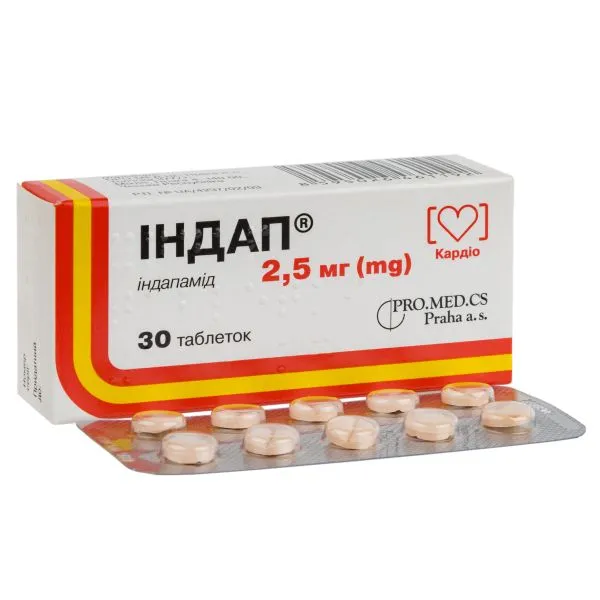
Table of Contents
INSTRUCTIONS FOR MEDICAL USE OF THE MEDICINAL PRODUCT INDAP® (INDAP®)
Composition:
Active substance: indapamide;
1 tablet contains 1.25 mg or 2.5 mg of indapamide;
Excipients:
INDAP®, 1.25 mg tablets: lactose monohydrate, microcrystalline cellulose, talc, magnesium stearate, colloidal anhydrous silicon dioxide, iron oxide red (E 172);
INDAP®, 2.5 mg tablets: lactose monohydrate, microcrystalline cellulose, talc, magnesium stearate, colloidal anhydrous silicon dioxide, TopMill ORANGE 231.05.C (iron oxide yellow (E 172), iron oxide red (E 172), lactose monohydrate).
Pharmaceutical form. Tablets.
Main physicochemical properties: 1.25 mg tablets: pink, round, flat tablets, 7 mm in diameter; slight marbling may be present;
2.5 mg tablets: light-orange, round tablets, 8 mm in diameter, with a cross-shaped groove; slight marbling may be present (the tablet can be divided into 2 or 4 equal parts).
Pharmacotherapeutic group. Non-thiazide diuretics with moderate diuretic activity. Simple sulfonamides. ATC code C03B A11.
Pharmacological properties.
Pharmacodynamics.
Indapamide is a sulfonamide diuretic pharmacologically related to thiazide diuretics. Indapamide inhibits sodium reabsorption in the cortical segment of the kidneys. This increases urinary excretion of sodium and chlorides, and to a lesser extent, excretion of potassium and magnesium, thereby enhancing diuresis.
The antihypertensive effect of indapamide is evident at doses where the diuretic effect is minimal.
Like other diuretics, indapamide acts at the vascular level by:
- reducing the contractility of vascular smooth muscle, associated with changes in transmembrane ion exchange (primarily calcium);
- stimulating the synthesis of prostaglandin PGE2 and prostacyclin PGI2 (a vasodilator and inhibitor of platelet aggregation).
Like other diuretics, indapamide reduces left ventricular hypertrophy.
Moreover, studies of varying duration (short, medium, and long-term) involving patients with arterial hypertension have shown that indapamide:
- improves lipid metabolism: reduces triglycerides, low-density lipoprotein cholesterol (LDL-C), and increases high-density lipoprotein cholesterol (HDL-C);
- improves carbohydrate metabolism, even in patients with arterial hypertension and diabetes mellitus.
When the recommended dose is exceeded, the therapeutic effect of thiazides and thiazide-like diuretics does not increase, while the incidence of adverse effects rises. If treatment is insufficiently effective, the dose should not be increased.
Pharmacokinetics.
Absorption
The bioavailability of indapamide is high — 93%.
Maximum plasma concentration (Cmax) after a 2.5 mg dose is reached approximately within 1–2 hours.
Distribution
Protein binding in plasma exceeds 75%.
The elimination half-life is 14–24 hours (on average, 18 hours).
With regular administration, a steady-state plasma concentration (plateau) is achieved, higher than the concentration observed after a single dose. This plasma concentration level remains stable over a prolonged period without accumulation.
Excretion
Renal clearance accounts for 60–80% of total clearance.
Indapamide is primarily excreted as metabolites; the fraction excreted unchanged in the urine is 5%.
Patients with renal impairment
In patients with renal impairment, pharmacokinetic parameters are not altered.
Clinical characteristics.
Indications.
Essential hypertension.
Contraindications.
- Hypersensitivity to the active substance, other sulfonamides, or to any of the excipients;
- severe renal impairment;
- hepatic encephalopathy or severe liver disease;
- hypokalemia.
This medicinal product is generally not recommended for use in combination with lithium-containing preparations.
Interaction with other medicinal products and other forms of interaction.
Not recommended combinations
Lithium. Possible increase in plasma lithium levels and occurrence of lithium toxicity symptoms, as may also occur with a low-salt diet (due to reduced urinary lithium excretion). If a diuretic must be prescribed, careful monitoring of plasma lithium levels is required, and lithium dosage should be adjusted accordingly.
Combinations requiring caution
Medicinal products that may induce torsades de pointes-type ventricular tachycardia:
- class Ia antiarrhythmics (e.g., quinidine, hydroquinidine, disopyramide);
- class III antiarrhythmics (e.g., amiodarone, sotalol, dofetilide, ibutilide, bretylium);
- certain antipsychotic agents:
phenothiazines (e.g., chlorpromazine, cyamemazine, levomepromazine, thioridazine, trifluoperazine);
benzamides (e.g., amisulpride, sulpiride, sultopride, tiapride);
butyrophenones (e.g., droperidol, haloperidol);
other neuroleptics (e.g., pimozide);
- other medicinal products: bepridil, cisapride, difemalane, intravenous erythromycin, halofantrine, mizolastine, pentamidine, sparfloxacin, moxifloxacin, intravenous vinca alkaloids, methadone, astemizole, terfenadine.
When indapamide is used concomitantly with the above-mentioned medicinal products, the risk of ventricular arrhythmias, particularly torsades de pointes (a form of polymorphic ventricular tachycardia), increases (hypokalemia being a risk factor).
Before initiating such combination therapy, serum potassium levels should be checked and corrected if necessary. Clinical status, plasma electrolytes, and ECG should be monitored. In the presence of hypokalemia, use of agents not associated with torsades de pointes is recommended.
Non-steroidal anti-inflammatory drugs (NSAIDs) for systemic use, including selective cyclooxygenase-2 inhibitors, and high-dose salicylates (≥ 3 g/day):
- may reduce the antihypertensive effect of indapamide;
- in dehydrated patients, the risk of acute renal failure increases (due to reduced glomerular filtration). Fluid balance should be restored and renal function assessed before initiating treatment.
Angiotensin-converting enzyme (ACE) inhibitors. Sudden onset of arterial hypotension and/or acute renal failure may occur in patients with low sodium levels (especially in patients with renal artery stenosis).
Hypertension. If prior diuretic therapy has caused sodium depletion, diuretic treatment should be discontinued 3 days before starting ACE inhibitor therapy; diuretic therapy may then be resumed if necessary, or the ACE inhibitor may be initiated at a low dose with gradual dose escalation.
In congestive heart failure, ACE inhibitor therapy should be initiated at the lowest dose and possibly after reducing the dose of any previously prescribed potassium-wasting diuretic.
In all cases, renal function (plasma creatinine) should be monitored during the first weeks of ACE inhibitor therapy.
MEDICINAL PRODUCTS THAT MAY INDUCE HYPOKALEMIA: systemic glucocorticoids and mineralocorticoids, intravenous amphotericin B, tetracosactide, stimulant laxatives — increase the risk of hypokalemia (additive effect). Serum potassium levels should be monitored and corrected if necessary. Particular attention is required when concomitant therapy with digitalis is used. Use of non-stimulant laxatives is recommended.
Cardiac glycosides:
Hypokalemia and/or hypomagnesemia may predispose to digitalis toxicity. Monitoring of plasma potassium and magnesium levels and ECG is recommended, with appropriate correction of treatment if necessary.
Baclofen enhances the antihypertensive effect of the drug. At the start of therapy, the patient's fluid and electrolyte balance should be restored and renal function monitored.
Allopurinol. Concomitant therapy with indapamide increases the frequency of hypersensitivity reactions to allopurinol.
Combinations requiring attention
Potassium-sparing diuretics (e.g., amiloride, spironolactone, triamterene). When such combination therapy is considered appropriate, the possibility of hypokalemia (especially in patients with diabetes mellitus or renal impairment) or hyperkalemia cannot be excluded. Monitoring of plasma potassium levels and ECG is recommended, with therapy adjusted as necessary.
Metformin. The risk of lactic acidosis increases if functional renal impairment develops due to diuretic therapy, particularly loop diuretics. Metformin should not be prescribed if plasma creatinine exceeds 15 mg/L (135 µmol/L) in men or 12 mg/L (110 µmol/L) in women.
Iodinated contrast agents. In cases of diuretic-induced dehydration, the risk of acute renal failure increases, particularly with high doses of iodinated contrast agents. Fluid balance should be restored before administration of iodinated contrast agents.
Tricyclic antidepressants, neuroleptics. Enhanced antihypertensive effect and increased risk of orthostatic hypotension due to additive effects.
Calcium salts. Hypercalcemia may occur due to reduced renal elimination of calcium.
Cyclosporine, tacrolimus. Risk of increased plasma creatinine levels without influence on circulating cyclosporine levels, even in the absence of water/sodium depletion.
Corticosteroids, systemic tetracosactide. Reduced antihypertensive effect of indapamide due to water and sodium retention induced by corticosteroids.
Special precautions for use.
Patients with impaired liver function
The use of thiazide-like diuretics in patients with impaired liver function may lead to the development of hepatic encephalopathy, particularly in the presence of electrolyte imbalances. This condition may progress to hepatic coma. In such cases, diuretic therapy should be discontinued immediately.
Photosensitivity
Cases of photosensitivity reactions have been reported in patients taking thiazide and thiazide-like diuretics (see section "Adverse reactions"). If such reactions occur, diuretic treatment should be discontinued. If re-administration is necessary, vulnerable skin areas should be protected from sunlight or artificial ultraviolet sources.
Water and electrolyte balance
Plasma sodium
Plasma sodium levels should be monitored before initiating treatment and regularly during therapy. Hyponatremia may initially be asymptomatic; therefore, regular monitoring is essential. Monitoring should be performed more frequently in elderly patients and in patients with liver cirrhosis (see sections "Overdose" and "Adverse reactions"). Any diuretic may cause hyponatremia, which can sometimes have serious consequences. Hyponatremia with hypovolemia may lead to dehydration and orthostatic hypotension; concomitant chloride ion loss may result in secondary compensatory metabolic alkalosis (this phenomenon is infrequent and mild).
Plasma potassium
Hypokalemia is a major risk during treatment with thiazide and related diuretics. Hypokalemia may cause muscle disorders. Cases of rhabdomyolysis have been reported, most frequently in association with severe hypokalemia.
Hypokalemia (< 3.4 mmol/L) should be prevented in certain high-risk patient groups, such as elderly patients, malnourished patients, patients on multiple medications, patients with cirrhosis accompanied by edema and ascites, patients with ischemic heart disease, and patients with heart failure. In these patients, hypokalemia increases the cardiotoxicity of digitalis and the risk of arrhythmias.
Patients with congenital or acquired prolonged QT interval are also at increased risk. Hypokalemia, as well as bradycardia, may provoke severe cardiac rhythm disturbances, including the development of polymorphic ventricular tachycardia (torsades de pointes), which may be fatal.
In all the above cases, more frequent monitoring of serum potassium levels is required. The first test should be performed within the first week of treatment. If hypokalemia is detected, it should be corrected.
Hypokalemia associated with low serum magnesium levels may be difficult to treat unless serum magnesium levels are also corrected.
Serum magnesium:
Thiazides and related diuretics, including indapamide, have been shown to increase urinary excretion of magnesium, which may lead to hypomagnesemia (see sections "Interaction with other medicinal products and other forms of interaction" and "Adverse reactions").
Plasma calcium
Thiazide and thiazide-like diuretics may reduce urinary calcium excretion and lead to a slight and transient increase in plasma calcium levels. Marked hypercalcemia may indicate previously undiagnosed hyperparathyroidism. In such cases, treatment should be discontinued and parathyroid function should be evaluated.
Blood glucose
In patients with diabetes mellitus, blood glucose levels should be closely monitored, especially in the presence of hypokalemia.
Uric acid
In patients with elevated uric acid levels, there may be an increased tendency to gout attacks.
Kidney function and diuretics
Thiazide and thiazide-like diuretics are most effective when kidney function is normal or only slightly impaired (plasma creatinine <25 mg/L, i.e., <220 µmol/L in adults). In elderly patients, plasma creatinine levels should be appropriate for age, body weight, and sex. Hypovolemia due to water and sodium loss following diuretic use at the beginning of treatment may reduce glomerular filtration rate. This may lead to increased blood urea and creatinine levels. This transient functional renal insufficiency has no consequences in individuals with normal kidney function, but may worsen pre-existing renal impairment.
In athletes, indapamide may lead to a positive result in doping controls.
Choroidal effusion, acute myopia, and secondary angle-closure glaucoma.
Medicinal products containing sulfonamide or sulfonamide derivatives may cause an idiosyncratic reaction leading to choroidal effusion with visual field defects, transient myopia, and acute angle-closure glaucoma. Symptoms include acute onset of decreased visual acuity or eye pain and typically occur within hours to weeks after initiating the drug.
Untreated acute angle-closure glaucoma may result in permanent vision loss. The primary treatment is immediate discontinuation of the drug. If intraocular pressure remains uncontrolled, medical or surgical interventions may be required. Risk factors for developing acute angle-closure glaucoma may include a history of sulfonamide or penicillin allergy.
Excipients
The medicinal product contains lactose and therefore should not be administered to patients with rare hereditary problems of galactose intolerance, the Lapp lactase deficiency, or glucose-galactose malabsorption.
Use during pregnancy or breastfeeding.
Pregnancy
Data on the use of indapamide in pregnant women are lacking or limited (fewer than 300 cases). Prolonged use of a thiazide diuretic during the third trimester of pregnancy may reduce the pregnant woman's circulating blood volume and uteroplacental perfusion, potentially leading to fetoplacental ischemia and delayed fetal development. Animal studies have not revealed any direct or indirect toxic effects on reproduction. As a precautionary measure, indapamide should not be used during pregnancy.
Period of breastfeeding
Data on the passage of indapamide/metabolites into breast milk are insufficient. Hypersensitivity to sulfonamide derivatives and hypokalemia may occur. Risk to the newborn/infant cannot be excluded. Indapamide belongs to the group of thiazide-like diuretics, the use of which during breastfeeding has been associated with reduced or even suppressed lactation. Indapamide is not recommended during breastfeeding.
Fertility
Reproductive toxicity studies showed no effect on fertility in male and female animals. No effect on human fertility is expected.
Ability to affect reaction speed when driving or operating machinery.
Indapamide does not affect alertness; however, in some patients, particularly at the beginning of treatment or when combined with another antihypertensive agent, individual reactions related to decreased blood pressure may occur.
As a result, the ability to drive or operate machinery may be impaired.
Dosage and Administration
Route of Administration
For oral use.
Dosage
One 2.5 mg tablet once daily, preferably in the morning. The tablet should be swallowed whole, without chewing, with a glass of water.
The usual daily dose of indapamide is 2.5 mg. Doses exceeding 2.5 mg per day are not recommended. Higher doses do not enhance the antihypertensive effect of indapamide but may increase its diuretic effect.
Lower doses of indapamide (1.25 mg) are typically used in combination with other antihypertensive agents.
Special Patient Groups
Renal Impairment (see sections "Contraindications" and "Special Warnings and Precautions for Use")
Indapamide is contraindicated in patients with severe renal impairment (creatinine clearance <30 mL/min). Thiazide and thiazide-like diuretics are most effective when renal function is normal or only mildly impaired.
Elderly (see section "Special Warnings and Precautions for Use")
In elderly patients, plasma creatinine levels should be appropriate for age, body weight, and sex. Indap® may be administered to elderly patients if renal function is normal or only mildly impaired.
Hepatic Impairment (see sections "Contraindications" and "Special Warnings and Precautions for Use")
Indapamide is contraindicated in patients with severe hepatic impairment.
Children
Indapamide should not be used in children. The safety and efficacy of Indap in pediatric patients have not been established.
Overdose
Symptoms
Indapamide has not shown toxicity at doses up to 40 mg.
Symptoms of overdose are primarily related to fluid and electrolyte imbalances (hyponatremia, hypokalemia). Clinically, nausea, vomiting, hypotension, seizures, drowsiness, dizziness (vertigo), confusion, polyuria, or oliguria up to anuria (due to hypovolemia) may occur.
Treatment
Emergency measures include rapid elimination of the drug by gastric lavage and/or administration of activated charcoal, followed by correction of fluid and electrolyte imbalances under hospital conditions.
Adverse reactions.
The following adverse reactions have most frequently been reported: hypokalemia, hypersensitivity reactions, mainly dermatological, in patients predisposed to allergic and asthmatic reactions, and maculopapular rashes.
The following adverse events have been observed during treatment with indapamide, with the frequency of occurrence as follows: very common (≥ 1/10), common (≥ 1/100, < 1/10), uncommon (≥ 1/1000, < 1/100), rare (≥ 1/10000, < 1/1000), very rare (≥ 1/100000, < 1/10000), frequency not known (cannot be estimated from the available data).
| MedDRA system organ classes |
Adverse reactions |
Frequency |
| Blood and lymphatic system disorders |
Agranulocytosis |
very rare |
| Aplastic anemia |
very rare |
|
| Hemolytic anemia |
very rare |
|
| Leukopenia |
very rare |
|
| Thrombocytopenia |
very rare |
|
| Metabolism and nutrition disorders |
Hypercalcemia |
very rare |
| Hypokalemia (see section "Special precautions") |
common |
|
| Hyponatremia (see section "Special precautions") |
uncommon |
|
| Hypochloremia |
rare |
|
| Hypomagnesemia |
rare |
|
| Nervous system disorders |
Dizziness (vertigo) |
rare |
| Increased fatigue |
rare |
|
| Cephalalgia (headache) |
rare |
|
| Paraesthesia |
rare |
|
| Syncope |
frequency not known |
|
| Eye disorders |
Myopia |
frequency not known |
| Blurred vision |
frequency not known |
|
| Visual disturbances |
frequency not known |
|
| Acute angle-closure glaucoma |
frequency not known |
|
| Choroidal effusion |
frequency not known |
|
| Cardiac disorders |
Arrhythmia |
very rare |
| Paroxysmal ventricular tachycardia of the torsades de pointes type, which may lead to fatal outcome (see sections "Interaction with other medicinal products and other forms of interactions", "Special precautions") |
frequency not known |
|
| Vascular disorders |
Arterial hypotension |
very rare |
| Gastrointestinal disorders |
Vomiting |
uncommon |
| Nausea |
rare |
|
| Constipation |
rare |
|
| Dry mouth |
rare |
|
| Pancreatitis |
very rare |
|
| Hepatobiliary disorders |
Liver function disorders |
very rare |
| In liver failure, hepatic encephalopathy may occur (see sections "Contraindications", "Special precautions") |
frequency not known |
|
| Hepatitis |
frequency not known |
|
| Skin and subcutaneous tissue disorders |
Hypersensitivity reactions |
common |
| Maculopapular rash |
common |
|
| Purpura |
uncommon |
|
| Angioneurotic edema |
very rare |
|
| Urticaria |
very rare |
|
| Toxic epidermal necrolysis |
very rare |
|
| Stevens-Johnson syndrome |
very rare |
|
| Possible exacerbation of existing systemic lupus erythematosus |
frequency not known |
|
| Photosensitivity reactions (see section "Special precautions") |
frequency not known |
|
| Renal and urinary disorders |
Renal failure |
very rare |
| Musculoskeletal and connective tissue disorders |
Muscle cramps |
frequency not known |
| Muscle weakness |
frequency not known |
|
| Muscle pain |
frequency not known |
|
| Rhabdomyolysis |
frequency not known |
|
| Reproductive system and breast disorders |
Erectile dysfunction |
uncommon |
| Investigations |
QT interval prolongation on ECG (see sections "Interaction with other medicinal products and other forms of interactions", "Special precautions") |
frequency not known |
| Increased blood glucose level (see section "Special precautions") |
frequency not known |
|
| Elevated blood uric acid level (see section "Special precautions") |
frequency not known |
|
| Elevated liver enzymes |
frequency not known |
Description of individual adverse reactions
During phase II and III studies comparing indapamide doses of 1.5 and 2.5 mg, analysis of plasma potassium levels revealed a dose-dependent effect of indapamide:
-
Indapamide 1.5 mg: plasma potassium level <3.4 mmol/L was observed in 10% of patients and <3.2 mmol/L in 4% of patients after 4–6 weeks of treatment. After 12 weeks of treatment, the mean decrease in plasma potassium level was 0.23 mmol/L.
-
Indapamide 2.5 mg: plasma potassium level <3.4 mmol/L was observed in 25% of patients and <3.2 mmol/L in 10% of patients after 4–6 weeks of treatment. After 12 weeks of treatment, the mean decrease in plasma potassium level was 0.41 mmol/L.
Reporting of adverse reactions after marketing authorization is of great importance. It enables ongoing monitoring of the benefit-risk balance of the medicinal product. Healthcare and pharmaceutical professionals, as well as patients or their legal representatives, are encouraged to report all suspected adverse reactions and lack of efficacy through the Automated Pharmacovigilance Information System at the following link: https://aisf.dec.gov.ua
Shelf life. 4 years.
Storage conditions.
Keep out of reach of children. No special storage conditions required.
Packaging.
1.25 mg tablets: 10 tablets in a blister, 3 or 6 blisters in a cardboard box.
2.5 mg tablets: 10 tablets in a blister, 3 or 6 blisters in a cardboard box.
Prescription status. Prescription only.
Manufacturer.
PRO.MED.CS Prague a.s. / PRO.MED.CS Prahа a.s.
Manufacturer's address and place of business.
Telčska 377/1, Michle, Praha 4, 140 00, Czech Republic / Telčska 377/1, Michle, Praha 4, 140 00, Czech Republic.