Horosten
Ukraine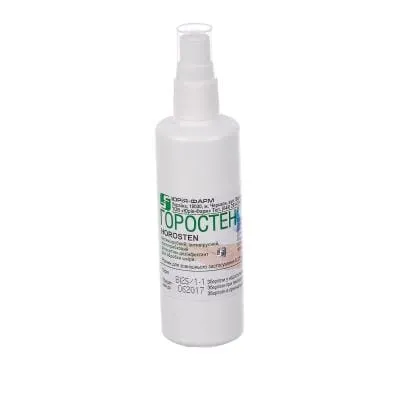
Table of Contents
INSTRUCTIONS for medical use of the medicinal product HOROSTEN (HOROSTEN)
Composition:
Active substance: decamethoxin;
1 ml of solution contains 0.25 mg of decamethoxin;
Excipients: glycerin, ethanol 96%, citral, water for injections.
Pharmaceutical form. Solution for external use.
Main physicochemical properties: colorless, slightly opalescent liquid with a lemon odor.
Pharmacotherapeutic group.
Antiseptics and disinfectants. Quaternary ammonium compounds.
ATC code D08AJ10.
Pharmacological Properties
Pharmacodynamics
The antiseptic agent GorostenÒ exhibits antimicrobial, antiviral, and antifungal effects. The mechanism of action of dequalinium is based on its effect on microbial cell membranes: dequalinium disrupts the supramembrane layer, destabilizes the membrane, and increases its permeability to macromolecular substances. Since most enzymes are bound to membrane structures, dequalinium alters the enzymatic activity of the cell by inhibiting enzymatic systems. The hydrophobic moiety of dequalinium promotes maximum binding of the drug to microbial cell membranes. The cationic moiety of dequalinium initially reduces and subsequently neutralizes the charge of the microbial cell wall. Dequalinium does not affect human cell membranes, as they possess significantly longer lipid radicals, thus preventing hydrophobic interactions. Dequalinium exerts pronounced bactericidal activity against Gram-positive and Gram-negative aerobic and anaerobic microorganisms: staphylococci, streptococci, Corynebacterium diphtheriae, Escherichia coli, Salmonella, Proteus, Klebsiella, Shigella, Pseudomonas, Clostridium, Campylobacter, Gardnerella, Chlamydia, and Mycoplasma. Dequalinium also exerts fungicidal effects against yeast-like fungi, causative agents of epidermophytia, trichophytia, and microsporia, as well as some species of mold fungi (Aspergillus, Penicillium), and exhibits virucidal activity against lipophilic viruses, including HIV and hepatitis viruses.
GorostenÒ is highly active against microorganisms resistant to antibiotics (penicillin, chloramphenicol, tetracyclines, streptomycin, gentamicin, neomycin, novobiocin, oleandomycin, cephalosporins, fluoroquinolones).
Development of microbial strains resistant to GorostenÒ does not occur even with prolonged use of the drug. Bacteriostatic (fungistatic) concentrations are similar to its bactericidal (fungicidal), virucidal, and sporicidal concentrations.
During treatment with GorostenÒ, increased sensitivity of antibiotic-resistant microorganisms to antibiotics is observed.
Pharmacokinetics
The drug is practically not absorbed through mucous membranes, skin, or wound surfaces. It does not stain the skin, and citral imparts a pleasant lemon-like odor.
Clinical characteristics.
Indications.
- Disinfection of hands of medical personnel in healthcare facilities, treatment of hands before and after medical procedures.
- Treatment of skin areas affected by staphylococcal and streptococcal impetigo, as well as adjacent areas.
- Skin disinfection of hands in all cases associated with increased risk of infection and spread of health-threatening microorganisms.
- Treatment of minor skin injuries.
- Hygienic skin disinfection.
Contraindications.
Individual hypersensitivity to the components of the drug.
Interaction with other medicinal products and other types of interactions.
HorostenÒ is compatible with preparations containing cationic surfactants (benzalkonium chloride, ethonium).
Decamethoxine, a component of HorostenÒ, increases the sensitivity of antibiotic-resistant microorganisms to antibiotics.
Warming HorostenÒ to 37−38 °C prior to use significantly enhances its antimicrobial efficacy.
Special precautions for use
Avoid contact of the product with mucous membranes of the eyes. In case of accidental contact with eyes, rinse thoroughly with plenty of running water.
Use during pregnancy or breastfeeding
There are no data indicating contraindications for topical use of the product during pregnancy. It is not recommended for cleaning nipples during breastfeeding.
Ability to influence reaction rate while driving or operating machinery
The product is intended for topical use only and therefore does not affect reaction speed while driving or operating machinery.
Method of Administration and Dosage
Apply externally as wipes or compresses.
Wash hands thoroughly with running water and soap, remove residual soap foam, and dry. Pour 3−5 ml of GorostenÒ into the palm and thoroughly distribute it over the inner and outer surfaces of the hand, interdigital spaces, periungual areas, and the lower third of the forearm for 1−2 minutes. After this, allow the skin to dry.
If hands have not been previously washed with soap, treat with GorostenÒ twice.
To prevent pressure ulcers, rub GorostenÒ into the skin areas using a cotton ball. In the presence of pressure ulcers, apply GorostenÒ as dressings.
After shaving, wipe facial skin with a tampon or palm moistened with the product.
Children
There is no experience with use in children.
Overdose
Due to the absence of systemic absorption, cases of overdose have not been reported.
Side effects.
In individual cases, increased individual sensitivity is possible, including skin rash, irritation, burning, dryness, itching, after application of the drug and other local allergic reactions, which disappear after discontinuation of use.
If any adverse events occur, consult a physician!
Shelf life.
2 years.
Storage conditions.
Store at a temperature not exceeding 30 °C. Store in the original packaging in a place inaccessible to children.
Incompatibility.
HorostenÒ belongs to cationic surfactants and therefore is incompatible with soap and other anionic compounds (sodium lauryl sulfate, saponins). For this reason, soap must be thoroughly rinsed off before applying the drug to the skin.
Packaging.
100 ml, 400 ml in polymer bottles.
Availability.
Over-the-counter.
Manufacturer.
LLC "Yuria-Pharm".
Manufacturer's address and location of business activity.
Ukraine, 18030, Cherkasy region, city of Cherkasy, Kobzarska Street, 108. Tel.: (044) 281-01-01.