Glucose solution 10 % for infusion
Ukraine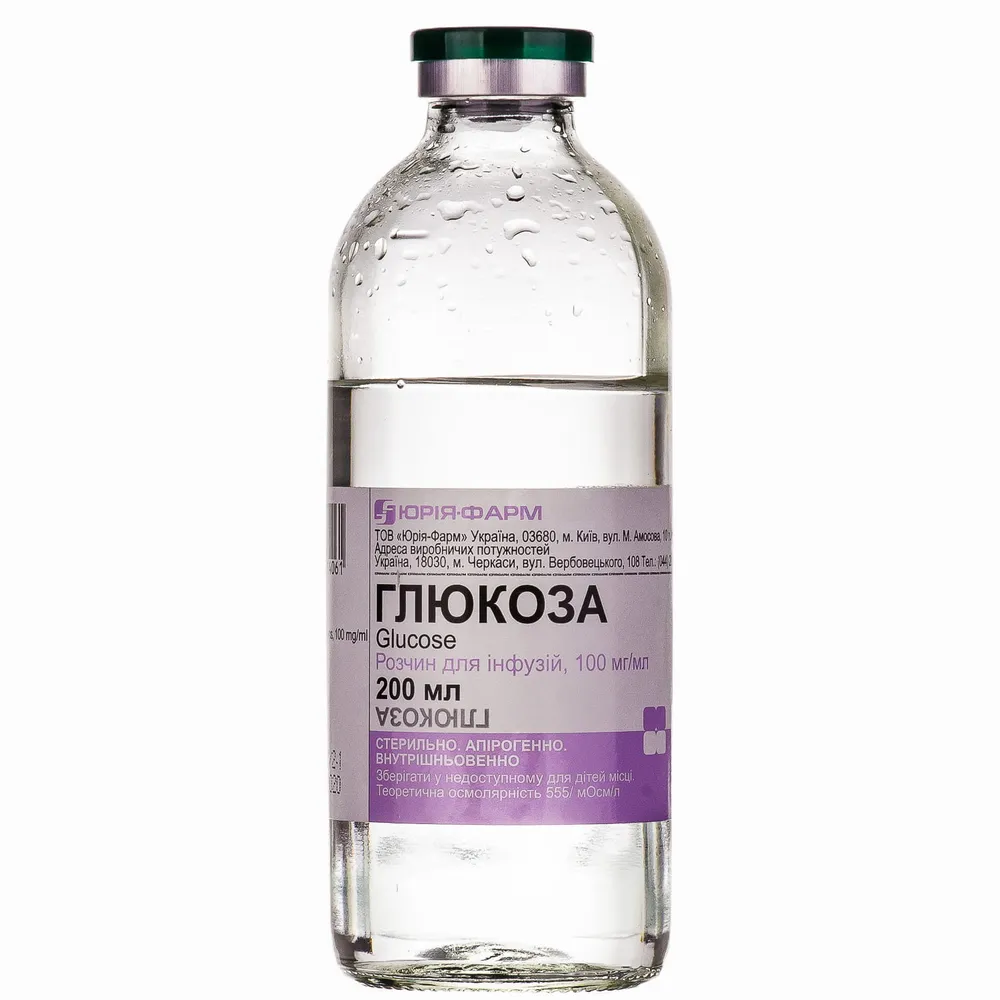
Table of Contents
INSTRUCTIONS FOR MEDICAL USE OF THE MEDICINAL PRODUCT Glucose 10% Solution for Infusion (Glucosi solutio 10% PRO INFUSIONIBUS)
Composition:
Active substance: glucose;
100 ml of solution contain glucose (calculated as anhydrous glucose) 10 g;
Excipient: water for injections.
Pharmaceutical form. Solution for infusion.
Main physico-chemical properties: clear colorless or slightly yellowish liquid, theoretical osmolarity – 555 mosmol/L, pH 3.5–6.5.
Pharmacotherapeutic group. Solutions for parenteral nutrition.
ATC code V06D C01.
Pharmacological properties.
Pharmacodynamics.
Glucose solution has plasma-substituting, hydrating, metabolic, and detoxifying effects. It maintains the volume of circulating blood and replenishes lost fluid volume. It can induce diuresis depending on the patient's clinical condition.
Glucose undergoes complete metabolism, may reduce protein and nitrogen losses, supports glycogen deposition, and reduces or prevents ketosis (excessive formation of ketone bodies) when administered in sufficient doses. During tissue metabolism, glucose releases a significant amount of energy necessary for vital body functions.
Pharmacokinetics.
Normal blood glucose levels range between 45–85 mg/100 ml, corresponding to a molar concentration of 3.0–5.6 mmol/l. To maintain these levels, the daily intake for an adult with a body weight of 60–100 kg should be 100–200 g. The contribution of blood glucose to the total plasma osmolarity of 290 mOsm/l is insignificant, amounting to only 5.6 mOsm/l. Thus, infusion of glucose solutions does not significantly affect plasma osmolarity due to rapid glucose utilization. In patients receiving glucose solely via intravenous infusion, the minimum daily requirement to prevent acidosis is 100 g of glucose (1000 ml of 10% glucose solution).
Glucose metabolism in the body ends with the formation of carbon dioxide (CO₂) and water; during aerobic glycolysis of one mole of glucose, 686 kcal or 4.1 kcal per 1 g is released.
Glucose elimination is practically achieved entirely through metabolism. In healthy individuals, glucose may be detected in urine only in trace amounts, as after glomerular filtration it enters the primary urine and is completely reabsorbed in the proximal tubules; this process continues until blood glucose levels rise to values not less than 200–240 mg/100 ml.
Clinical characteristics.
Indications.
- Hypoglycemia;
- parenteral nutrition;
- conditions associated with increased protein breakdown due to hypoergosis.
Contraindications.
Glucose 10% solution for infusion is contraindicated in patients with:
- intracranial and intraspinal hemorrhages, except in conditions associated with hypoglycemia and requiring parenteral nutrition;
- severe hyperosmolar dehydration;
- hypersensitivity to dextrose;
- diabetic coma with hyperglycemia;
- hyperosmolar coma;
- glucose-galactose malabsorption syndrome.
The preparation must not be administered simultaneously with blood products.
Interaction with other medicinal products and other forms of interaction.
When used concomitantly with thiazide diuretics and furosemide, their ability to affect serum glucose levels should be taken into account.
Insulin promotes glucose uptake into peripheral tissues, stimulates glycogen formation, protein and fatty acid synthesis. Glucose solution reduces the hepatotoxic effect of pyrazinamide. Administration of a large volume of glucose solution may lead to hypokalemia, which increases the toxicity of concurrently administered cardiac glycosides.
Glucose is incompatible in solution with aminophylline, soluble barbiturates, erythromycin, hydrocortisone, kanamycin, soluble sulfonamides, cyanocobalamin.
Special precautions.
During prolonged intravenous administration of the drug, monitoring of blood glucose levels is required.
When administering the drug, subcutaneous insulin should be prescribed at a dose of 1 IU per 4–5 g of glucose.
Use during pregnancy or breastfeeding.
The drug may be used only when the expected benefit to the mother outweighs the potential risk to the fetus or infant.
Ability to influence reaction rate while driving or operating machinery.
Data are lacking due to the exclusive use of the drug under hospital conditions.
Dosage and Administration
Administer the drug intravenously by drip infusion. The adult dose is up to 1500 mL per day. The maximum daily dose for adults is 2000 mL. If necessary, the maximum infusion rate for adults is 150 drops per minute (500 mL/h).
Children.
The dose for children depends on age, body weight, clinical condition, and laboratory parameters.
Overdose.
Exaggeration of adverse reactions. Tachypnea, pulmonary edema.
Hyperglycemia and hyperhydration may develop. In case of overdose, administer symptomatic treatment and, if necessary, regular insulin preparations.
Adverse reactions.
Central nervous system: very rare – confusion or loss of consciousness;
Endocrine system and metabolism: hyperglycemia; hypokalemia; hypophosphatemia; hypomagnesemia.
Urinary system: polyuria; glucosuria.
Gastrointestinal tract: polydipsia; nausea.
General reactions: hypervolemia; sensation of flushing and skin redness; allergic reactions (hyperthermia, skin rashes, angioneurotic edema, shock).
Local reactions at the site of administration: pain at the injection site; venous irritation, phlebitis, venous thrombosis.
If adverse reactions occur, the infusion should be discontinued, the patient's condition assessed, and appropriate supportive measures provided.
Shelf life. 5 years.
Storage conditions. Store at a temperature not exceeding 25 °C, in a place inaccessible to children.
Freezing of the preparation, provided the bottle remains hermetically sealed, does not contraindicate its use. Non-wettability of the inner surface of the bottle is not a contraindication for the use of the preparation.
Incompatibility. Glucose is incompatible in solutions with aminophylline, soluble barbiturates, erythromycin, hydrocortisone, warfarin, kanamycin, soluble sulfonamides, cyanocobalamin.
Do not use in the same infusion system simultaneously with, before, or after blood transfusion due to the risk of pseudoagglutination.
Packaging. 200 ml, 250 ml, 400 ml, or 500 ml in bottles.
Prescription status. Prescription only.
Manufacturer. Private Joint-Stock Company "Infuziya".
Manufacturer's address and location of business activity.
Ukraine, 21034, Vinnytsia, Voloshkova St., bld. 55 or Ukraine, 23219, Vinnytsia region, Vinnytsia district, village Vinnytski Khutory, Nemirovskе Highway, bld. 84A.
Marketing Authorization Holder. Private Joint-Stock Company "Infuziya".
Address of the Marketing Authorization Holder.
Ukraine, 04073, Kyiv, Moskovskyi Avenue, bld. 21-A.