Glucose-test
Ukraine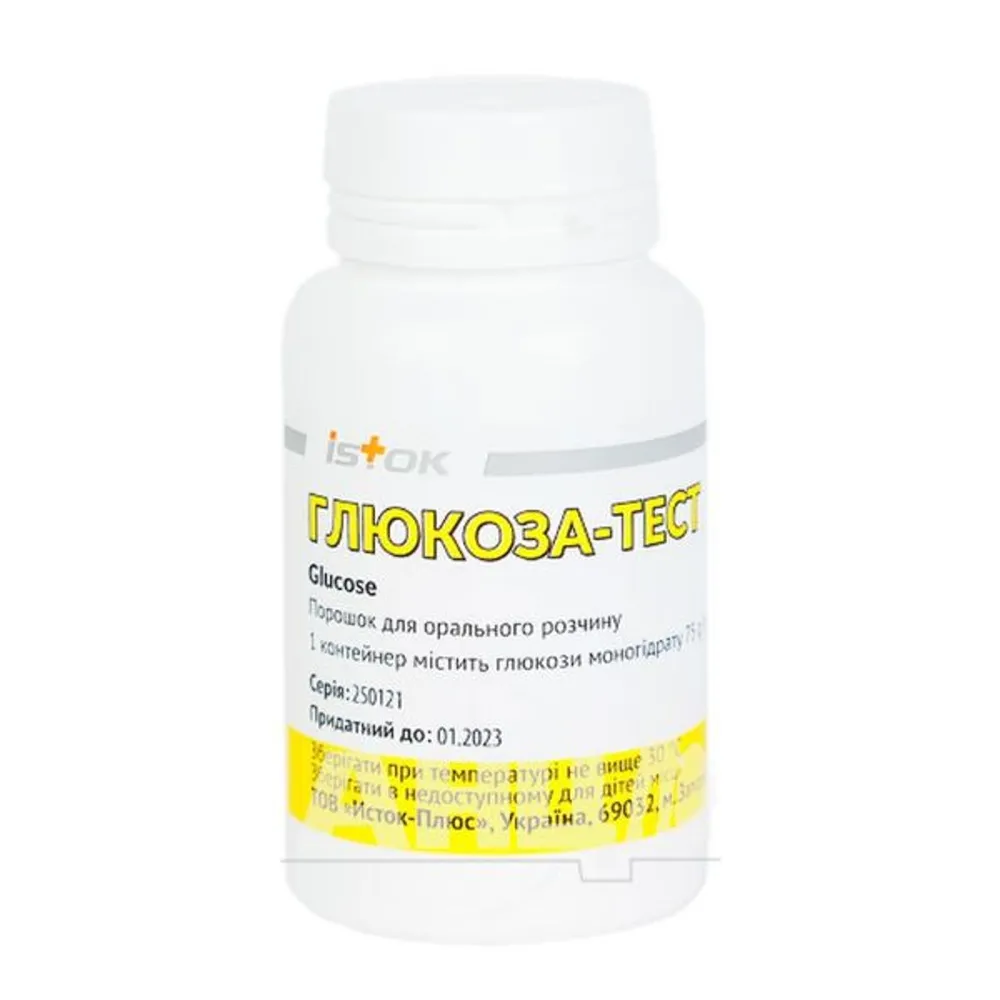
Table of Contents
INSTRUCTIONS FOR MEDICAL USE OF THE MEDICINAL PRODUCT GLUCOSE-TEST (GLUCOSE-TEST)
Composition:
Active substance:
glucose;
1 container or sachet contains 75 g of glucose monohydrate.
Pharmaceutical form.
Oral powder for solution.
Main physicochemical properties:
white or almost white crystalline powder with a sweet taste.
Pharmacotherapeutic group.
Diagnostic agents. ATC code V04C A02.
Pharmacological properties.
Glucose is involved in carbohydrate metabolism. The drug is well absorbed in the gastrointestinal tract and distributed via the bloodstream to all organs and tissues; its metabolic products are excreted in urine.
Clinical characteristics.
Indications.
Used in performing the glucose tolerance test when blood glucose levels do not allow diagnosis of impaired glucose tolerance or diabetes mellitus.
Contraindications.
Increased individual sensitivity.
Interaction with other medicinal products and other types of interactions.
Not observed.
Special precautions.
- The glucose tolerance test should be performed when the patient is in a resting state; prior stress or excessive physical exertion should be avoided.
- During the test, the patient should remain seated (or lying) quietly; smoking and physical activity are not permitted.
- The test is not recommended after exhausting illnesses, surgeries, or childbirth, during inflammatory processes, infectious diseases, fever, alcoholic liver cirrhosis, hepatitis, during menstruation, gastrointestinal disorders with impaired glucose absorption, or in malignant diseases.
- The day before and on the day of the test, medications that may affect blood glucose levels (epinephrine, glucocorticoids, caffeine, diuretin, morphine, thiazide diuretics, phenytoin, psychotropic agents, and antidepressants) as well as therapeutic procedures influencing glucose levels should be discontinued.
- False-positive results may occur in hypokalemia, liver dysfunction, and endocrinopathies.
Use during pregnancy or breastfeeding.
Performing the glucose tolerance test during pregnancy or breastfeeding is not contraindicated.
Ability to influence reaction rate while driving or operating machinery.
Has no effect.
Administration and dosage.
For at least 3 days prior to the test, subjects must adhere to their usual diet (containing no less than 150–200 g of carbohydrates per day) and maintain their regular physical activity. The first blood sample is taken in the morning on an empty stomach, after an overnight fast of 10–14 hours (drinking water is permitted).
After the initial finger-prick blood collection, the subject ingests 75 g of glucose dissolved in 250–500 mL of water within 2–5 minutes. To improve the taste of the solution and prevent nausea in some individuals, lemon juice or citric acid may be added.
When performing the test in individuals with excess body weight, glucose is administered at a dose of 1 g per 1 kg of body weight, but not exceeding 100 g.
For children, the glucose dose is 1.75 g per 1 kg of body weight, but not exceeding 75 g.
Blood glucose level is measured 2 hours after glucose ingestion.
Interpretation of results
The test results can be interpreted using the table provided below.
|
State |
Glucose content in capillary blood, mmol/L (mg %) |
|
|
Fasting |
2 hours after glucose intake |
|
|
Normal |
< 5.5 (100) |
< 7.8 (140) |
|
Impaired glucose tolerance |
< 6.1 (110) |
> 7.8 < 11.1 (> 140 < 200) |
|
Diabetes mellitus |
> 6.1 (110) |
> 11.1 (> 200) |
For venous blood, threshold values will be approximately 1 mmol/l (18 mg/dl) lower.
Children.
Used in pediatric practice according to indications.
Overdose.
After single administration of a large amount of the drug, gastrointestinal disturbances are possible (nausea, bloating, diarrhea). Symptomatic therapy is recommended.
Side effects.
Allergic reactions are possible in individuals with increased sensitivity.
Shelf life.
2 years.
Storage conditions.
Store at a temperature not exceeding 30 ˚C. Keep out of the reach of children.
Packaging.
75 g of powder in a container. 1 container in a cardboard box or without a cardboard box.
75 g of powder in a sachet. 1 sachet in a cardboard box or without a cardboard box.
Dispensing category.
Over-the-counter.
Manufacturer.
LLC "Istok-Plus"
Manufacturer's address and place of business.
4 Makarenka Street, Zaporizhzhia, Ukraine, 69032