Glucose
Ukraine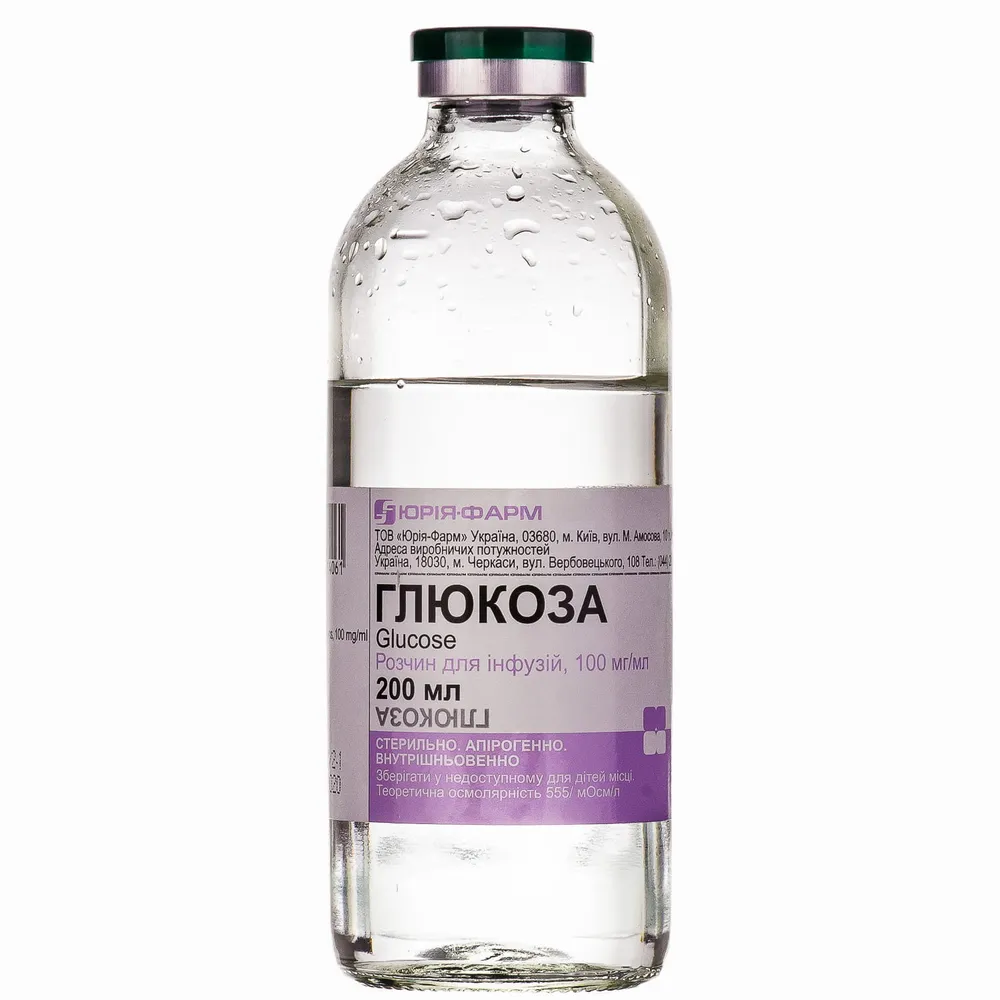
Table of Contents
INSTRUCTION FOR MEDICAL USE OF THE MEDICINAL PRODUCT GLUCOSE (GLUCOSE)
Composition:
active ingredient: glucose monohydrate;
1 ml of solution contains glucose monohydrate equivalent to 50 mg of glucose;
excipient: water for injections.
Medicinal form. Infusion solution.
Main physicochemical properties: clear, colorless or slightly yellowish solution.
Pharmacotherapeutic group. Plasma substitutes and perfusion solutions.
ATC code B05CX01.
Pharmacological Properties
Pharmacodynamics
A low-concentration glucose solution is a suitable solvent for medicinal products because glucose, as a natural cellular component, is metabolized throughout the body. Under physiological conditions, glucose is the most important carbohydrate providing energy, with approximately 17 kJ (or 4 kcal) contained in 1 g. Normal blood glucose concentration in adults ranges from 70–100 mg/100 mL, or 3.9–5.6 mmol/L (fasting).
Pharmacokinetics
Absorption
Since glucose solution is administered intravenously, its bioavailability is 100%.
Distribution
After administration, glucose is initially distributed in the intracellular space and then enters the cells.
Metabolism
During glycolysis, glucose is broken down into pyruvate. Under aerobic conditions, pyruvate is completely oxidized to carbon dioxide and water. During hypoxia, pyruvate is converted into lactate. Lactate can be partially re-incorporated into glucose metabolism (the Cori glucose-lactate cycle).
Glucose utilization may be impaired (resulting in glucose intolerance) during metabolic disorders. These include diabetes mellitus and metabolic stress (e.g., during and after surgery, severe illness, or trauma), as well as hormonally mediated reduction in glucose tolerance, which may lead to hyperglycemia even without external substrate administration. Depending on its severity, hyperglycemia may cause renal excretion of water due to changes in osmotic pressure, potentially leading to hypertonic dehydration, osmotic pressure-related complications, including hyperosmolar coma.
Glucose and electrolyte metabolism are closely interrelated. Insulin facilitates potassium entry into cells. Phosphates and magnesium participate in enzymatic reactions related to glucose utilization. The need for potassium, phosphates, and magnesium may increase during glucose administration; therefore, their levels should be monitored and supplemented according to individual requirements. Failure to administer these electrolytes may lead to impaired cardiac and nervous system function.
Elimination
The end products formed during glucose oxidation are eliminated via the lungs (carbon dioxide) and kidneys (water).
In healthy individuals, glucose is practically not excreted by the kidneys. Under pathological metabolic conditions associated with hyperglycemia (e.g., in diabetes mellitus, post-aggression syndrome), when the maximum renal tubular reabsorption threshold is exceeded (at blood glucose levels above 160–180 mg/100 mL, or 8.8–9.9 mmol/L), some glucose is excreted by the kidneys into urine (resulting in glucosuria).
Safety Preclinical Data
According to results of standard pharmacological safety studies regarding repeated-dose toxicity, genotoxicity, carcinogenic potential, and reproductive and developmental toxicity, no specific hazard to humans has been identified.
Clinical Characteristics
Indications
- For use as a carbohydrate solution for intravenous infusion therapy.
- For dilution of compatible medicinal products.
Contraindications
- Hyperglycemia unresponsive to insulin administration at a dose of no more than 6 units per hour;
- Lactic acidosis;
- Hypersensitivity to the active substance; allergy to corn—see sections "Special Warnings" and "Side Effects".
Contraindications for administration of large volume of fluid (when there is a need to administer a significant amount of solution):
- Hypotonic hyperhydration;
- Isotonic hyperhydration;
- Acute heart failure;
- Pulmonary edema.
This solution should not be used solely for fluid and/or rehydration purposes, as it does not contain electrolytes (see section "Special Warnings").
Special Precautions
After opening the bottle
After opening, the infusion solution should be used immediately (see below).
After adding compatible medicinal products
From a microbiological standpoint, the medicinal product should be used immediately. If not used immediately, the user is responsible for storage conditions and duration, which generally should not exceed 24 hours at 2–8 °C, provided that dilution was performed under controlled and validated aseptic conditions.
Any unused medicinal product or waste material must be disposed of in accordance with local requirements.
Bottles are intended for single use only.
After use, dispose of the bottle and any remaining contents. Partially used bottles must not be reused.
The solution may be used only if it is clear or almost colorless and the bottle and its cap are undamaged.
Infusion should begin immediately after connecting the bottle to an infusion set or other infusion device.
Before adding medicinal products or preparing a parenteral nutrition mixture, physical and chemical compatibility must be verified. Due to the acidic pH of the Glucose medicinal product, incompatibility may occur when mixed with other medicinal products.
When adding compatible medicinal products, strict aseptic techniques must be followed.
Interaction with Other Medicinal Products and Other Forms of Interaction
Interactions with medicinal products affecting glucose metabolism should be evaluated.
Medicinal products that enhance the effect of vasopressin
The following medicinal products enhance the effect of vasopressin, which in turn leads to reduced renal excretion of electrolyte-free water and an increased risk of hospital-acquired hyponatremia due to inadequately balanced intravenous infusion therapy (see sections "Dosage and Administration", "Special Warnings", and "Side Effects").
- Medicinal products that stimulate vasopressin release, such as chlorpropamide, clofibrate, carbamazepine, vincristine, selective serotonin reuptake inhibitors (SSRIs), 3,4-methylenedioxy-N-methamphetamine (MDMA), ifosfamide, antipsychotic medicinal products, opioids.
- Medicinal products that potentiate the effect of vasopressin, such as chlorpropamide, nonsteroidal anti-inflammatory drugs (NSAIDs), cyclophosphamide.
- Medicinal products whose active ingredient is a vasopressin analogue, e.g., desmopressin, oxytocin, vasopressin, terlipressin.
When prescribing a medicinal product, the instructions for medical use provided with it should be followed.
Special precautions for use
Glucose solutions for intravenous infusion are usually isotonic. However, after entering the body, a solution containing glucose may cause a pronounced physiological hypotonic effect due to the rapid metabolism of glucose (see section "Method of administration and dosage").
Depending on the osmotic pressure of the solution, dose and rate of infusion, as well as the patient's clinical condition and ability to metabolize glucose, intravenous administration of glucose-containing drugs may lead to electrolyte imbalance and, in particular, to the development of hypoosmolar or hyperosmolar hyponatremia.
Hyponatremia
Patients at particularly high risk of acute hyponatremia include those with a diagnosis of non-osmotic vasopressin secretion (e.g., due to acute illness, pain, postoperative stress, infections, burns, and central nervous system disorders), patients with heart, liver, or kidney disease, and patients receiving vasopressin agonists (see section "Interaction with other medicinal products and other forms of interaction").
Acute hyponatremia may lead to acute hyponatremic encephalopathy (cerebral edema), manifesting as headache, nausea, seizures, lethargy, and vomiting. Patients diagnosed with cerebral edema are at particularly high risk of severe, irreversible, and life-threatening brain injury.
Children, women of childbearing age, and patients with impaired brain function (e.g., patients diagnosed with meningitis, intracranial hemorrhage, or traumatic brain injury) are at particularly high risk of severe and life-threatening cerebral edema due to acute hyponatremia.
Glucose medicinal product should be administered with particular caution to patients with impaired glucose metabolism, such as in the postoperative or post-traumatic period, or patients with diabetes mellitus—i.e., patients requiring frequent monitoring (see below) and dosage adjustments.
Hyperglycemia must be adequately controlled and treated with insulin. Insulin administration causes additional changes in intracellular potassium levels, which may cause or exacerbate hypokalemia.
During patient monitoring, blood glucose levels, serum electrolyte concentrations (especially potassium and sodium), and acid-base and fluid balance should be regularly checked.
Glucose solution should also be administered with particular caution to patients with functional renal insufficiency.
Glucose solutions should not be administered after acute ischemic stroke, as hyperglycemia has been shown to worsen ischemic brain damage and impair recovery.
Glucose solutions should not be administered through the same infusion system used, being used, or previously used for blood transfusion, as pseudoagglutination may occur.
Infusion of hypotonic solutions, such as the Glucose medicinal product, in the presence of non-osmotic secretion of antidiuretic hormone (due to pain, anxiety, postoperative state, nausea, vomiting, fever, sepsis, hypovolemia, respiratory disorders, central nervous system infections, metabolic or endocrine disorders) may cause hyponatremia. Hyponatremia may lead to headache, nausea, seizures, lethargy, coma, cerebral edema, or even death; therefore, in cases of acute symptomatic hyponatremia (e.g., hyponatremic encephalopathy), immediate medical intervention is required.
Hypersensitivity reactions related to infusion, including anaphylactic/anaphylactoid reactions, have been reported during glucose solution administration (see section "Adverse reactions"). Therefore, glucose-containing solutions should be used with caution and only if absolutely necessary in patients with known allergy to corn or corn products (see section "Contraindications"). If signs or symptoms of hypersensitivity occur, the infusion must be stopped immediately. Appropriate therapeutic measures should be initiated if clinically necessary.
Children
Intravenous infusion therapy in children requires careful monitoring due to the risk of developing fluid and electrolyte imbalances. Adequate fluid intake and urine output must be ensured, and fluid balance as well as plasma and urine electrolyte concentrations should be closely monitored.
The safety information provided by the manufacturer of any concomitant medicinal product should be taken into account.
Use during pregnancy or breastfeeding
Pregnancy
There is insufficient data on the use of glucose monohydrate during pregnancy (data from fewer than 300 pregnancies). Animal studies have not shown direct or indirect adverse reproductive toxicity when the medicinal product is used at therapeutic doses (see section "Pharmacological properties").
The Glucose medicinal product may be used during pregnancy if blood glucose levels, electrolyte, and fluid balance are carefully monitored and maintained within physiological norms.
Due to the risk of hyponatremia, special precautions should be taken when administering the Glucose medicinal product to pregnant women during labor, especially if this medicinal product is administered in combination with oxytocin (see sections "Interaction with other medicinal products and other forms of interaction," "Special precautions for use," and "Adverse reactions").
Breastfeeding
Glucose and/or its metabolites are excreted into breast milk; however, administration of the Glucose medicinal product at therapeutic doses has shown no adverse effects on newborns and/or infants who are breastfed.
The Glucose medicinal product may be used during breastfeeding, provided that the recommended guidelines are followed.
Fertility
Data are lacking.
Ability to affect reaction speed when driving or operating machinery. The Glucose medicinal product does not affect the ability to drive or operate machinery.
If used as a solvent, the safety information provided by the manufacturer of the concomitant medicinal product should be considered.
Method of Administration and Dosage
Dosage
Fluid balance, serum glucose concentration, and other electrolyte levels must be monitored before and during infusion, especially in patients with increased non-osmotic vasopressin secretion (syndrome of inappropriate antidiuretic hormone secretion — SIADH) and in patients receiving concomitant medications that are vasopressin agonists, due to the risk of hyponatremia.
Serum sodium concentration must be particularly monitored when using fluids with a physiologically hypotonic effect. Administration of Glucose medicinal product may cause a pronounced hypotonic effect due to glucose metabolism in the body (see sections "Interaction with Other Medicinal Products and Other Forms of Interaction", "Special Warnings and Precautions for Use", and "Undesirable Effects").
Carbohydrate Solution for Intravenous Infusion Therapy
Dosage depends on age, body weight, and the clinical and physiological (acid-base balance) status of the patient. Concomitant therapy must be prescribed by the attending physician.
Dilution of Compatible Medicinal Products
The volume of solution required to dilute other medicinal products depends on the desired concentration of the prepared solution, taking into account the maximum doses specified below.
Note that providing the entire daily fluid requirement solely with this solution is contraindicated (see sections "Contraindications" and "Special Warnings and Precautions for Use").
Adults
Maximum Dose
The maximum daily dose depends on daily fluid requirements and is up to 40 mL/kg body weight per day (equivalent to 2 g of glucose per kilogram body weight per day).
In exceptional cases, if clinically indicated, the dose may be increased, but must not exceed the patient's maximum capacity for glucose oxidation. This capacity is 5 mg/kg body weight per minute for adults and 10–18 mg/kg body weight per minute for infants and children, depending on age and total body weight.
Maximum Infusion Rate is up to 5 mL/kg body weight per hour (equivalent to 0.25 g of glucose per kilogram body weight per hour).
When using this solution, the total daily requirements for fluid and glucose must be taken into account.
Method of Administration
Administer intravenously.
The possibility of infusion into peripheral veins depends on the osmolarity of the prepared mixture.
Children
Dosage generally depends on age, body weight, clinical and physiological (acid-base balance) status of the patient; concomitant therapy is prescribed by the attending physician.
Recommended Dosage for Dehydration Treatment:
- body weight 0–10 kg: 100 mL/kg/24 hours;
- body weight 10–20 kg: 1000 mL + 50 mL for each kilogram > 10 kg/24 hours;
- body weight > 20 kg: 1500 mL + 20 mL for each kilogram > 20 kg/24 hours.
Glucose solution dosage should be kept to a minimum, and sufficient electrolytes should be administered concurrently (see sections "Contraindications" and "Special Warnings and Precautions for Use").
When using this solution, total daily requirements for fluid and glucose must be considered.
Method of Administration
During intravenous administration, the possibility of infusion into peripheral veins depends on the osmolarity of the prepared mixture.
Overdose
Symptoms of Glucose Overdose
Excessive glucose infusion may cause hyperglycemia, glucosuria, hyperosmolar dehydration, and in extreme cases of overdose, may lead to hyperglycemic-hyperosmolar coma.
Symptoms of Fluid Overdose
Fluid overdose may cause hyperhydration with increased skin turgor, venous congestion, edema (including pulmonary or cerebral edema), dilution of blood electrolytes, electrolyte imbalance—especially hyponatremia and hypokalemia (see section "Special Warnings and Precautions for Use")—and acid-base imbalance.
Clinical symptoms of water intoxication may occur, such as nausea, vomiting, and seizures.
Depending on concomitant medicinal products used, other overdose symptoms may also occur.
Treatment
Treatment depends on the nature and severity of the condition. Infusion should be stopped immediately, and administration of electrolytes, diuretics, or insulin may be required.
The following formula may be used to treat hyponatremia:
Required Na+ (mmol) = (target Na+ level (1) – actual Na+ level) × TBW (2)
(1) Should not be lower than 130 mmol/L.
(2) TBW — Total Body Water — body water content relative to body weight: 0.6 for children, 0.6 and 0.5 for younger adult males and females, respectively, 0.5 and 0.45 for elderly males and females, respectively.
Serum electrolyte levels must be monitored during treatment.
If symptoms of overdose occur from a medicinal product administered simultaneously with glucose solution, treatment should be carried out according to the instructions for medical use of that medicinal product.
Adverse Reactions
The adverse reactions listed below have been observed during the use of the medicinal product. The frequency of occurrence of these adverse reactions is unknown (cannot be estimated from the available data).
Metabolism and nutritional disorders: electrolyte imbalance, for example hyponatremia and hypokalemia.
Neurological disorders: hyponatremic encephalopathy.
Hospital-acquired hyponatremia may lead to irreversible brain damage and death due to the development of acute hyponatremic encephalopathy (see sections "Special precautions for use" and "Dosage and administration").
Immune system disorders: anaphylactic reactions*, hypersensitivity*.
Skin and subcutaneous tissue disorders: rash.
Vascular disorders: venous thrombosis, phlebitis.
General disorders: chills*, fever*, infection at infusion site, irritation at infusion site, such as erythema, extravasation, infusion site reactions, localized pain.
* Potential manifestation in patients with allergy to corn (see section "Special precautions for use").
Reporting of adverse reactions
Reporting suspected adverse reactions after the medicinal product has been authorized is important. It allows continued monitoring of the benefit-risk balance of the medicinal product. Healthcare professionals and patients, as well as their legal representatives, are encouraged to report any suspected adverse reactions and lack of efficacy of the medicinal product through the Automated Pharmacovigilance Information System at the following link: https://aisf.dec.gov.ua
Shelf life. 3 years.
Storage conditions. Store below 25 °C in the original packaging.
Incompatibilities. Due to the acidic pH of Glucose medicinal product, incompatibility may occur when mixed with other medicinal products or blood.
Glucose medicinal product must not be used for dilution of erythrocyte concentrate, as this may cause pseudoagglutination (see section "Special precautions for use").
Packaging. 200 ml, 250 ml, 400 ml, or 500 ml in polymer bottles.
Prescription status. Prescription only.
Manufacturer. TOB "Yuria-Pharm".
Manufacturer's address and place of business. Ukraine, Cherkasy region, city of Cherkasy, 108 Kobzarska Street. Phone: (044) 281-01-01.