Gliaton
Ukraine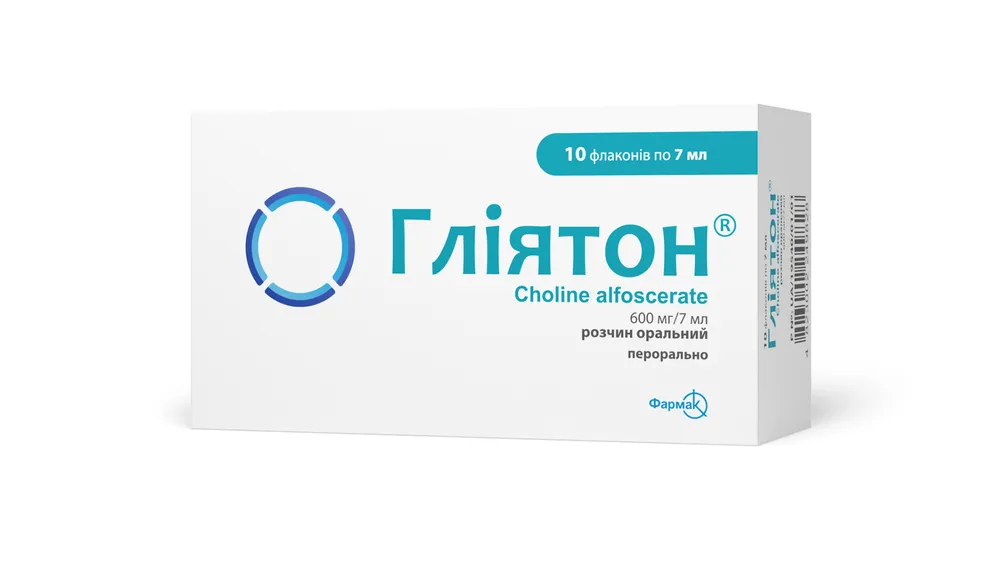
Table of Contents
INSTRUCTIONS FOR MEDICAL USE OF THE MEDICINAL PRODUCT GLIATON® (GLIATON)
Composition:
Active substance: choline alfoscerate;
1 ml of solution contains 250 mg of choline alfoscerate calculated as 100% substance;
Excipient: water for injections.
Pharmaceutical form. Solution for injection.
Main physicochemical properties: clear, colorless solution.
Pharmacotherapeutic group. Agents affecting the nervous system. Parasympathomimetics. Choline alfoscerate. ATC code N07AX02.
Pharmacological Properties
Pharmacodynamics
Choline alfoscerate is an agent belonging to the group of central cholinomimetics with a predominant effect on the central nervous system (CNS). Choline alfoscerate, as a choline carrier and a precursor of phosphatidylcholine, has the potential to prevent and correct biochemical impairments that are particularly significant among the pathogenic factors of psychorganic involutional syndrome; thus, it may influence reduced cholinergic tone and altered phospholipid composition of neuronal membranes. The formulation contains 40.5% metabolically protected choline. Metabolic protection ensures the release of choline in the brain. Choline alfoscerate positively affects memory functions and cognitive abilities, as well as emotional state and behavioral parameters, the deterioration of which is caused by the development of brain involutional pathology.
The mechanism of action is based on the fact that after entering the body, choline alfoscerate is enzymatically cleaved into choline and glycerophosphate: choline participates in the biosynthesis of acetylcholine—one of the main mediators of nerve excitation; glycerophosphate serves as a precursor of neuronal membrane phospholipids (phosphatidylcholine). Thus, choline alfoscerate improves nerve impulse transmission in cholinergic neurons and has a positive effect on neuronal membrane plasticity and receptor function. Choline alfoscerate enhances cerebral blood flow, stimulates metabolic processes in the brain, activates structures of the brain's reticular formation, and restores consciousness following traumatic brain injury.
An open, multicenter, randomized, comparative, parallel-group study demonstrated a statistically significant reduction in awakening time among patients under mechanical ventilation in the group receiving Glyaton® (injection solution) compared to the group not receiving this medicinal product. The median awakening time was 8 minutes in the Glyaton® group and 17 minutes in the control group (p < 0.001).
Vital parameters (arterial pressure [AP], heart rate [HR], and body temperature) did not show clinically significant changes during therapy in either group and remained similar, indicating the absence of a negative impact of the investigational drug on these parameters.
The study confirmed higher efficacy of Glyaton® in preventing postoperative cognitive dysfunction compared to the control group not receiving Glyaton®.
The obtained results demonstrate the safety and good tolerability of Glyaton® injection solution, 250 mg/mL, 4 mL in ampoules, administered intravenously at a dose of 1 g (1 ampoule) 20 minutes before the end of surgery, followed by doses at 24, 48, and 72 hours post-surgery, in patients undergoing elective abdominal and gynecological surgical procedures under total intravenous anesthesia with mechanical ventilation. During the study, no cases of serious adverse reactions were recorded. All reported adverse reactions were mild and did not require medical intervention or discontinuation of the investigational drug. Glyaton® at the studied doses did not negatively affect vital parameters (AP, HR, and body temperature) or laboratory parameters including complete blood count, urinalysis, and blood biochemistry.
According to preclinical data on safety and efficacy, Glyaton® is capable of preventing surgical intervention-induced cognitive neuropathic disorders. Parenteral administration of this medicinal product in operated animals helps maintain higher cortical functions, learning and memory abilities, and behavioral characteristics at levels comparable to those in non-operated animals. Glyaton® improves performance of skills related to hippocampal function, prevents depressive behavior, increases exploratory activity in animals, and preserves overall cognitive functions after surgery, indicating potent neuroprotective properties, activation of neuronal plasticity, and enhancement of cholinergic signaling in the CNS. Glyaton® significantly reduces inflammatory responses in brain tissue following surgical intervention, consistent with data from 49 behavioral tests, and demonstrates its therapeutic effect on the central component of the pathogenesis of postoperative cognitive disorders.
Pharmacokinetics
After administration, approximately 88% of the dose of choline alfoscerate is absorbed. The drug accumulates predominantly in the brain (45% of the plasma concentration), lungs, and liver. Elimination occurs primarily via the lungs in the form of carbon dioxide (CO₂). Only 15% of the drug is excreted in urine and bile.
Clinical characteristics.
Indications.
Acute period of severe traumatic brain injury with predominantly brainstem-level damage (impaired consciousness, coma, focal hemispheric symptoms, brainstem injury signs).
Degenerative involutional cerebral psychorganic syndromes or secondary consequences of cerebrovascular insufficiency, i.e., primary and secondary cognitive impairments in elderly individuals characterized by memory disturbances, confusion, disorientation, reduced motivation and initiative, and decreased ability to concentrate; emotional and behavioral sphere changes: emotional instability, irritability, indifference to the surrounding environment; pseudomelancholia in elderly individuals.
For prevention of postoperative cognitive dysfunction in patients after elective surgical procedures in abdominal surgery and gynecology performed under total intravenous anesthesia with artificial ventilation of the lungs.
Contraindications.
Known hypersensitivity to the drug or to any of its components.
In patients with psychotic syndrome or severe psychomotor agitation.
Pregnancy or breastfeeding period.
Interaction with other medicinal products and other forms of interaction.
Clinically significant interaction of the drug with other medicinal products has not been established.
Special precautions for use.
Use during pregnancy or breastfeeding.
The drug is contraindicated during pregnancy and breastfeeding.
Ability to affect reaction rate when driving or operating machinery.
The drug does not affect the ability to drive or operate machinery.
Dosage and Administration
In acute conditions, administer Glyaton® intramuscularly or by slow intravenous injection at a dose of 1 g (1 ampoule) daily for 15–20 days. After the patient's condition has stabilized, switch to the capsule dosage form of the drug.
For prophylaxis of postoperative cognitive dysfunction in patients following elective surgical procedures in abdominal surgery and gynecology, performed under total intravenous anesthesia with artificial ventilation of the lungs, administer 1 g (1 ampoule) intravenously 20 minutes before the end of surgery, then at 24, 48, and 72 hours after completion of surgery.
Children. Experience with the use of Glyaton® in children is lacking.
Overdose.
Overdose of Glyaton®, which may manifest as nausea, restlessness, excitement, and insomnia, requires dose reduction. Symptomatic treatment should be administered.
Side effects.
The drug is generally well tolerated even with long-term use. Injection site reactions may occur. During the first days or weeks of treatment, the following adverse reactions may appear: anxiety, agitation, insomnia. These symptoms are temporary and do not require discontinuation of treatment, although a temporary dose reduction may be considered.
Nausea (primarily due to secondary dopaminergic activation), decreased blood pressure, headache may possibly occur; very rarely abdominal pain and brief episodes of confusion may develop. In such cases, the administered dose should be reduced.
Hypersensitivity reactions are possible, including rash, pruritus, urticaria, angioneurotic edema, and skin redness.
Shelf life. 3 years.
Do not use the drug after the expiry date stated on the package.
Storage conditions. Store in a place protected from light at a temperature not exceeding 25 °C.
Keep out of reach of children.
Incompatibility.
The drug should not be used in the same container with other medicinal products.
Packaging. 4 ml in vials, pack of 5 (5x1) or 10 (10x1); pack of 5 (5x1) or 10 (5x2) in blisters.
Prescription status. Prescription only.
Manufacturer. JSC "Farmak".
Manufacturer's address and place of business.
74, Kyrylivska Street, Kyiv, 04080, Ukraine.
Date of last review.