Gynoflor
Ukraine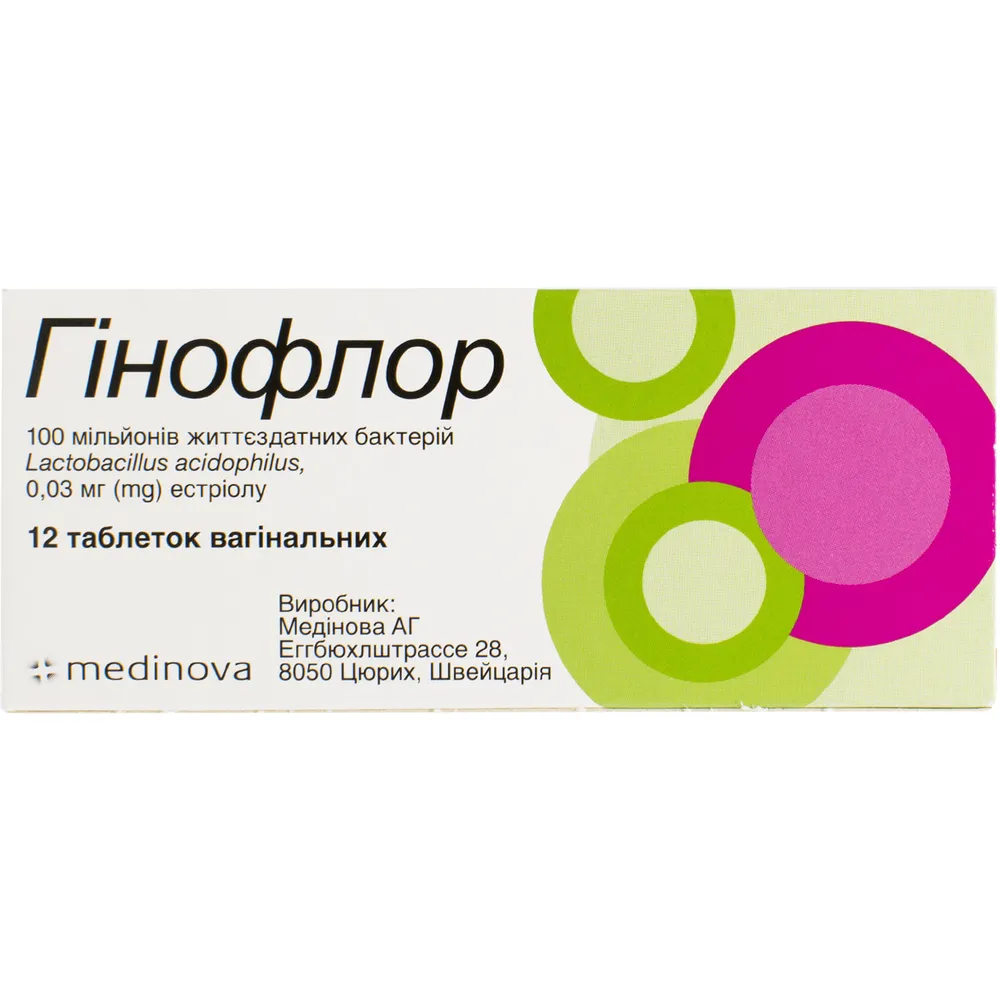
Table of Contents
INSTRUCTIONS FOR MEDICAL USE OF THE MEDICINAL PRODUCT GYNOFLOR
Composition:
Active substances: viable bacteria Lactobacillus acidophilus, estriol;
1 vaginal tablet contains 100 million viable bacteria Lactobacillus acidophilus, 0.03 mg estriol;
Excipients: lactose monohydrate; microcrystalline cellulose; sodium starch glycolate (type A); magnesium stearate; anhydrous sodium hydrogen phosphate.
Medicinal form. Vaginal tablets.
Main physicochemical characteristics: slightly beige-colored tablets with speckles, biconvex, oval-shaped.
Pharmacotherapeutic group.
Antibacterial and antiseptic agents used in gynecology.
ATC code G01A X14.
Pharmacological Properties.
Pharmacodynamics.
Lactobacillus acidophilus is one of the predominant microorganisms in the vaginal flora of a healthy woman. Lactobacilli perform a protective function in the vagina. They ferment glycogen from the vaginal epithelium into lactic acid. The acidic environment (pH 3.8–4.5) created as a result establishes unfavorable conditions for colonization and growth of pathogenic microorganisms and provides an optimal environment for the proliferation of Lactobacilli. In addition to lactic acid, Lactobacilli produce hydrogen peroxide and bacteriocins, which also inhibit the growth of pathogenic microorganisms.
Estradiol is an endogenous estrogenic hormone that particularly affects the vagina and has no effect on the endometrium. Estradiol promotes proliferation of the vaginal epithelium. Proliferating and mature epithelium acts as a physiological barrier and contains glycogen, a nutritional substrate for Lactobacilli. In hormonal disorders, which are more common in elderly women, the vaginal epithelium becomes damaged and the amount of glycogen decreases.
Exogenous estradiol, even in small doses, restores the proliferating and mature epithelium and thereby provides a glycogen reserve to nourish Lactobacilli.
Disruption or destruction of the physiological vaginal flora mainly occurs due to local or systemic anti-infective treatments, severe systemic diseases, improper hygiene practices, and vaginal infections. In a non-physiological vaginal environment, the number of Lactobacilli may decrease or they may even disappear entirely, and their protective function is no longer maintained.
The therapeutic effect of Gynoflor consists of restoring the vaginal flora through the introduction of exogenous Lactobacilli and improving the condition of the vaginal epithelium through the administration of exogenous estradiol. The result is the restoration of physiological balance in the vagina and regeneration of the vaginal epithelium.
Lactobacilli and estradiol act locally, exclusively within the vagina.
Lactose, contained in the vaginal tablets as an excipient, can also be fermented by Lactobacilli into lactic acid. The multiplication of Lactobacilli and recolonization of the vagina by these bacteria begins after the first application of the medicinal product.
Pharmacokinetics.
As soon as the vaginal tablets come into contact with vaginal secretions, they begin to disintegrate, releasing Lactobacilli and estradiol. In vitro experiments have shown that Lactobacilli resume their metabolism and reduce the pH value within several hours. Positive estrogenic effects caused by estradiol begin rapidly, and during the course of treatment (6–12 days), the condition of the proliferative and mature vaginal epithelium gradually improves.
After the 12th administration of vaginal tablets (at the end of once-daily Gynoflor treatment), the peak level of unbound estradiol in plasma, compared to baseline levels, was not elevated.
No accumulation of estradiol was observed during the 12-day treatment period. Plasma concentrations observed after repeated administration of the drug remained within the normal range of endogenous levels of unbound estradiol in plasma.
Estradiol therapy does not affect plasma concentrations of estrone and estradiol, as estradiol is the terminal product of their metabolism.
Due to the low dose of estradiol (0.03 mg), local application, and limited duration of treatment (6–12 days), accumulation of estradiol does not occur and systemic estrogenic effects are unlikely.
Clinical Characteristics.
Indications.
- Restoration of Lactobacillus acidophilus flora following local and/or systemic anti-infective therapy;
- atrophic vaginitis due to estrogen deficiency during menopause and the postmenopausal period, or as an adjunctive treatment during systemic hormone replacement therapy;
- mild to moderate cases of bacterial vaginosis and candidiasis, and vaginal discharge of unknown origin (Fluor vaginalis), in which anti-infective therapy is not strictly necessary;
- prophylactic treatment of recurrent vaginal infections.
Contraindications.
- Hypersensitivity to the active substances or to any of the excipients;
- malignant neoplasms of the breasts, uterus, or vagina (diagnosed, suspected, or in medical history);
- estrogen-dependent malignant tumor (diagnosed or suspected, especially endometrial carcinoma);
- endometriosis (diagnosed or suspected);
- vaginal bleeding of unknown origin;
- untreated endometrial hyperplasia;
- acute vaginitis with severe inflammation and purulent infiltrates;
- venous thromboembolic disease (diagnosed or in medical history, especially deep vein thrombosis, pulmonary embolism);
- diagnosed thrombophilia (in case of protein C or S deficiency or antithrombin deficiency);
- arterial embolic disease (diagnosed or recently experienced, especially angina pectoris and myocardial infarction);
- acute liver disease or liver disease in medical history, if levels of relevant liver enzymes have not returned to normal;
- porphyria;
- not to be used in young girls who have not yet reached sexual maturity.
Interaction with other medicinal products and other forms of interaction.
Lactobacillus acidophilus is sensitive to numerous anti-infective agents (local or systemic). Concomitant treatment with such agents may reduce the effectiveness of the medicinal product.
Due to the very low dose of estriol and the local route of administration, clinically significant interactions are unlikely.
There are no data from studies on possible interactions between the medicinal product and latex products (e.g., condoms, diaphragms, etc.). As a precautionary measure, alternative contraceptive methods should be used during treatment and for the first few days after completion of treatment.
Special precautions for use.
The medicinal product contains components that may not be completely broken down; remnants of the tablet are sometimes found on underwear. This does not affect the efficacy of the medicinal product.
In cases of significant vaginal dryness, the tablet may be moistened with a small amount of plain water to facilitate its dissolution.
Patients should use hygiene wipes or sanitary pads.
Gynoflor contains only a small amount of estriol, and only a minor portion is absorbed. In patients with severe liver, kidney, or cardiac dysfunction, epilepsy or migraine (including in history), hypertension, diabetes mellitus, porphyria, or hyperlipidemia, the risk of adverse effects is low when the medicinal product is used for a short duration of 6–12 days.
This also applies to patients with severe pruritus, gestational herpes, or worsening otosclerosis in early pregnancy, as well as individuals with thrombophlebitis or a history of thromboembolism.
However, if any of these conditions worsen, treatment should be discontinued, as should be the case if abnormal vaginal bleeding develops during treatment.
The following precautions apply to long-term therapy.
Local estrogen therapy should only be initiated to treat postmenopausal symptoms that negatively affect quality of life. A careful benefit-risk assessment should be performed at least annually. Treatment should be continued only if benefits outweigh risks.
Medical examinations/follow-up monitoring.
Before initiating or resuming treatment, a complete personal and family medical history should be obtained. In addition, during treatment, patients should undergo regular thorough physical and gynecological examinations. The frequency and nature of examinations should depend on the individual risk profile of the patient. Patients should be informed about changes that require reporting to their physician (e.g., sudden genital bleeding or changes in the breast).
Examinations, including imaging procedures such as mammography, should be performed according to current standard monitoring practices and based on the individual needs of the patient.
Cases requiring special medical monitoring.
Close monitoring is required for postmenopausal patients with vaginal atrophy receiving supportive therapy with Gynoflor, to detect any of the following conditions/situations, including those with prior occurrence or worsening during pregnancy or previous hormonal therapy.
This also applies if any of the following conditions/situations occur or worsen during the current treatment course:
- risk factors for estrogen-dependent tumors, e.g., breast cancer in a close relative;
- history of endometrial hyperplasia;
- leiomyoma (fibroid tumor) or endometriosis;
- risk factors for thromboembolic disorders;
- migraine or severe headaches;
- systemic lupus erythematosus;
- liver diseases (e.g., hepatic adenoma);
- diabetes mellitus with or without vascular involvement;
- cholelithiasis;
- hypertension;
- epilepsy;
- asthma;
- otosclerosis.
Reasons for immediate discontinuation of supportive therapy.
Treatment should be discontinued in the following cases:
- jaundice or impaired liver function;
- significant increase in blood pressure;
- development of migraine-like headache or increased frequency of severe headache.
Endometrial hyperplasia.
The risk of endometrial hyperplasia and carcinoma increases with systemic estrogen monotherapy, depending on the duration and dose of estrogen. No increased risk of endometrial hyperplasia or uterine cancer has been established with vaginal estriol monotherapy. If long-term treatment is required, regular examinations are recommended; however, particular attention should be paid to symptoms that may indicate endometrial hyperplasia or malignancy.
If unexpected bleeding occurs during treatment or persists after treatment ends, the cause should be investigated. Endometrial biopsy may be necessary to exclude malignancy.
Uncontrolled estrogen stimulation may lead to premalignant transformation of residual endometrial lesions. Therefore, the medicinal product should be used with caution in women who have undergone hysterectomy due to endometriosis and in whom residual endometriosis is present.
Breast, uterine, and ovarian cancer.
Systemic estrogen therapy increases the risk of certain cancers, particularly cancers of the uterus, ovaries, and breast. Gynoflor vaginal tablets are applied locally, contain a low dose of estriol, and systemic absorption of estriol after administration is minimal and transient. Therefore, an increased risk of cancer development with Gynoflor treatment is not expected.
Venous thromboembolic disease, stroke, and ischemic heart disease.
Systemic hormone therapy is associated with an increased risk of venous thromboembolism (VTE), stroke, and ischemic heart disease. Gynoflor vaginal tablets, containing a low dose of estriol and applied locally, are not expected to increase the risk of VTE, stroke, or ischemic heart disease.
Risk factors for VTE include: personal or family history of VTE, significant obesity (BMI > 30 kg/m²), and systemic lupus erythematosus (SLE). There is no consensus on the possible role of varicose veins in VTE development. Close monitoring of such patients is recommended.
Other diseases.
Systemic estrogens may cause fluid retention or increased plasma triglyceride levels. Therefore, patients with heart disease, renal dysfunction, or hypertriglyceridemia should be closely monitored during the first few weeks of treatment. Gynoflor vaginal tablets contain a low dose of estriol and are applied locally; thus, systemic effects are not expected.
Patients with severe renal insufficiency should be closely monitored, as elevated blood levels of estriol may occur.
Use during pregnancy or breastfeeding.
Gynoflor may be used during pregnancy and lactation. However, like all other medicinal products, Gynoflor should be prescribed with caution to women during the first trimester of pregnancy.
Data do not indicate adverse effects of estriol and Lactobacillus acidophilus on pregnancy or fetal/neonatal health.
Ability to affect reaction speed when driving or operating machinery.
Studies on the effect on reaction speed when driving or operating machinery have not been conducted.
Method of Administration and Dosage.
Restoration of Lactobacillus flora after local and/or systemic anti-infective treatment, Fluor vaginalis (vaginal discharge), vaginal infections.
1 – 2 vaginal tablets should be administered daily for 6 – 12 days. The vaginal tablets must be inserted deeply into the vagina in the evening before going to bed. It is best to do this while lying on the back, with knees slightly bent.
Treatment should be suspended during menstruation and resumed after menstruation ends.
Atrophic vaginitis, vaginal discharge (Fluor vaginalis) in the postmenopausal period.
1 vaginal tablet daily for 12 days, followed by a maintenance dose of 1 vaginal tablet 1 – 2 times per week. Regular use of the medicinal product in cases of atrophic changes in the vaginal epithelium is necessary for the prevention of atrophic vaginitis.
Treatment of recurrent vaginal infections.
The recommended dose is 1 vaginal tablet daily for 12 days.
Children.
Do not use in young girls who have not yet reached menarche and sexual maturity.
Overdose.
Following an overdose by vaginal administration, adverse reactions do not occur; instead, the number of lactobacilli in the vaginal environment increases. In any case, this is a desired effect of the medicinal product. Regarding estriol, a temporary increase in its serum concentration is possible. Systemic effects usually do not occur.
Adverse reactions.
Adverse reactions reported during clinical and post-marketing studies are listed by system organ class and frequency:
uncommon (≥ 1/1000, < 1/100), rare (≥ 1/10000, < 1/1000).
Immune system.
Rare: allergic reaction with redness and itching.
Reproductive system and breast.
Uncommon: vulvovaginal pruritus, vaginal discharge, burning sensation in the vulvovaginal area (especially at the beginning of treatment).
Infections and infestations.
Uncommon: vaginitis.
No adverse reactions are expected in case the medicinal product is accidentally taken orally.
Shelf life.
3 years.
Storage conditions.
Store in the original packaging. Store in the refrigerator (from 2 to 8 °C).
Storage of the medicinal product at room temperature for 1–2 weeks does not affect its efficacy. Keep out of reach and sight of children.
Packaging.
6 tablets per blister; 1 or 2 blisters per cardboard box. 2 tablets per blister, 1 blister per cardboard box.
Supply classification.
Available without prescription.
Manufacturer.
Medinova AG / Medinova AG.
Manufacturer's address and place of business.
Eggbuhlstrasse 28, 8050 Zurich, Switzerland / Eggbuhlstrasse 28, 8050 Zurich, Switzerland.