Ginipral
Ukraine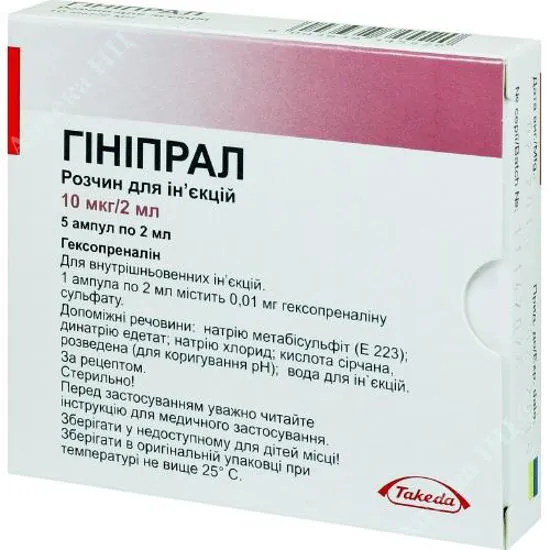
Table of Contents
INSTRUCTIONS FOR MEDICAL USE OF THE MEDICINAL PRODUCT GYNIPRAL® (GYNIPRAL®)
Composition:
Active substance: hexoprenaline;
Each 2 ml ampoule contains 0.01 mg of hexoprenaline sulfate;
Excipients: sodium metabisulfite (E 223); disodium edetate; sodium chloride; sulfuric acid, diluted (for pH adjustment); water for injections.
Pharmaceutical form. Injection solution.
Main physicochemical properties: clear, colorless solution.
Pharmacotherapeutic group. Drugs affecting the genitourinary system and sex hormones. Other agents used in gynecology. Sympathomimetics suppressing uterine contractile activity. ATC code G02CA.
Pharmacological Properties
Pharmacodynamics
Ginipral is a selective beta-2 sympathomimetic agent that relaxes uterine muscles. Under the influence of Ginipral, the frequency and intensity of uterine contractions are reduced or suppressed. The drug inhibits both spontaneous uterine contractions and those induced by oxytocin. The tocolytic effect begins within 3–15 minutes after intravenous administration and lasts approximately 30 minutes. Maximum effect is achieved within 12–18 minutes.
Pharmacokinetics
Distribution. There is no data available on the distribution of the drug in the human body. Preclinical studies indicate that after intravenous administration, high concentrations of hexoprenaline are observed in the liver, kidneys, and skeletal muscles; lower concentrations are found in the brain and myocardium.
Metabolism. Hexoprenaline is metabolized by catechol-O-methyltransferase into mono-3-O-methyl-hexoprenaline and di-3-O-methyl-hexoprenaline.
Elimination. After intravenous administration, approximately 44% of the drug is excreted in urine and 5% in feces within 24 hours; within 8 days, the respective values are 54% and 15.5%. In the initial phase, free hexoprenaline, two methylated metabolites, and their sulfate and glucuronide conjugates are not excreted in urine. Forty-eight hours after administration, only the metabolite di-3-O-methyl-hexoprenaline is detectable in urine. A small amount of the drug (approximately 10%) is excreted in bile, usually in the form of O-methylated metabolite conjugates. Since a lower dose of the drug is excreted in feces than is secreted in bile, some degree of reabsorption of the drug occurs.
Clinical characteristics.
Indications.
- Short-term treatment of uncomplicated preterm labor:
suppression of uterine contractility in patients with a gestational age from 22 to 37 weeks in the absence of medical or gynecological contraindications to tocolytic therapy.
- Prior to fetal version from transverse lie.
- As an emergency measure in preterm labor prior to transporting the pregnant patient to hospital.
Contraindications.
- Hypersensitivity to hexoprenaline or to any component of the drug.
- Presence of any condition before 22 weeks of gestation.
- Use of the drug as a tocolytic agent in patients with a history of ischemic heart disease or in patients with significant risk factors for developing ischemic heart disease.
- Threatened abortion during the I and II trimesters of pregnancy.
- Any maternal or fetal condition in which continuation of pregnancy is hazardous, e.g., severe preeclampsia, intrauterine infection, vaginal bleeding due to placenta previa, eclampsia or severe preeclampsia, placental abruption, or umbilical cord compression.
- Intrauterine fetal death, lethal congenital anomalies in history, or lethal chromosomal abnormalities.
- Bronchial asthma with hypersensitivity to sulfates.
- Cardiovascular disorders, particularly tachyarrhythmia, myocarditis, mitral valve disease.
- Hyperthyroidism.
- Severe liver and kidney diseases.
- Angle-closure glaucoma.
Use of Ginipral is contraindicated in patients with conditions where administration of beta-mimetics may have undesirable effects, e.g., pulmonary hypertension, cardiovascular disorders (hypertrophic obstructive cardiomyopathy or left ventricular outflow tract obstruction, such as aortic stenosis).
Interaction with other medicinal products and other forms of interaction.
Halogenated anesthetics. Due to additional antihypertensive effect, the risk of developing uterine inertia leading to hemorrhage is increased. Serious ventricular arrhythmias have been reported due to increased cardiac reactivity when the drug interacts with halogenated anesthetics.
Treatment with the drug must be discontinued at least 6 hours before any planned anesthesia using halogenated anesthetics.
Glucocorticoids. Systemic glucocorticoids are frequently administered in preterm labor to accelerate fetal lung maturation. Pulmonary edema has been reported in women receiving concomitant beta-agonists and glucocorticoids.
Glucocorticoids increase blood glucose levels and may lead to decreased serum potassium levels. Combination therapy with glucocorticoids should be administered under constant monitoring due to increased risk of hyperglycemia and hypokalemia (see section "Special precautions for use").
Antidiabetic agents. Administration of beta-agonists increases blood glucose levels, which may be interpreted as reduced efficacy of antidiabetic therapy. In this case, antidiabetic treatment should be adjusted (see section "Special precautions for use").
Agents that reduce potassium levels. Administration of beta-agonists is associated with decreased serum potassium levels. Combination therapy with other agents that increase the risk of hypokalemia (such as diuretics, digoxin, methylxanthines, glucocorticoids) should be prescribed with caution and only after careful assessment of the risk/benefit ratio of treatment, with particular attention to the increased risk of cardiac arrhythmias due to hypokalemia (see section "Special precautions for use").
Other interactions. Nonselective beta-adrenergic blockers reduce or abolish the effect of Ginipral.
The intensity of glycogen accumulation in the liver induced by glucocorticoid administration is reduced under the influence of Ginipral.
Concomitant treatment with sympathomimetics (cardiovascular and antiasthmatic drugs) should not be performed, as this enhances the effects on the cardiovascular system and increases the risk of adverse reactions due to overdose.
Ginipral should not be used concomitantly with drugs containing ergot alkaloids, as well as with drugs containing calcium, vitamin D, dihydrotachysterol, and mineralocorticoids.
Special precautions for use.
The decision to initiate therapy with Ginipral should be made only after a careful assessment of the risk-benefit ratio of its use.
Treatment must be administered exclusively in properly equipped medical facilities that allow continuous monitoring of maternal and fetal health status.
Tocolysis with beta-adrenergic agonists is not recommended in cases of ruptured membranes or cervical dilatation exceeding 4 cm.
Ginipral should be used with caution during tocolysis. Throughout the entire treatment period, cardiac and respiratory functions must be closely monitored, including continuous electrocardiographic (ECG) monitoring.
The following monitoring of maternal condition, and fetal condition when possible/necessary, should be performed continuously:
- Measurement of arterial blood pressure and heart rate;
- Performance of ECG;
- Assessment of fluid and electrolyte balance to detect possible development of pulmonary edema;
- Monitoring of blood glucose and lactate levels, particularly in patients with diabetes mellitus;
- Monitoring of serum potassium levels, as beta-adrenergic agonists may cause a decrease in serum potassium concentration, increasing the risk of arrhythmias (see section "Interaction with other medicinal products and other forms of interaction"). Patients with hypokalemia should receive oral potassium supplementation prior to initiation of tocolytic therapy.
Treatment should be discontinued if signs or symptoms of myocardial ischemia occur (e.g., chest pain or ECG changes).
Ginipral should not be used as a tocolytic agent in patients with significant risk factors or suspicion of any cardiovascular disease in their medical history (e.g., tachyarrhythmia, heart failure, or valvular heart disease; see section "Contraindications"). In cases of preterm labor in a patient with established or suspected cardiovascular disease, a physician experienced in managing such patients should evaluate the appropriateness of Ginipral therapy prior to initiating infusion.
Pulmonary edema. Due to the potential risk of developing pulmonary edema and myocardial ischemia in the mother during or after beta-adrenergic agonist therapy for preterm labor, careful monitoring of fluid and electrolyte balance, cardiac and respiratory function is essential. Patients with predisposing factors that impair physiological defense mechanisms—including multiple gestation, hypervolemia, infection, and pre-eclampsia—are at increased risk of developing pulmonary edema. Using an infusion pump to administer the drug, rather than intravenous infusion without pump control, minimizes the risk of hypervolemia. If symptoms of pulmonary edema or myocardial ischemia occur, especially during concomitant corticosteroid therapy or in the presence of comorbid conditions (e.g., renal disease, NPG-gestosis), treatment with Ginipral should be discontinued. Sodium intake should be restricted.
Arterial blood pressure and heart rate. Infusion of beta-adrenergic agonists typically causes an increase in maternal heart rate (HR) by 20–50 beats per minute. Maternal pulse rate should be monitored, and in each individual case, consideration should be given to whether dose reduction or discontinuation of the drug is necessary to control this tachycardia. Generally, the resting maternal heart rate should not exceed 120 beats per minute.
Maternal arterial blood pressure may slightly decrease during infusion, with diastolic pressure decreasing more than systolic. The drop in diastolic pressure usually ranges between 10 and 20 mm Hg. The effect of infusion on fetal heart rate is less pronounced, but an increase of up to 20 beats per minute may occur.
To minimize the risk of arterial hypotension associated with tocolytic therapy, special precautions should be taken to avoid compression of the vena cava superior. The patient should be positioned alternately on her left and right side during infusion.
Diabetes mellitus. Administration of beta-adrenergic agonists may increase blood glucose levels. Therefore, blood glucose and lactate levels should be monitored in pregnant women with diabetes mellitus, and antidiabetic treatment should be adjusted as needed during tocolysis (see section "Interaction with other medicinal products and other forms of interaction").
Other precautions. During beta-adrenergic tocolytic therapy, symptoms of concomitant myotonic dystrophy may be exacerbated. In such cases, phenytoin is recommended.
Ginipral should be administered in low, individually adjusted doses under continuous medical supervision in patients with increased sensitivity to sympathomimetic agents.
Since Ginipral therapy may suppress intestinal peristalsis (rarely, intestinal atony has been observed), bowel movements should be monitored regularly throughout tocolytic treatment.
Use during pregnancy or breastfeeding.
Pregnancy. Ginipral is indicated for use during pregnancy (see section "Indications").
Breastfeeding. Ginipral is not intended for use during breastfeeding, as appropriate data are lacking.
Ability to affect reaction speed when driving or operating machinery.
Ginipral has no or negligible effect on the ability to drive or operate machinery.
Method of Administration and Dosage
For intravenous bolus injection or infusion.
The dosage indicated below is intended as a guideline only, since tocolysis requires an individualized approach to each patient.
Initiation of treatment with Ginipral must be performed only by obstetricians/physicians experienced in the use of tocolytic agents. Treatment must be carried out exclusively in adequately equipped medical facilities allowing continuous monitoring of maternal and fetal status.
Ginipral should be administered as early as possible after diagnosis of preterm labor and after exclusion of any contraindications to the use of hexoprenaline (see section "Contraindications").
During therapy, appropriate assessment of the cardiovascular system must be performed using continuous ECG monitoring (see section "Special Warnings and Precautions for Use").
Dosage
Prior to fetal version from transverse lie, and as an emergency measure for preterm labor before transporting the pregnant woman to hospital
Recommended dose: 10 mcg (1 ampoule of 2 mL) of Ginipral diluted in 10 mL of 0.9% sodium chloride solution or 5% glucose solution, administered intravenously over 5–10 minutes. If continued treatment with Ginipral is required, proceed with the concentrate for infusion solution.
Short-term treatment of preterm labor in the presence of cervical shortening and/or dilation
At the beginning of treatment, start with an intravenous bolus dose of 10 mcg (1 ampoule of 2 mL) (dilution method as described above), followed by continuous infusion of Ginipral at a rate of 0.3 mcg/min.
As an alternative, treatment may consist solely of Ginipral infusion at 0.3 mcg/min without prior bolus administration.
Administer intravenously by drip infusion (when calculating infusion rate using standard infusion sets, note that 20 drops = 1 mL). Dilute the required number of ampoules of the concentrate for infusion in 500 mL of 0.9% sodium chloride solution or 5% glucose solution.
Infusion rate of 0.3 mcg/min:
| Dose |
Total volume |
Drops per minute |
mL per minute |
| 25 mcg (1 ampoule of 5 mL) |
500 mL |
120 drops/min |
6 mL/min |
| 50 mcg (2 ampoules of 5 mL) |
500 mL |
60 drops/min |
3 mL/min |
| 75 mcg (3 ampoules of 5 mL) |
500 mL |
40 drops/min |
2 mL/min |
| 100 mcg (4 ampoules of 5 mL) |
500 mL |
30 drops/min |
1.5 mL/min |
Single cases of hexoprenaline use at a dose of 430 mcg per day have been registered.
Short-term treatment of preterm labor without shortening or dilation of the cervix.
Recommended dose: continuous infusion of 0.075 mcg/min. Administer intravenously by drip infusion (when calculating the infusion rate using standard infusion systems, note that 20 drops = 1 mL). The required number of vials of infusion concentrate should be dissolved in 500 mL of 0.9% sodium chloride solution or 5% glucose solution.
Infusion rate of 0.075 mcg/min:
| Dose |
Total volume |
Drops per minute |
mL per minute |
| 25 mcg (1 ampoule of 5 mL) |
500 mL |
30 drops/min |
1.5 mL/min |
| 50 mcg (2 ampoules of 5 mL) |
500 mL |
15 drops/min |
0.75 mL/min |
Treatment duration.
The duration of tocolytic treatment depends on the existing risk level of pregnancy interruption (tendency towards reduced intervals between contractions, condition of the cervix) and on the severity of adverse effects (e.g., increased heart rate). Adverse effects should be minimized as much as possible.
The duration of treatment with the drug should not exceed 48 hours, as study data indicate that tocolytic therapy can delay delivery by up to 48 hours. In randomized controlled trials, no statistically significant effect of treatment with Ginipral on perinatal mortality or morbidity was observed. Delaying delivery using Ginipral may allow time for implementing other interventions that significantly improve perinatal outcomes.
Special safety measures for infusion administration.
The drug dosage should be individually adjusted according to limiting factors: suppression of uterine contractions, increased pulse rate, and changes in arterial pressure. These parameters should be carefully monitored during treatment. The maternal heart rate should not exceed 120 beats per minute.
Continuous assessment of maternal hydration status should be performed to prevent possible development of pulmonary edema (see section "Special instructions"). The volume of fluid used for drug administration should be minimized. The drug should be administered using a controlled infusion device, preferably an infusion pump.
Children.
The drug is not intended for use in children.
Overdose.
Symptoms of overdose may include: significant increase in maternal heart rate, tremor, palpitations, headache, and sweating.
Usually, reducing the drug dosage is sufficient to alleviate these symptoms. To manage severe overdose symptoms, administration of non-selective beta-adrenoblockers, which competitively inhibit the action of Ginipral, is recommended.
Side effects.
The most common adverse effects of Ginipral are associated with the pharmacological properties of beta-mimetics. To prevent or minimize the occurrence of adverse effects, careful monitoring of hemodynamic parameters such as arterial pressure, heart rate, and appropriate dose adjustment are required. These effects usually resolve after discontinuation of the drug.
Adverse effects are classified by frequency of occurrence as follows:
very common (≥ 1:10), common (≥ 1:100, < 1:10), uncommon (≥ 1:1000, < 1:100), rare (≥ 1:10000, < 1:1000), very rare (< 1:10000), not known (frequency cannot be estimated from available data).
Endocrine system.
Not known: lipolysis.
Metabolic disturbances.
Common: hypokalemia.*
Rare: hyperglycemia (more pronounced in patients with diabetes mellitus).*
Nervous system.
Very common: tremor.
Not known: headache, dizziness, anxiety.
Cardiovascular system.
Very common: tachycardia.*
Common: palpitations*, decrease in diastolic pressure*, arterial hypotension (see section "Special precautions for use").*
Rare: cardiac arrhythmias, e.g. atrial fibrillation, myocardial ischemia (see section "Special precautions for use")*, peripheral vasodilation*, ventricular extrasystoles.
Not known: increased cardiac output, increased systolic pressure, minor fluctuations in fetal heart rate.
Respiratory system.
Uncommon: pulmonary edema.*
Gastrointestinal tract.
Rare: nausea.
Not known: vomiting, inhibition of intestinal peristalsis, intestinal atony.
Hepatic system.
Not known: (transient) increase in serum transaminase concentrations.
Skin and subcutaneous tissue.
Common: sweating.
Not known: skin flushing.
Renal and urinary system.
Not known: decreased diuresis (especially in the initial phase of treatment), edema.
* These reactions have been reported during use of short-acting beta-agonists in obstetric practice and are considered class-specific effects (see section "Special precautions for use").
In isolated cases, particularly in patients with bronchial asthma, sulfites contained in the preparation may provoke hypersensitivity reactions with possible symptoms: nausea, diarrhea, wheezing, acute asthmatic attack, impaired consciousness, or shock. The severity of these symptoms depends on individual patient characteristics and may lead to life-threatening consequences.
Diabetes mellitus. If delivery occurs shortly after treatment with the drug, the newborn should be monitored for signs of hypoglycemia, as hexoprenaline may increase glucose and insulin levels in maternal blood. Also, the possibility of acidosis in newborns should be considered due to potential placental transfer of acidic metabolites (lactate, ketone bodies).
In rare cases, sodium metabisulfite contained in the preparation may cause severe hypersensitivity reactions and bronchospasm.
Shelf life.
3 years.
Reconstituted solution: chemical and physical stability of the reconstituted solution after dilution (with 0.9% sodium chloride solution or 5% glucose solution) has been demonstrated for 24 hours at 15–25 °C. From a microbiological standpoint, the product should be used immediately. If not used immediately, the duration and conditions of storage of the reconstituted solution prior to use are the responsibility of the user.
Storage conditions.
Store in the original packaging at a temperature not exceeding 25 °C.
Keep out of reach of children!
Incompatibility.
Sulfite is a highly reactive component; therefore, Ginipral should not be mixed with other solutions except 0.9% sodium chloride solution and 5% glucose solution.
Packaging.
2 ml in a vial; 5 vials in a cardboard box.
Prescription status.
Prescription only.
Manufacturer.
Takeda Austria GmbH, Austria / Takeda Austria GmbH, Austria.
Manufacturer's address and place of business.
St. Peter-Strasse 25, 4020 Linz, Austria / St. Peter-Strasse 25, 4020 Linz, Austria.