Hik
Ukraine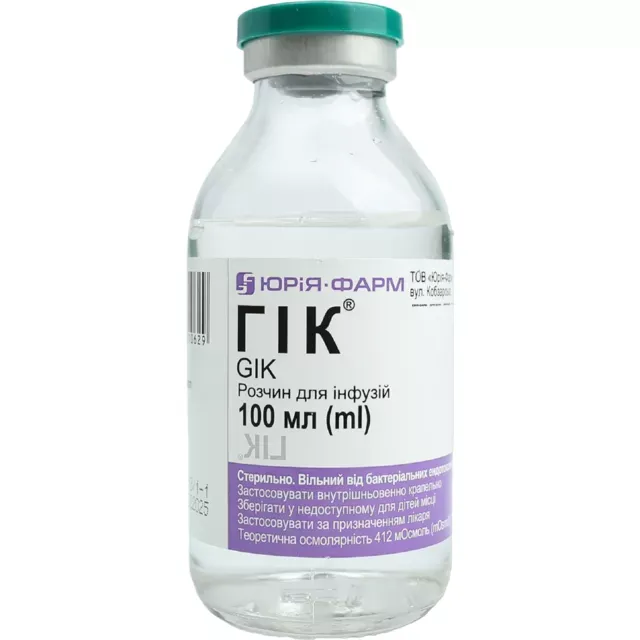
Table of Contents
INSTRUCTION for medical use of the medicinal product GIK® (GІK)
Composition:
Active substances: 1 ml of solution contains: potassium chloride 5.0 mg, glucose monohydrate (calculated as anhydrous substance) 50.0 mg;
Excipient: water for injections.
Pharmaceutical form. Infusion solution.
Main physico-chemical properties: clear colorless or slightly yellowish liquid;
Ion content per 1 liter of product: K+ – 67.06 mmol – 2.6 mg; Cl– – 67.06 mmol – 2.4 mg;
theoretical osmolarity – 412 mOsmol/L.
Pharmacotherapeutic group. Plasma substitutes and perfusion solutions. Electrolytes with carbohydrates. ATC code B05B B02.
Pharmacological properties.
Pharmacodynamics.
A potassium-replenishing agent. Helps maintain adequate intracellular and extracellular potassium levels. Potassium is the main intracellular ion and plays an important role in cellular metabolism and regulation of various body functions. Potassium ions activate a large number of cytoplasmic enzymes, regulate intracellular osmotic pressure, enhance the tone of the sympathetic division of the autonomic nervous system, increase adrenaline production by the adrenal glands, stimulate synthesis of ATP (adenosine triphosphate), glycogen, proteins, and acetylcholine. Potassium reduces heart rate, decreases myocardial contractility, conductivity, automaticity, and excitability. In low doses, potassium dilates coronary vessels; in high doses, it constricts them. Glucose is a readily absorbable energy substrate that simultaneously promotes potassium penetration into cardiomyocytes, thereby increasing its intracellular concentration.
The drug corrects electrolyte imbalance in the body, improves myocardial metabolism and energy supply, and has antiarrhythmic properties. It reduces increased sensitivity to cardiac glycosides and diminishes their cardiotoxic effects.
Pharmacokinetics.
Following infusion, the medicinal product enters cells, particularly cardiomyocytes, in the form of potassium ions. Potassium and glucose are incorporated into cellular metabolism. Potassium is excreted in the urine.
Clinical characteristics.
Indications.
Tachycardia, extrasystolic arrhythmia caused by hypokalemia, including digitalis intoxication; severe hypokalemia (serum potassium concentration less than 2.5 mmol/L).
Contraindications.
Hyperglycemia, acute and chronic renal failure, complete heart block, atrioventricular (AV) conduction disturbances, hyperkalemia, metabolic disorders (acidosis, hypovolemia with hyponatremia), hyperhydration, acute dehydration, hyperchloremia, cerebral edema, Addison's disease, hypersensitivity to glucose, extensive burns, intestinal obstruction.
The medicinal product must not be administered simultaneously with blood preparations.
Interaction with other medicinal products and other types of interactions.
The drug improves tolerance of cardiac glycosides, thus allowing simultaneous administration of strophanthin or digitalis preparations if necessary. When used concomitantly with thiazide diuretics and furosemide, their ability to affect serum glucose levels should be taken into account. Potassium-sparing diuretics, ACE inhibitors (angiotensin-converting enzyme inhibitors), and trimethoprim increase the risk of developing hyperkalemia, which requires monitoring of blood potassium levels during their concomitant use with ГІК® solution. Simultaneous administration of insulin with ГІК® solution in cases of arrhythmia caused by hypokalemia promotes repolarization of cardiac cells and facilitates glucose uptake into peripheral tissues. Glucose contained in ГІК® solution reduces the hepatotoxic effect of pyrazinamide.
In cases of arrhythmias caused by hypokalemia, insulin may be added to the ГІК® infusion solution at a dose of 2 IU per 100 mL of glucose to enhance cardiac cell repolarization.
Do not use as a solvent or carrier for administration of other medicinal products.
Under the influence of potassium preparations, the cardiac effect of quinidine is enhanced.
Concomitant parenteral administration of calcium ions may cause arrhythmia.
Special precautions for use
Use with caution in patients with impaired AV conduction. It should be taken into account that potassium salts toxicity increases in adrenal insufficiency. The drug should be administered very cautiously in patients with intracranial and intraspinal hemorrhages. During prolonged intravenous administration, blood glucose levels should be monitored. When administering large doses, insulin may be required subcutaneously at a dose of 1 IU per 4–5 g of glucose.
To prevent the development of plasma hypoosmolality, GIK® solution may be combined with the administration of isotonic sodium chloride solution.
The contents of a single vial should be used for only one patient; any unused solution must be discarded.
Plasma potassium levels and ECG should be monitored. Use with caution in combination with potassium-sparing diuretics.
Rapid administration may lead to hyperkalemia, which potentially can result in a fatal outcome.
Use during pregnancy or breastfeeding
There are no data indicating contraindications during pregnancy or breastfeeding; however, it should be remembered that potassium preparations reduce uterine tone. GIK® should be used cautiously and only for life-threatening indications in pregnant women with nephropathy. The drug may be used when there are life-threatening indications, provided that the benefit outweighs the risk.
Ability to influence reaction rate while driving or operating machinery
Since the medicinal product should be administered only under hospital conditions, data regarding such effects are not available.
Dosage and Administration.
The dosage regimen and duration of treatment should be determined individually, monitoring electrocardiography results and serum potassium levels.
Generally, adults should be administered 1–2 infusions per day of 200 ml each (1 g calculated as potassium chloride). The infusion rate is 20–30 drops per minute.
Children.
Experience of use is lacking.
Overdose.
Overdose often remains asymptomatic until serum potassium concentration reaches high levels (6.5–8 mmol/L). It manifests as an intensification of adverse reactions. Hyperkalemia and hyperhydration may develop. Patients may experience muscle weakness, abdominal pain, paresthesia, rapid shallow breathing, arrhythmia, possible loss of consciousness, and increased body temperature. Early signs of hyperkalemia include apathy, decreased arterial pressure and body weight, and mental disorders.
Hyperglycemia may also occur.
Electrocardiogram shows increased T-wave amplitude, ST-segment depression, QRS complex widening, reduced P-wave amplitude, and prolonged PQ interval.
In case of overdose, symptomatic treatment aimed at supporting vital functions should be administered. Parenteral administration of regular insulin preparations and calcium preparations is indicated. Hemodialysis should be performed if necessary.
Side effects.
Electrolyte imbalance:
- hypophosphatemia;
- hypomagnesemia;
- hyperkalemia;
- hyperglycemia;
- hyponatremia.
Gastrointestinal disorders:
- dyspeptic disorders: nausea, abdominal pain.
Cardiovascular system disorders:
- bradycardia;
- cardiac conduction disorders, arrhythmia, extrasystole;
- arterial hypotension.
Immune system disorders:
- hypersensitivity reactions, including fever, skin rashes, pruritus, angioneurotic edema, shock.
Nervous system disorders:
in isolated cases with high-dose administration, weakness, paresthesia, confusion may occur.
General disorders:
- hyperglycemia;
- hypervolemia;
- malaise;
- sore throat;
- injection site reactions, including pain at injection site and phlebitis.
If adverse reactions occur, administration of the solution should be discontinued. Symptomatic therapy should be administered.
Shelf life. 2 years.
Storage conditions.
Store at a temperature not exceeding 25 °C. Keep out of reach of children.
Incompatibility.
Since glucose is a component, the medicinal product is incompatible in solutions with aminophylline, barbiturates, erythromycin, hydrocortisone, warfarin, kanamycin, soluble sulfonamides, and cyanocobalamin.
Packaging.
100 ml or 200 ml in bottles.
Prescription status.
By prescription only.
Manufacturer.
LLC "Yuria-Pharm".
Manufacturer's address and location of business activity.
108, Kozbirska Street, Cherkasy, Cherkasy region, 18030, Ukraine.
Tel.: (044) 281-01-01.