Hydrocortisone
Ukraine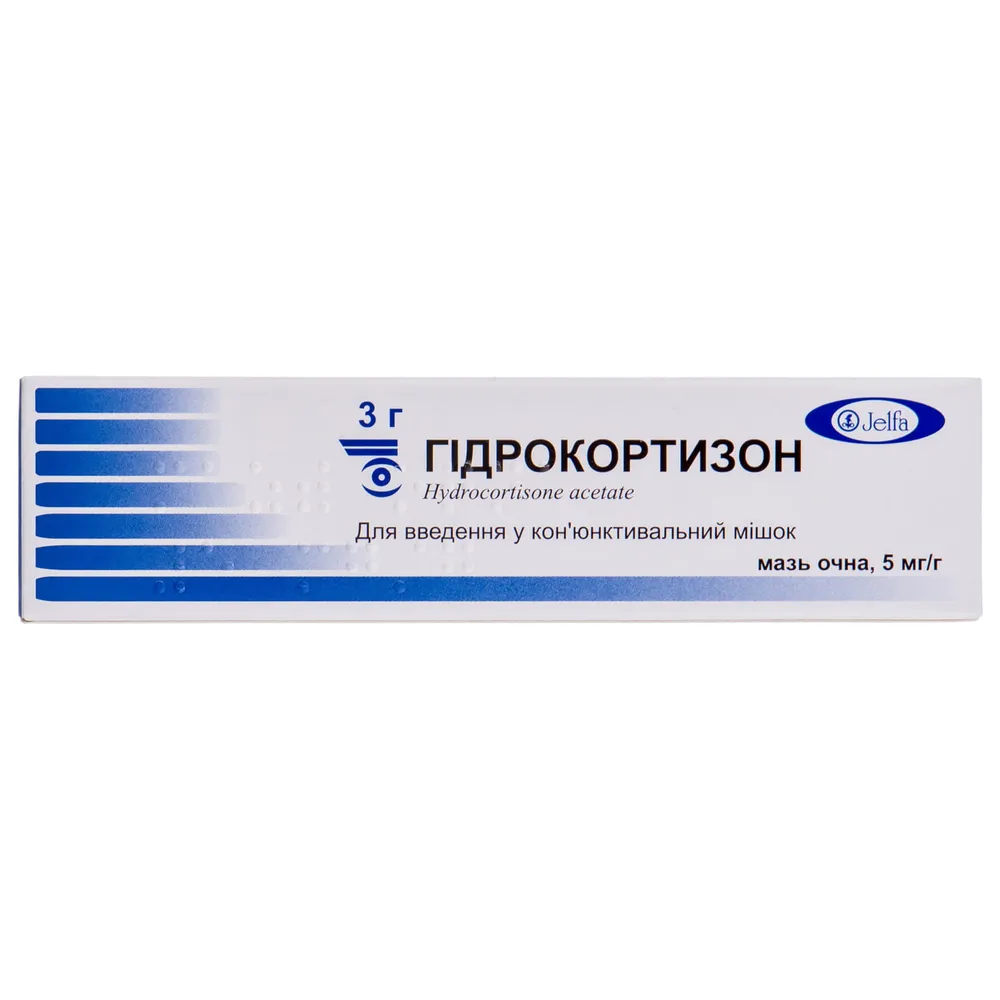
Table of Contents
INSTRUCTIONS FOR MEDICAL USE OF THE MEDICINAL PRODUCT HYDROCORTISONE
Composition:
Active ingredient: hydrocortisone acetate;
1 g of ointment contains 5 mg of hydrocortisone acetate;
Excipients: methylparaben (E 218), white soft paraffin.
Pharmaceutical form. Eye ointment.
Main physicochemical properties: a white or almost white, semi-transparent, greasy, soft mass of homogeneous consistency with a faint odour of the ointment base.
Pharmacotherapeutic group. Agents used in ophthalmology. Anti-inflammatory agents. Simple corticosteroids. ATC code S01B A02.
Pharmacological Properties
Pharmacodynamics
The mechanism of action of corticosteroids has not yet been fully elucidated. It is believed that corticosteroids interact with protein receptors in the cytoplasm of sensitive cells, forming a "steroid-receptor" complex. After appropriate conformational changes, the "steroid-receptor" complex enters the nucleus, where it affects the cell's genetic apparatus, resulting in the inhibition of synthesis of certain proteins responsible for chemotaxis and immunological reactions. In addition, due to functional changes in leukocytes and macrophages, inflammatory and allergic reactions are suppressed. The anti-inflammatory efficacy of hydrocortisone is due to inhibition of phospholipase A2, an enzyme essential for the synthesis of arachidonic acid, which is a precursor of pro-inflammatory substances—prostaglandins and leukotrienes. Thus, corticosteroids are effective in inflammatory processes in mesenchymal tissues caused by infections, allergens, and trauma.
Pharmacokinetics
The extent of penetration of hydrocortisone acetate, which largely depends on the condition of the cornea, significantly increases during inflammation or damage to ocular mucous membranes.
Hydrocortisone is absorbed by the aqueous humor, cornea, iris, choroid, ciliary body, and retina. Systemic absorption occurs, but it is likely to be clinically significant only with high doses or prolonged treatment in children.
The plasma half-life of hydrocortisone is approximately 90 minutes. It is primarily inactivated in the liver. Over 90% of hydrocortisone is excreted by the kidneys as glucuronide. Only about 0.5% of the dose is found in urine as free cortisol. Approximately 90% of hydrocortisone is bound to plasma proteins, of which about 75% bind to specific transport proteins.
Clinical characteristics
Indications
- Allergic conjunctivitis;
- acute and chronic iritis, iridocyclitis, uveitis, choroidoretinitis;
- sympathetic ophthalmia, postoperative irritations.
For restoration of corneal transparency after keratitis (chemical burns); for suppression of neovascularization.
Contraindications
- Hypersensitivity to the active substance or to any of the excipients of the medicinal product;
- epithelial herpetic keratitis or other viral eye diseases;
- bacterial eye infections;
- corneal wounds and ulcerative lesions;
- open-angle and closed-angle glaucoma;
- ocular tuberculosis or fungal eye infections.
Interaction with other medicinal products and other types of interactions
During treatment with hydrocortisone, vaccination against smallpox and other forms of immunization are not recommended due to the lack of immune response. Increased systemic absorption of hydrocortisone may reduce the effectiveness of insulin, as well as oral hypoglycemic and antihypertensive agents, anticoagulants, and drugs that lower blood salicylate levels, particularly in cases of incorrect or prolonged use. The risk of adverse reactions is higher when used concomitantly with oral contraceptives, anabolic steroids, neuroleptic drugs, cholinergic receptor inhibitors, antihistamines, tricyclic antidepressants, nitrates, and cardiac glycosides. Due to mutual inactivation, the medicinal product must not be used together with preparations containing lead or silver.
Concomitant use with other agents that may increase intraocular pressure (e.g., atropine or other anticholinergic agents) may lead to additional elevation of intraocular pressure in predisposed patients.
Concomitant use with CYP3A inhibitors, including products containing cobicistat, increases the risk of systemic adverse reactions. Such combinations should be avoided unless the expected benefit outweighs the potential risk of systemic corticosteroid-related adverse effects. When this medicinal product is used, patients should be monitored for the development of systemic corticosteroid-related adverse reactions.
When using this medicinal product together with other local ophthalmic agents, a 15-minute interval should be maintained between administrations, and hydrocortisone acetate ointment should be applied last.
Special precautions for use
Prolongation of treatment duration is not recommended. Since prolonged treatment (more than 2 weeks) with ophthalmic corticosteroid preparations may cause reversible elevation of intraocular pressure or irreversible cataract formation, regular monitoring of intraocular pressure and the condition of the cornea and lens is required when the medication is used continuously for more than 2 weeks.
In diseases causing corneal thinning, use of the medication may lead to corneal perforation.
Use of the medication increases the risk of developing bacterial, fungal, or viral (e.g. herpes simplex-induced keratitis) eye infections.
Corticosteroids should not be prescribed for local application in cases of undiagnosed red eye, as inappropriate use of the medication may lead to blindness.
Visual disturbances may occur during treatment with systemic and topical corticosteroids.
If symptoms such as blurred vision or other visual disturbances occur, patients should consult an ophthalmologist to evaluate possible causes, including cataract, glaucoma, or rare conditions such as central serous chorioretinopathy, which has been reported with use of both systemic and topical corticosteroids.
During treatment with hydrocortisone acetate ophthalmic ointment, contact lenses should not be worn. Prolonged use may also lead to skin sensitization and development of organism resistance. Long-term use may pose a risk of adrenal suppression in infants. Infants born to mothers who used hydrocortisone acetate ophthalmic ointment during pregnancy should be carefully examined for adrenal insufficiency (hypoadrenalism). Corticosteroid treatment should not be repeated or prolonged without regular examinations to rule out possible increased intraocular pressure, cataract formation, or unexpected infections.
Cases of hypertrophic cardiomyopathy have been reported after administration of hydrocortisone in premature newborns; therefore, diagnostic evaluation and monitoring of cardiac function and structure are advisable.
Use during pregnancy or breastfeeding
Pregnancy
Since significant amounts of the active substance may enter the systemic circulation after application of hydrocortisone acetate ophthalmic ointment, use of the medication during pregnancy should be avoided. If use of hydrocortisone acetate ophthalmic ointment is absolutely necessary during pregnancy, treatment should be conducted for the shortest possible duration and at the lowest effective doses.
Prolonged use of corticosteroids during pregnancy may be associated with intrauterine growth retardation of the fetus. Animal studies have shown that corticosteroids may cause congenital cleft palate. The potential increase in the incidence of congenital cleft palate in humans due to maternal corticosteroid treatment during the first trimester of pregnancy is still under investigation.
Based on results of epidemiological and animal studies, a possible link between metabolic and cardiovascular diseases in adulthood and intrauterine exposure to corticosteroids is being discussed. When corticosteroids are administered late in pregnancy, adrenal atrophy may develop in the fetus, which may require replacement therapy with gradual dose reduction.
Breastfeeding
Corticosteroids may pass into breast milk. Adverse effects in infants have not been reported to date. However, the medication should be used during breastfeeding only if clearly indicated. Breastfeeding should be discontinued if higher doses of the medication are required for treatment.
Fertility
Currently, there is no information available regarding adverse effects of the medication on fertility.
Ability to affect reaction speed while driving or operating machinery
After application of hydrocortisone ophthalmic ointment, vision may be temporarily impaired due to film formation on the cornea, resulting in reduced reaction speed while driving or operating machinery. Therefore, such patients are advised to apply the ointment only in the evening before bedtime.
Method of Administration and Dosage
Unless otherwise prescribed by a physician, apply a strip of ointment approximately 1 cm in length into the conjunctival sac several times a day. When applying the ointment, avoid contact between the tube tip and the eye or skin. Contact lenses must be removed prior to application of the medication and should not be worn during the entire course of treatment.
The usual duration of treatment should not exceed 2 weeks. The exact duration of treatment is determined by the physician, taking into account treatment efficacy, possible adverse reactions, and the clinical condition of the disease.
Depending on the clinical picture, treatment efficacy, intraocular pressure, and corneal condition should be monitored periodically to determine whether continuation or modification of therapy is necessary.
Children
There is no experience with the use of this medicinal product for the treatment of children.
Overdose
With proper use of the medicinal product, overdose or intoxication is not expected. No cases of overdose with medicinal products containing hydrocortisone have been reported to date. Therefore, information regarding specific symptoms of overdose and its treatment is lacking.
Adverse Reactions
Eye-related: In epithelial corneal injury, the healing effect may be suppressed, increasing the risk of corneal perforation. Delays healing of the damaged cornea.
When corticosteroids are used locally in conditions causing thinning of the cornea or sclera, cases of perforation may occur.
Possible blurred vision, ptosis, mydriasis.
In some patients sensitive to corticosteroids, prolonged treatment with ophthalmic corticosteroid preparations without regular monitoring of intraocular pressure may lead to increased intraocular pressure, resulting in optic nerve damage, decreased visual acuity, visual field constriction, or irreversible cataract formation.
Prolonged treatment may lead to the development of post-steroid glaucoma. After several treatment cycles, glaucoma may recur.
Cardiovascular system: Hypertrophic cardiomyopathy in premature infants (frequency unknown).
Infections: Secondary infections, especially of viral origin, may spread.
In certain viral infections (Herpes simplex), corticosteroid treatment requires strict medical supervision with frequent slit-lamp examinations. Concomitant use of hydrocortisone acetate ophthalmic ointment may mask acute bacterial, viral, and fungal corneal infections. Since fungal corneal infections often develop during prolonged corticosteroid therapy, especially in the presence of pre-existing corneal defects or after completion of therapy, the possibility of such infection should be considered.
Immune system: Hypersensitivity reactions, including itching, burning sensation, transient blurred vision; contact dermatitis, dermatokeratoconjunctivitis, and eyelid eczema may occur.
Contains methylparaben. May cause delayed-type allergic reactions.
Reporting of adverse reactions
Reporting suspected adverse reactions after drug registration is important. It enables continuous monitoring of the benefit-risk balance of the medicinal product. Healthcare and pharmaceutical professionals, as well as patients or their legal representatives, should report all suspected adverse reactions and lack of efficacy via the Automated Pharmacovigilance Information System at: https://aisf.dec.gov.ua.
Shelf life: 2 years.
Shelf life after first opening of the tube: 4 weeks.
Do not use after the expiry date.
Storage conditions
Store at a temperature not exceeding 15°C.
Keep out of reach of children.
Packaging
3 g in a tube, 1 tube per cardboard box.
Prescription status
Prescription only.
Manufacturer
LLC "Arpimed".
Manufacturer's address and location of business activity
Building 19, 2nd microdistrict, city of Abovyan, Kotayk region, Republic of Armenia.