Hyalgan
Ukraine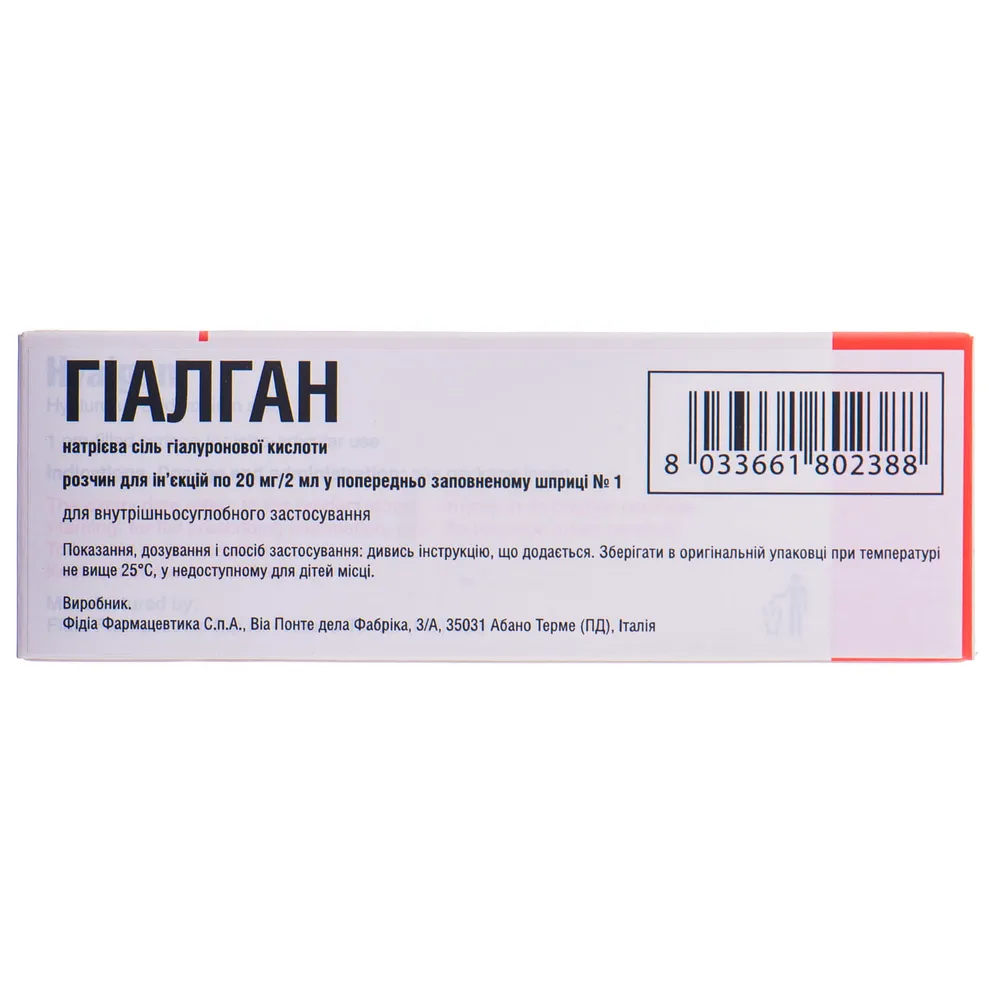
Table of Contents
INSTRUCTIONS FOR MEDICAL USE OF THE MEDICINAL PRODUCT HYALGAN® (HYALGAN®)
Composition:
Active substance: hyaluronic acid;
2 ml of solution contain 20 mg of sodium hyaluronate;
Excipients: sodium chloride; sodium dihydrogen phosphate dihydrate; sodium hydrogen phosphate dodecahydrate; water for injections.
Pharmaceutical form. Solution for injection.
Main physicochemical properties: clear, highly viscous aqueous solution.
Pharmacotherapeutic group. Agents used in disorders of the musculoskeletal system. ATC code M09AX01.
Pharmacological properties.
Pharmacodynamics.
Hyaluronic acid is a component present in high concentrations in articular cartilage and synovial fluid. Endogenous hyaluronic acid provides viscosity and elasticity of synovial fluid, and is also necessary for the formation of proteoglycans in articular cartilage. By normalizing the quality of synovial fluid and activating tissue regeneration processes in articular cartilage, the drug improves joint function. Hyalgan exerts an anti-inflammatory effect on the joint epithelium and stimulates the natural production of hyaluronic acid within the joint.
Pharmacokinetics.
Hyaluronic acid is effectively metabolized in the body, rapidly cleared from the bloodstream, and quickly degraded in the liver. Metabolites are predominantly excreted via urine. Approximately 42% of the administered dose is detected in the liver within 24 hours after administration. The drug is detectable in synovial fluid within 2 hours and in articular cartilage within 6 hours. Cartilage is the most stable site of hyaluronic acid localization. Hyaluronic acid remains in synovial fluid for 4–5 days.
Clinical characteristics.
Indications. Mild to moderate knee joint arthritis.
Contraindications. Individual hypersensitivity to the components of the drug. History of allergy to poultry protein. Severe liver function disorders.
Intra-articular injections are contraindicated in the presence of active infection or skin diseases at the injection site in order to reduce the potential risk of septic arthritis development.
Interaction with other medicinal products and other forms of interaction.
Hyaluronic acid interacts with certain local anesthetics, prolonging their analgesic effect.
Special precautions for use.
- Disinfectants containing quaternary ammonium salts are not recommended, as contact with hyaluronic acid may lead to precipitate formation;
- intra-articular injection must be performed by competent medical personnel according to established procedures under aseptic conditions required for this route of administration;
- prior to intra-articular injection, the patient should be examined for signs of acute inflammation. If such signs are present, the physician must evaluate the appropriateness of administering the injection;
- in some patients with inflammatory arthritis (rheumatoid arthritis or gouty arthritis), transient increase in inflammation has been observed after administration of the medicinal product;
- in the presence of joint effusion, aspiration is recommended prior to administration of Hyalgan;
- it is recommended to avoid overloading the joint for several hours after injection.
Use during pregnancy or breastfeeding. Although no embryotoxicity or teratogenic effects were observed in animal studies, use of the drug in pregnant women and breastfeeding mothers should be limited, except in cases where, in the physician's judgment, it is absolutely necessary, and only after careful risk/benefit assessment.
Ability to influence reaction rate while driving or operating machinery. No effect.
Administration and Dosage.
For adults, administer 2 ml of Hyalgan (20 mg) by intra-articular injection once a week for 5 weeks.
Children. Should not be administered to children.
Overdose. Symptoms related to overdose have not been reported to date.
Adverse reactions.
Reactions at the injection site, including discomfort, pain, swelling, redness, irritation, rash, nodules, pustules, vesicles, hemorrhages, ecchymosis, pruritus, joint inflammation, synovitis, joint effusion, joint stiffness, and impaired joint mobility. These symptoms usually resolve within a few days by resting the joint and applying an ice pack. Only in isolated cases were such reactions more prolonged and severe.
Hypersensitivity reactions, including anaphylactoid reactions, angioneurotic edema, skin reactions such as rash, pruritus, erythema, eczema, dermatitis, urticaria; very rarely anaphylactic shock, but without fatal outcomes; serum sickness; fever, hot flushes, headache, paresthesia.
In patients with chronic inflammatory disease in the stage of exacerbation, administration of hyaluronic acid has worsened the clinical condition in some individual cases.
Cases of bacterial arthritis and reactive arthritis at the site of intra-articular injection have been observed (see section "Special precautions").
Shelf life. 3 years.
Storage conditions. Store in the original packaging, out of reach of children, at a temperature not exceeding 25 °C.
Incompatibility. Should not be mixed with other medicinal products in the same container.
Packaging. 2 mL in a glass vial; 1 vial in a blister; 1 blister per carton.
2 mL in a pre-filled glass syringe; 1 syringe in a blister; 1 blister per carton.
Prescription status. Prescription only.
Manufacturer. Fidia Farmaceutici S.p.A., Italy.
Manufacturer's address and location of its business operations.
Via Ponte della Fabbrica 3/A, 35031 Abano Terme (PD), Italy.