Heparin-biolic
Ukraine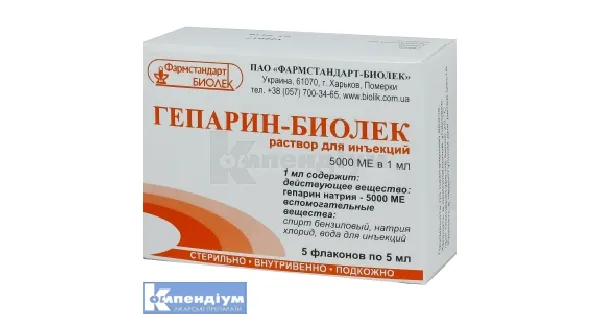
Table of Contents
INSTRUCTIONS FOR MEDICAL USE OF THE MEDICINAL PRODUCT HEPARIN-BIOLIK (HEPARIN-BIOLIK)
Composition:
Active substance: heparin;
1 ml of solution contains 5000 IU of sodium heparin;
Excipients: benzyl alcohol, sodium chloride, water for injections.
Pharmaceutical form.
Solution for injection.
Main physico-chemical properties: clear, colorless or slightly yellow liquid.
Pharmacotherapeutic group.
Antithrombotic agents. Heparin group. ATC code B01A B01.
Pharmacological Properties
Pharmacodynamics
Heparin is a glycosaminoglycan (mucopolysaccharide) composed of sulfated residues of D-glucosamine and D-glucuronic acid.
Heparin is a direct-acting anticoagulant. In solution, heparin carries a negative charge, which promotes its interaction with proteins involved in the blood coagulation process. Heparin binds to antithrombin III (heparin cofactor) and inhibits blood coagulation by inactivating factors V, VII, IX, and X. This results in neutralization of factors that promote blood coagulation (kallikrein, IXa, Xa, XIa, XIIa) and disruption of the conversion of prothrombin to thrombin. When thrombus formation has already begun, high doses of heparin can inhibit further coagulation by inactivating thrombin and suppressing the transformation of fibrinogen into fibrin. Heparin also prevents the formation of stable fibrin clots by inhibiting activation of the fibrin-stabilizing factor. After parenteral administration, heparin delays blood coagulation, activates the fibrinolysis process, suppresses the activity of certain enzymes (hyaluronidase, phosphatase, trypsin), and slows down the effect of prostacyclin on platelet aggregation induced by adenosine diphosphate.
Pharmacokinetics
After intravenous infusion, maximum plasma concentration is reached within a few minutes; after slow intravenous infusion, not later than 2–3 minutes; after subcutaneous injection, within 40–60 minutes. The volume of distribution of heparin corresponds to plasma volume and increases significantly with higher doses of the drug. Plasma proteins bind up to 95% of heparin at blood concentrations of 2 IU/mL; at higher concentrations, binding is lower. Heparin is partially metabolized in the liver. Approximately 20% is excreted in urine as unchanged heparin and uroheparin (which has 50% of the activity of the parent compound). The biological half-life ranges from 1.32 to 1.72 hours. The plasma elimination half-life is 30–60 minutes. Heparin accumulates in hepatic insufficiency. Heparin does not penetrate into breast milk and poorly crosses the placenta.
Clinical characteristics.
Indications.
- Prevention and treatment of thromboembolic disorders and their complications (acute coronary syndrome, thrombosis and embolism of major veins and arteries, cerebral and ocular vessels, phase I of disseminated intravascular coagulation syndrome, permanent atrial fibrillation with embolization);
- prevention of postoperative venous thrombosis and pulmonary artery embolism (in low-dose regimen) in patients undergoing surgical procedures or in those who, for any other reasons, are at risk of developing thromboembolic disease;
- prevention of blood coagulation during laboratory tests, dialysis, extracorporeal circulation, cardiac and vascular surgery, and direct blood transfusion.
Contraindications.
Hypersensitivity to heparin and/or benzyl alcohol; hemophilia; hemorrhagic diatheses; thrombocytopenia, suspicion of heparin-induced immune thrombocytopenia; peptic ulcer of the stomach and duodenum; severe arterial hypertension; liver cirrhosis associated with esophageal varices; severe renal and hepatic insufficiency; bacterial endocarditis; menstruation; recent surgical interventions, especially neurosurgical and ophthalmological procedures; ulcerative colitis; malignant neoplasms; hemorrhagic stroke (first 2–3 days); head injuries; retinopathy; hemorrhage into ocular tissues; destructive pulmonary tuberculosis; encephalomalacia; hemorrhagic pancreonecrosis; bleeding of any localization (open gastric ulcer, intracranial hemorrhage), except for hemorrhage occurring on the background of embolic pulmonary infarction (hemoptysis) or kidneys (hematuria); recurrent bleeding in medical history, regardless of localization; increased vascular permeability (e.g., in Werlhof’s disease); shock state; threat of abortion.
Heparin must not be used in: patients who have consumed high doses of alcohol; by intramuscular injection; in acute and chronic leukemias; aplastic and hypoplastic anemias; acute aneurysm of the heart and aorta; during surgery on the brain or spinal cord, eyeball, or ears; after surgical procedures in areas where bleeding may be life-threatening; in diabetes mellitus when epidural anesthesia is administered during childbirth. Conductive anesthesia is contraindicated in patients receiving therapeutic doses of heparin undergoing planned surgical procedures, since heparin use in rare cases may cause epidural or spinal hematomas, potentially leading to prolonged or irreversible paralysis.
Interaction with other medicinal products and other forms of interactions.
Oral anticoagulants (dicoumarol) and antiplatelet agents (acetylsalicylic acid, dipyridamole) should be discontinued at least 5 days before any surgical intervention, as they may enhance the risk of bleeding during or after surgery.
Direct and indirect-acting anticoagulants potentiate the effect of heparin. Concurrent use of ascorbic acid, antihistamines, digitalis preparations, tetracyclines, nicotine, nitroglycerin, corticotropin, and thyroxine may suppress the anticoagulant effect of the drug. Agents that reduce platelet aggregation (acetylsalicylic acid, dextrin, phenylbutazone, ibuprofen, metindol, dipyridamole, hydroxychloroquine, fibrinolytics, ascorbic acid, ergot alkaloids, indomethacin, sulfinpyrazone, probenecid, cephalosporins, ketorolac, epoprostenol, clopidogrel, ticlopidine, streptokinase, intravenous penicillins, etacrynic acid, cytostatics) may cause hemorrhage when used concomitantly with heparin and therefore must be administered with extreme caution. The risk of hemorrhage is also increased when heparin is combined with ulcerogenic, immunosuppressive, and thrombolytic agents.
Heparin may displace phenytoin, quinidine, propranolol, benzodiazepines, and bilirubin from plasma protein binding sites. Alkaline medicinal products, enalaprilat, and tricyclic antidepressants may bind to heparin when used concurrently, resulting in mutual reduction of efficacy.
Angiotensin-converting enzyme (ACE) inhibitors, angiotensin II antagonists: hyperkalemia may occur.
Alcohol: concurrent consumption of alcoholic beverages may significantly increase the risk of bleeding.
The risk is also increased when heparin is used concomitantly with ulcerogenic, immunosuppressive, and thrombolytic medicinal products.
Effect on laboratory test results. False elevation of total thyroxine and triiodothyronine levels. Pseudopositive metabolic acidosis and hypocalcemia (in patients undergoing hemodialysis). Inhibition of chromogenic limulus tests for endotoxin detection. Heparin-Biolik may interfere with immunoassay determination of aminoglycosides.
Special precautions for use.
When prescribing heparin for therapeutic purposes, the drug must not be administered intramuscularly. Biopsies, epidural anesthesia, and diagnostic lumbar punctures should be avoided.
Heparin should be used with caution in patients with a history of hypersensitivity reactions to low-molecular-weight heparins.
Platelet count should be determined before starting treatment, on the first day of treatment, and every 3–4 days throughout the entire period of heparin administration (especially between days 6 and 14 after initiation of therapy). Sudden drop in platelet count requires immediate discontinuation of the drug and further investigation to determine the etiology of thrombocytopenia. If heparin-induced thrombocytopenia type I or II is suspected, heparin therapy should be discontinued.
When switching from heparin therapy to oral anticoagulants, heparin should be discontinued only when the indirect anticoagulants have achieved a therapeutic range of prothrombin time for at least 2 consecutive days.
Except for low-dose regimens, coagulation tests should always be performed before initiating therapy.
Heparin should be prescribed with extreme caution in patients with conditions associated with an increased risk of bleeding (e.g., arterial hypertension).
To prevent significant hypocoagulation, the dose of heparin should be reduced without increasing the intervals between injections.
During heparin therapy, hematological parameters should be monitored, and the patient's clinical condition and the development of hemorrhagic complications should be closely observed.
The preparation contains benzyl alcohol as an excipient; therefore, heparin should not be used in premature infants and newborns. Benzyl alcohol may cause toxic and allergic reactions in infants and children under 3 years of age.
Discontinuation of the drug should be gradual.
In patients aged 60 years and older (especially in women) and in patients with impaired renal function, heparin may cause hemorrhages.
Patients sensitive to animal-derived proteins may also be sensitive to heparin.
If hypersensitivity reaction is suspected, a diluted test dose of 1000 IU should be slowly administered intravenously several minutes before the full dose.
Administration of the medicinal product Heparin-Biolik requires caution during the postoperative and postpartum periods within the first 3–8 days (except for vascular surgery and cases where heparinization is indicated for life-threatening conditions). Particular caution is required within 36 hours after delivery.
In patients with arterial hypertension, arterial blood pressure should be monitored.
In patients with renal insufficiency, metabolic acidosis, elevated blood potassium concentration, or those receiving potassium-containing preparations, frequent monitoring of serum potassium levels is recommended due to the increased risk of hyperkalemia.
Use during pregnancy or breastfeeding.
Heparin is not contraindicated during pregnancy. The drug does not cross the placenta. Although heparin does not pass into breast milk, its use in breastfeeding mothers has in individual cases led to rapid (within 2–4 weeks) development of osteoporosis and spinal damage. The decision on using the drug should be made individually, weighing the benefit to the mother against the potential risk to the fetus.
Ability to affect reaction speed when driving or operating machinery.
There is no data on the effect of heparin on the ability to drive or operate machinery.
Administration and Dosage.
Heparin-Biolik should be administered as intravenous bolus or intermittent injections or subcutaneously. Before administering the drug, it is necessary to determine blood clotting time, thrombin time, activated partial thromboplastin time (aPTT), and platelet count. For dilution of heparin, use only 0.9% sodium chloride solution.
Adults:
For acute thrombosis, treatment should begin with intravenous administration of 10,000–15,000 IU of Heparin-Biolik, monitoring venous blood coagulation, thrombin time, and activated partial thromboplastin time. Subsequently, 5,000–10,000 IU of Heparin-Biolik should be administered intravenously every 4–6 hours. The adequate dose of Heparin-Biolik is considered to be that which prolongs blood clotting time by 2.5–3 times and activated partial thromboplastin time by 1.5–2 times.
For prophylaxis of acute thrombosis, Heparin-Biolik should be administered subcutaneously at 5,000 IU every 6–8 hours. In the first phase of disseminated intravascular coagulation (DIC) in adults, heparin should be administered subcutaneously over a prolonged period at a daily dose of 2,500–5,000 IU under control of thrombin time. One to two days before discontinuation of Heparin-Biolik, the daily dose should be gradually reduced.
During open-heart surgery with extracorporeal circulation apparatus, patients should receive Heparin-Biolik at an initial dose of no less than 150 IU per 1 kg of body weight. If the procedure lasts less than 60 minutes, administer 300 IU/kg; if the procedure lasts more than 60 minutes, administer 400 IU/kg.
For prophylactic purposes, Heparin-Biolik should be administered subcutaneously at a dose of 5,000 IU 2 hours before surgery, followed by 5,000 IU every 6–8 hours for 7 days.
As an adjunct to streptokinase, administration of sodium heparin at 5,000 IU three times daily or 10,000–12,500 IU twice daily may be indicated in patients at increased risk of thromboembolic complications:
- in recurrent myocardial infarction;
- in permanent atrial fibrillation with embolization.
In acute coronary syndrome (unstable angina or myocardial infarction), initially administer 5,000 IU of Heparin-Biolik as an intravenous bolus, followed by continuous intravenous infusion at a rate of 1,000 IU/hour. The infusion rate should be adjusted to maintain activated partial thromboplastin time at 1.5–2 times above the normal value during the first 2–3 days.
Children.
Heparin-Biolik should be administered to children according to the following regimen: initial dose is 50 IU/kg (intravenous injection/infusion), maintenance dose is 100 IU/kg every 4 hours. The average daily dose in children is 300 IU/kg.
In infants, administer 2 to 10 IU/kg/hour intravenously (continuously or intermittently). Subcutaneous administration in infants should be at a daily dose of 200–300 IU/kg, divided into 4–6 injections.
In all cases, indirect anticoagulants should be prescribed 1–3 days before discontinuation of Heparin-Biolik.
The drug should be administered to children according to their body weight. Do not use in premature infants or newborns. Allergic reactions, including toxic ones, may occur in children under 3 years of age.
Overdose.
Severe hemorrhagic complications, bleeding. Depending on the severity of hemorrhagic complications, either reduce the dose of Heparin-Biolik or discontinue the drug. If bleeding persists after discontinuation of Heparin-Biolik, administer intravenously the heparin antagonist protamine sulfate (or chloride) (1 mL of protamine sulfate neutralizes 100 IU of heparin). Within 90 minutes after intravenous administration of Heparin-Biolik solution, administer 50% of the calculated dose of protamine sulfate, and the remaining 50% over the next 3 hours.
In case of individual intolerance or development of allergic complications, Heparin-Biolik should be discontinued immediately and desensitizing agents prescribed. If continuation of anticoagulant therapy is necessary, indirect-acting anticoagulants should be used.
Adverse Reactions
The most common adverse reactions include hemorrhages, elevated liver enzymes, reversible thrombocytopenia, and various dermatological disorders. Isolated cases of generalized allergic reactions, skin necrosis, and priapism have also been reported.
Blood system disorders:
Type I and type II thrombocytopenia; epidural and spinal hematomas, hemorrhages, hematuria, gingival bleeding, epistaxis, renal hemorrhages, hemorrhages in adrenal glands, hemoptysis.
Psychiatric disorders:
Depression.
Nervous system disorders:
Headache, dizziness.
Gastrointestinal disorders:
Nausea, vomiting, diarrhea.
Hepatobiliary system disorders:
Elevated levels of liver transaminases – alanine aminotransferase (ALT) and aspartate aminotransferase (AST), lactate dehydrogenase, gamma-glutamyl transferase, and hyperlipidemia (these disturbances are reversible and resolve upon discontinuation of the drug).
Skin and subcutaneous tissue disorders:
Rashes (erythematous, maculopapular), urticaria, pruritus, itching and burning sensation in the skin of the feet, skin necrosis, erythema multiforme, alopecia.
Musculoskeletal system disorders:
Osteoporosis, bone demineralization.
Reproductive system disorders:
Priapism.
Immune system disorders:
Skin rashes, conjunctivitis, lacrimation, rhinitis, bronchospasm, asthma, tachypnea, cyanosis, urticaria, allergic vasospasm in limbs, anaphylactoid reactions, anaphylactic shock.
Endocrine system and metabolic disorders:
Hypoaldosteronism, metabolic acidosis, hyperkalemia, increased thyroxine levels, decreased cholesterol levels, elevated blood glucose levels.
Cardiovascular system disorders:
Hemorrhages and hematomas in any organ or organ system (subcutaneous, intramuscular, retroperitoneal, nasal, gastrointestinal, gastric, uterine).
Injection site reactions:
At the injection site, especially with improper injection technique, minor hemorrhages (subcutaneous, mucosal, internal), irritation, ulcers, pain, bleeding, hematomas, and atrophy may occur.
Other:
Rhinitis, fever, malaise.
Thrombocytopenia as a complication of heparin therapy occurs in 6% of patients. It may arise as a direct result of heparin-induced platelet aggregation or due to an immune reaction where antibodies target platelets and endothelium. First-type reactions are usually mild and resolve after discontinuation of therapy, whereas second-type reactions are severe. As a consequence of thrombocytopenia, skin necrosis and arterial thrombosis ("white clot") may develop, accompanied by recurrent venous thromboembolism, gangrene, myocardial infarction, and stroke. Heparin therapy must be discontinued if severe thrombocytopenia occurs (a decrease in platelet count by half from the initial level).
Elevated transaminase activity (ALT and AST), increased levels of free fatty acids and thyroxine, and reversible potassium retention may also be observed.
Shelf life: 2 years.
Storage conditions: Store in the original packaging at a temperature not exceeding 25 °C. Keep out of reach of children.
Incompatibilities: Heparin-Biolik should not be mixed with other medicinal products in the same infusion container or syringe due to possible precipitation.
Dobutamine hydrochloride and heparin must not be mixed or administered intravenously together, as chelate complexes may form.
Packaging: 5 ml in a vial; 5 vials in a pack, or 5 vials in a blister, 1 blister per pack.
Prescription status: Prescription only.
Manufacturer:
LLC "BIOLIK PHARMA"
Manufacturer's location and address of place of business:
Legal entity location:
Ukraine, 61070, Kharkiv region, city of Kharkiv, Pomirky, building 70.
Place of business address:
Ukraine, 61070, Kharkiv region, city of Kharkiv, Pomirky-70, building b/n.