Hepa-merz
Ukraine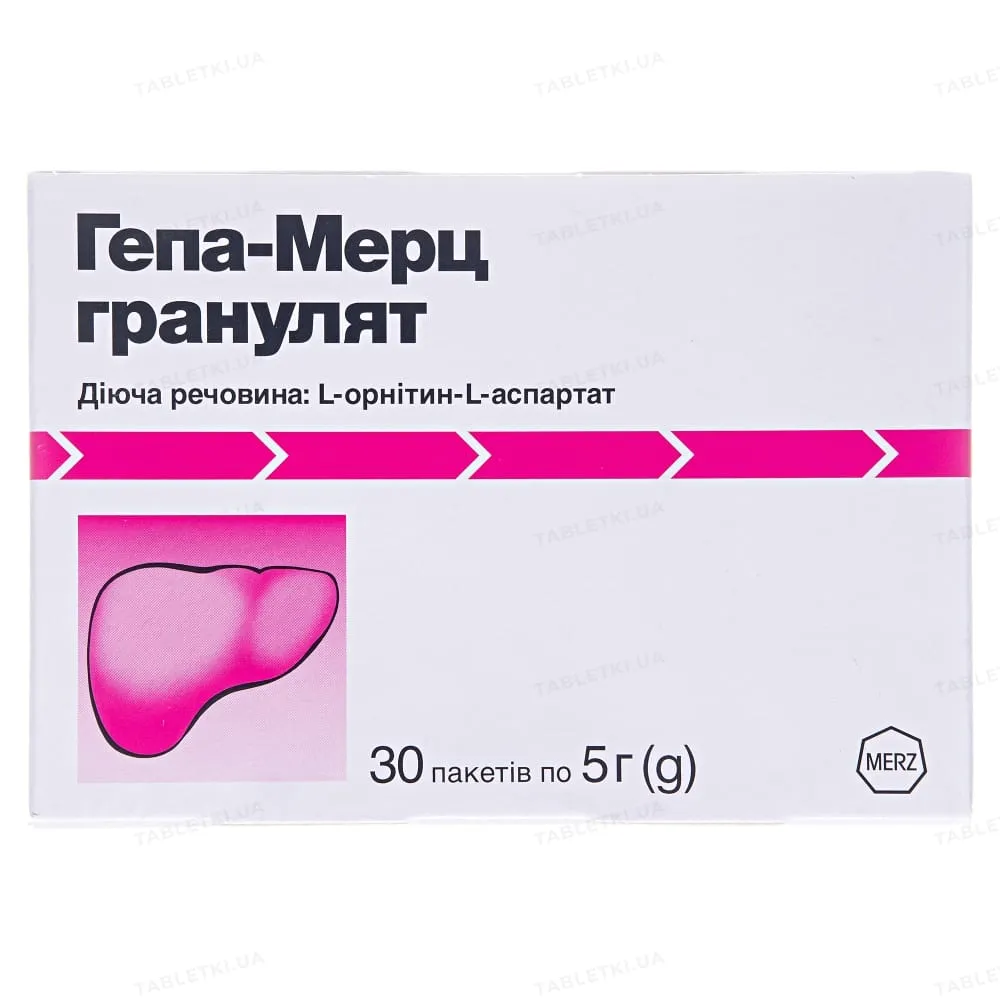
Table of Contents
INSTRUCTION FOR MEDICAL USE OF THE MEDICINAL PRODUCT Hepa-Merz
Composition:
Active substance: L-ornithine-L-aspartate;
1 sachet contains L-ornithine-L-aspartate 3 g;
Excipients: anhydrous citric acid, sodium saccharin, sodium cyclamate, povidone 25, fructose, lemon flavor, orange flavor, orange-yellow S (E 110).
Pharmaceutical form. Granules.
Main physicochemical characteristics: free-flowing granules ranging from white-orange to orange in color with an orange odor.
Pharmacotherapeutic group.
Agents used in liver diseases, lipotropic substances. Hepatotropic agents. ATC code A05BA.
Pharmacological properties.
Pharmacodynamics.
In vivo, the action of L-ornithine-L-aspartate, mediated by the amino acids ornithine and aspartate, is carried out through two key mechanisms of ammonia detoxification: urea synthesis and glutamine synthesis.
Urea synthesis occurs in the periportal hepatocytes, where ornithine acts as an activator of two enzymes: ornithine carbamoyltransferase and carbamoyl phosphate synthetase, as well as a substrate for urea synthesis.
Glutamine synthesis occurs in the perivenous hepatocytes. In particular, under pathological conditions, aspartate and dicarboxylates, including metabolites of ornithine, are absorbed by cells and used there to bind ammonia in the form of glutamine.
Glutamate is an amino acid that binds ammonia under both physiological and pathological conditions. The resulting amino acid, glutamine, represents not only a non-toxic form for ammonia elimination, but also stimulates intracellular glutamine metabolism.
Under physiological conditions, ornithine and aspartate do not limit urea synthesis.
Animal experimental studies have shown that the ability of L-ornithine-L-aspartate to reduce ammonia levels is due to accelerated glutamine synthesis. In some clinical studies, improvement in the ratio of branched-chain amino acids to aromatic amino acids has been demonstrated.
Pharmacokinetics.
L-ornithine-L-aspartate is rapidly absorbed and dissociated into ornithine and aspartate. The elimination half-life of both amino acids is short—0.3–0.4 hours. A portion of aspartate is excreted unchanged in urine.
Clinical characteristics.
Indications.
Treatment of concomitant diseases and complications caused by impaired hepatic detoxification function (e.g., in liver cirrhosis) associated with symptoms of latent or manifest hepatic encephalopathy.
Contraindications.
Hypersensitivity to L-ornithine-L-aspartate, to the colorant Orange Yellow S, or to any of the excipients.
Severe renal impairment (renal failure) when creatinine levels exceed 3 mg/100 ml.
Interaction with other medicinal products and other forms of interaction.
Interaction studies have not been performed. Data are lacking.
Special precautions for use.
Hepa-Merz granules contain 1.13 g of fructose per sachet (equivalent to 0.11 carbohydrate exchange units), which should be taken into account for patients with diabetes mellitus.
Do not use in patients with hereditary fructose intolerance.
Prolonged use of Hepa-Merz may be harmful to teeth (risk of caries development).
The colouring agent sunset yellow S (E 110) may cause allergic reactions.
High-dose administration of Hepa-Merz may lead to increased plasma uric acid levels; therefore, monitoring of blood plasma and urinary urea levels is required.
Do not use in patients with phenylketonuria.
Use during pregnancy or breastfeeding.
There are no data on the use of Hepa-Merz granules during pregnancy. Animal studies investigating the toxic effects of L-ornithine-L-aspartate on reproductive function have not been conducted. Therefore, use of Hepa-Merz granules during pregnancy should be avoided.
However, if treatment with Hepa-Merz is considered necessary due to life-threatening indications during pregnancy, the physician should carefully weigh the potential risk to the fetus/infant against the expected benefit for the mother.
It is unknown whether L-ornithine-L-aspartate passes into breast milk. Therefore, use of Hepa-Merz during breastfeeding should be avoided.
Ability to affect reaction rate when driving or operating machinery.
Due to liver disease, the ability to drive or operate machinery may be impaired during treatment with L-ornithine-L-aspartate; therefore, such activities should be avoided during therapy.
Dosage and Administration.
Dissolve the contents of 1–2 Hepa-Merz packets in a glass of water and take up to 3 times daily during or after meals.
The duration of treatment is determined by the physician depending on the patient's clinical condition.
Children.
Experience with use in children is limited; therefore, the drug should not be used in pediatric practice.
Overdose.
In case of overdose, increased levels of urea in blood and urine, as well as intensification of adverse reactions may occur.
To date, signs of intoxication caused by overdose of L-ornithine-L-aspartate have not been observed.
Treatment. No specific antidote is known. Gastric lavage and symptomatic treatment are recommended.
Side effects
The frequency of adverse reactions was defined as follows:
very common (≥ 1/10);
common (≥ 1/100, < 1/10);
uncommon (≥ 1/1000, < 1/100);
rare (≥ 1/10000, < 1/1000);
very rare (< 1/10000);
not known: cannot be estimated from available data.
Gastrointestinal side effects:
uncommon: nausea, vomiting, stomach pain, flatulence, diarrhea, constipation.
Musculoskeletal system side effects:
very rare: joint pain and muscle pain.
Skin and subcutaneous tissue side effects:
skin rashes, redness of the skin, itching, urticaria.
Neurological disorders:
dizziness.
Immune system side effects:
hypersensitivity reactions, including angioedema, anaphylactic shock, sneezing, lacrimation.
Metabolic disorders:
with high-dose administration, an increase in plasma uric acid levels is possible.
These adverse reactions are usually transient and do not require discontinuation of the medication.
The dye Orange-Yellow S (E 110) may cause allergic reactions.
Shelf life: 5 years.
Do not use after the expiry date stated on the packaging.
Storage conditions:
Store at a temperature not exceeding 25 °C.
Keep out of reach of children.
Packaging:
5 g of granules in a sachet; 30, 50, or 100 sachets in a cardboard box.
Availability:
Over-the-counter.
Manufacturer:
Merz Pharma GmbH & Co. KGaA
Manufacturer's address and place of business:
Ludwigstrasse 22, 64354 Reinheim, Germany