Gentasept
Ukraine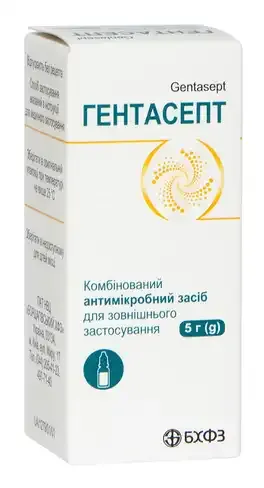
Table of Contents
INSTRUCTIONS FOR MEDICAL USE OF THE MEDICINAL PRODUCT GENTASEPT (GENTASEPT)
Composition:
Active substances: gentamicin sulfate, L-tryptophan, zinc sulfate heptahydrate, metoxan;
1 vial, dropper vial of 2 g contains a substance consisting of: gentamicin sulfate calculated as gentamicin and anhydrous substance – 0.048 g (48 mg), L-tryptophan – 0.028 g (28 mg), zinc sulfate heptahydrate – 0.020 g (20 mg), metoxan – sufficient quantity to obtain the total content mass of 2 g;
1 vial, dropper vial of 5 g contains a substance consisting of: gentamicin sulfate calculated as gentamicin and anhydrous substance – 0.120 g (120 mg), L-tryptophan – 0.070 g (70 mg), zinc sulfate heptahydrate – 0.050 g (50 mg), metoxan – sufficient quantity to obtain the total content mass of 5 g.
Pharmaceutical form.
Powder for external use.
Main physico-chemical properties: amorphous powder of white or white with a light-yellowish tint color, odorless.
Pharmacotherapeutic group.
Antibiotics in combination with chemotherapeutic agents. ATC Code D06C.
Pharmacological Properties
Pharmacodynamics
Gentasept is a prolonged-action combined antimicrobial agent for topical use, containing the aminoglycoside gentamicin sulfate, an organosilicon sorbent—polymethylsiloxane (metoxane), and a zinc tryptophan complex. Gentamicin sulfate is a broad-spectrum antibiotic with bactericidal activity against pathogenic gram-positive microorganisms: Staphylococcus aureus, Streptococcus, Mycobacterium spp., and gram-negative microorganisms: Pseudomonas aeruginosa, Aerobacter aeruginosa, Escherichia coli, Proteus spp., Klebsiella spp., Serratia spp., Shigella spp., Salmonella spp., Citrobacter spp., Providencia spp., Yersinia spp. Polymethylsiloxane provides sorption and detoxifying properties, and together with zinc tryptophan enhances the antibiotic's antibacterial effects and maintains a therapeutic antibiotic concentration in the wound for up to 8 days. Topical application of Gentasept reduces the number of microorganisms in the wound to a minimal level (10²–10³ per 1 g) by the 2nd–3rd day, accelerates the transition from the hydration phase to the dehydration phase, and prevents possible purulent-septic complications. Due to its sorption properties, the drug absorbs toxic metabolic products of microorganisms, low-molecular-weight tissue metabolites (pyruvic and lactic acids, peroxide compounds, amino acid oxidation products, polypeptides, lipids, etc.), and products of fibrin dehydration. The mechanism of action of Gentasept is associated not only with inhibition of microbial protein synthesis but also with disruption of the lipid layer of the cell wall due to complex formation. Gentasept reduces signs of local and systemic intoxication, exerts antibacterial, drainage, and anti-edematous effects, and normalizes microcirculation, gas exchange, and wound environment pH. This promotes wound debridement from exudation and tissue degradation products, resolves local inflammatory reactions, stimulates granulation tissue growth, improves wound healing, and prevents keloid scar formation. Gentasept also cleanses burn wounds, reduces inflammatory reactions during their treatment, decreases the area of deep burns by preventing tissue destruction, accelerates granulation tissue formation in deep burns and epithelialization in superficial burns, and contributes to optimal wound preparation for autodermoplasty.
Pharmacokinetics
Not studied, as Gentasept is a non-systemic preparation intended for topical use only, acting superficially without any resorptive effect.
Clinical characteristics.
Indications.
Treatment of wounds infected with pathogens sensitive to the drug:
- infected surgical wounds (postoperative suppurations, phlegmons, abscesses);
- traumatic infected wounds of various localization and origin;
- trophic ulcers occurring against the background of chronic venous insufficiency, obliterative atherosclerosis, thrombophlebitis of superficial veins of the lower limbs;
- burns of degree II and III A – III B;
- various forms of erysipelas;
- pressure sores;
- wounds in patients with various diseases in which regenerative processes are impaired (diabetes mellitus, immunodeficiency, radiation injury);
- prevention of sepsis in extensive purulent processes;
- prevention of keloid scar formation.
Contraindications.
Hypersensitivity to gentamicin sulfate and other components contained in the drug Gentaсept.
Interaction with other medicinal products and other types of interactions.
Interaction of the drug Gentaсept with other medicinal products has not been studied.
When applied over large areas of wound surface or with prolonged use, absorption of gentamicin is possible, which may enhance the ototoxicity of other aminoglycoside antibiotics, polymyxin B, colistin, cephaloridine, ethacrynic acid, furosemide.
Special precautions for use.
Gentasept can be applied to wound surfaces only after thorough surgical debridement. The product prevents dressing adherence and pain upon removal.
The product does not cause local irritation when used topically; however, contact of Gentasept with the eyes must be avoided.
Prolonged use of the product may lead to overgrowth of resistant microorganisms. If irritation, sensitization, or superinfection develops during treatment, therapy should be discontinued and appropriate treatment initiated.
With prolonged use (more than 14 days) over large skin areas, especially in patients with chronic renal insufficiency, possible systemic absorption effects of gentamicin should be considered: ototoxicity (dizziness, nausea, tinnitus), nephrotoxicity (increased blood urea and creatinine levels, decreased diuresis), and elevated serum bilirubin and transaminase levels.
Use during pregnancy or breastfeeding.
There are no data on the use of the product during pregnancy or breastfeeding. If use of Gentasept is necessary during pregnancy or breastfeeding, the physician should provide recommendations based on an assessment of the benefit-risk ratio.
Ability to affect reaction speed while driving or operating machinery.
Has no effect.
Method of Administration and Dosage
Apply Gentasept topically throughout the entire treatment period until complete wound healing. During the initial stage (days 1–5), change dressings 1–2 times daily. After inflammatory processes have subsided, the wound has been cleared of purulent-necrotic material, and granulation and epithelialization have begun, change dressings once every 1–2 days. Apply Gentasept to the wound surface via the dropper cap (the opening in the cap) after removing the lid, following thorough surgical debridement and irrigation of the wound with antiseptic solutions, ensuring subsequent thorough drying so that the agent forms a uniform layer (0.5–1 mm thick) covering the entire wound surface. In extensive lesions, such as burns, a single application of 8–12 g of the drug may be used. After application of Gentasept, drain the wound according to standard protocols and apply a dressing. In extensive tissue defects, loose packing with gauze swabs is permissible. If Gentasept partially detaches along with wound exudate and dressing, dry the wound with gauze pledgets and reapply the drug at the above single dose without any additional manipulations within the wound.
For burn treatment, apply Gentasept to the burned surface both during the first 5–6 days and during the eschar sequestration period (up to 15 days). The drug should be secured on the wound using an antiseptic dressing. During dressing changes, completely remove Gentasept from the surface of burn wounds using antiseptics or special wound shampoos. The drug may be applied to any body area in burn patients.
In cases where complete surgical wound debridement cannot be performed, sprinkle the wound with Gentasept at a dose of 0.5–4 g depending on the size of the affected area, and apply a dressing for a period not exceeding 24 hours.
Children.
The drug may be used in children aged 2 years and older.
Overdose.
Allergic reactions are possible and require discontinuation of the drug and initiation of desensitizing therapy.
Prolonged use of gentamicin on large body surfaces may lead to overgrowth of insensitive microorganisms. If overgrowth of resistant microorganisms occurs, treatment with the drug should be discontinued and appropriate therapy initiated.
Side effects.
Possible side effects due to the presence of gentamicin sulfate in the drug: allergic reactions including erythema, urticaria, contact dermatitis, and itching.
Shelf life. 4 years.
Storage conditions. In the original packaging at a temperature not exceeding 25 °C.
Keep out of reach of children.
Packaging. 2 g or 5 g in a glass dropper bottle; 1 glass dropper bottle per carton; 2 g in a glass bottle; 1 bottle per carton; 2 g or 5 g in a plastic bottle; 1 bottle per carton.
Prescription status. Over-the-counter.
Manufacturer. Public Joint-Stock Company "Scientific and Production Center "Borshchahivskiy Chemical and Pharmaceutical Plant".
Manufacturer's address. 17, Miru Street, Kyiv, Ukraine, 03134.