Hemotran®
Ukraine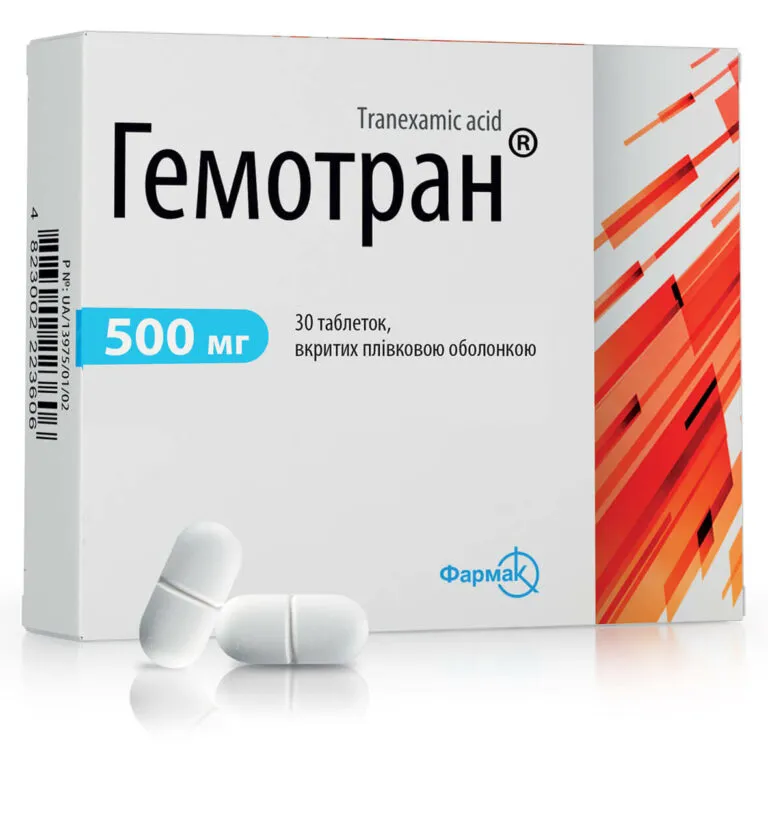
Table of Contents
INSTRUCTIONS FOR MEDICAL USE OF THE MEDICINAL PRODUCT HEMOTRAN® (GEMOTRAN)
Composition:
Active substance: tranexamic acid;
One tablet contains tranexamic acid equivalent to 100% dry substance – 500 mg;
Excipients: povidone, low-substituted hydroxypropylcellulose, hydroxypropylcellulose, colloidal anhydrous silicon dioxide, talc, polyethylene glycol 8000, calcium stearate;
Film coating: Opadry White 03 F 180011 (hypromellose, titanium dioxide (E 171), macrogol).
Pharmaceutical form. Film-coated tablets.
Main physicochemical properties: elongated-shaped, biconvex tablets with a score line, white or almost white in color, film-coated.
Pharmacotherapeutic group. Antihemorrhagic agents. Fibrinolysis inhibitors.
ATC code B02A A02.
Pharmacological properties.
Pharmacodynamics.
Antifibrinolytic, anti-allergic, anti-inflammatory agent. Competitively inhibits plasminogen activator; at higher concentrations, binds plasmin. It has been reported that the inhibitory effect of tranexamic acid on plasminogen activation by urokinase is 6–100 times greater, and by streptokinase – 6–40 times greater, compared to the inhibitory effect of aminocaproic acid. The antifibrinolytic effect of tranexamic acid is approximately 10 times stronger than that of aminocaproic acid. Prolongs prothrombin time. Inhibits the formation of kinins and other peptides involved in inflammatory and allergic reactions.
Pharmacokinetics.
After oral administration, 30–50% of the dose is absorbed. Cmax is reached within 3 hours after administration and amounts to 8 mg/L and 15 mg/L at doses of 1 g and 2 g, respectively. The concentration-time curve has a triphasic profile with a terminal half-life (T1/2) of 3 hours. Approximately 3% of the drug is protein-bound in blood (to plasminogen). The initial volume of distribution is 9–12 L.
Tranexamic acid readily crosses histohematogenous barriers, including the blood-brain barrier and placental barrier. The concentration in cerebrospinal fluid is about 1/10 of the plasma concentration. It is detected in seminal fluid, where it inhibits fibrinolytic activity but does not affect spermatozoa migration. A minor portion undergoes biotransformation. The main route of elimination is glomerular filtration. Over 95% (predominantly unchanged) is excreted in urine. Total renal Cl equals plasma Cl. Antifibrinolytic concentrations in various tissues are maintained for up to 17 hours, and in blood plasma – up to 7–8 hours.
Tranexamic acid rapidly penetrates into synovial fluid and synovial membrane. In synovial fluid, the concentration achieved is the same as in blood serum. The elimination half-life of tranexamic acid is approximately 3 hours. The concentration of tranexamic acid in blood is lower than in other tissues. In breast milk, the concentration is about 1/100 of the peak serum concentration. The concentration of tranexamic acid in cerebrospinal fluid is approximately 1/10 of the plasma concentration. The drug penetrates into intraocular fluid, where its concentration is approximately 1/10 of the plasma concentration.
In patients with renal insufficiency, plasma concentration of tranexamic acid is increased.
Clinical characteristics.
Indications.
Short-term treatment of bleeding or risk of bleeding due to increased fibrinolysis or fibrinogenolysis.
Local fibrinolysis observed in the following conditions:
- prostatectomy or interventions on the urinary bladder;
- menorrhagia;
- epistaxis;
- cervical conization;
- post-traumatic hyphema.
Hereditary angioedema.
Dental extraction in patients with hemophilia.
Contraindications.
- Hypersensitivity to tranexamic acid or to any of the excipients.
- Severe renal insufficiency (due to the risk of accumulation).
- Acute thromboembolic disorders.
- History of arterial or venous thrombosis.
- Fibrinolytic states due to consumption coagulopathy.
- History of seizures.
Interaction with other medicinal products and other forms of interactions.
Tranexamic acid antagonizes thrombolytic therapy with fibrinolytic agents.
Special precautions for use
In renal impairment (depending on the degree of increase in serum creatinine), the dose and frequency of administration should be reduced. In cases of hematuria of renal origin (especially in hemophilia), there is a risk of mechanical anuria due to clot formation in the ureters.
Patients with a personal or family history of thromboembolic complications (patients with thrombophilia) should use tranexamic acid only when there is a clear medical indication and under strict medical supervision.
For patients with hereditary angioedema undergoing long-term therapy, regular monitoring of vision (e.g., visual acuity, visual fields, intraocular pressure, fundoscopy) and liver function (liver tests) is required.
Tranexamic acid should be used with caution in women taking oral contraceptives due to an increased risk of thrombosis.
The use of tranexamic acid in cases of increased fibrinolysis due to disseminated intravascular coagulation is not recommended.
Women with irregular menstrual bleeding should not use tranexamic acid until the cause of such bleeding has been established. If treatment with tranexamic acid does not reduce the intensity of menstrual bleeding, alternative treatment options should be considered.
If visual disturbances occur, treatment must be discontinued.
There is no clinical experience with the use of tranexamic acid for the treatment of menorrhagia in children under 15 years of age.
Use during pregnancy or breastfeeding
Pregnancy
Tranexamic acid crosses the placenta. Although preclinical studies have not shown teratogenic effects of tranexamic acid on fetal development, it is recommended to follow general guidelines for the use of medicinal products during pregnancy; the drug should be administered only when the expected benefit to the pregnant woman outweighs the potential risk to the fetus.
Breastfeeding period
Tranexamic acid passes into breast milk at a concentration of approximately 1/100 of its concentration in maternal blood. An antifibrinolytic effect in the infant is unlikely.
Ability to affect reaction speed when driving vehicles or operating machinery
No data available.
Method of administration and dosage.
For adults, the medicinal product is administered orally. It is taken regardless of food intake.
| Local fibrinolysis: 15–25 mg/kg body weight (2–3 tablets of 500 mg) 2–3 times daily. The following dosages may be used for the indications listed below: |
||
|
||
|
||
|
||
|
||
|
||
| Hereditary angioedema: some patients familiar with the course of disease exacerbations usually require 1–1.5 g (2–3 tablets of 500 mg) 2–3 times daily for several days. Other patients should take the drug at the same dose over a prolonged period, depending on the disease course. |
||
| Tooth extraction in patients with hemophilia: 25 mg/kg (2–3 tablets of 500 mg) every 8 hours. |
||
Patients with renal impairment
Dosage adjustment is required for patients with mild to moderate renal impairment according to plasma creatinine levels.
| Serum creatinine |
Oral dose |
| 120–249 µmol/l |
15 mg/kg twice daily |
| 250–500 µmol/l |
15 mg/kg every 24 hours |
Elderly patients
If there are no renal excretory function disorders, dose adjustment is not required.
Children
There is no clinical experience with the use of tranexamic acid in children under 15 years of age with menorrhagia; therefore, the medicinal product should not be used in this patient population.
The recommended dose for children is 25 mg/kg. Data on efficacy, dosing, and safety of tranexamic acid use in children are limited.
Overdose.
Symptoms: nausea, vomiting, abdominal pain, orthostatic hypotension.
Treatment: induce vomiting, gastric lavage, administer activated charcoal. It is necessary to drink large amounts of fluid to promote renal excretion. Symptomatic treatment should be applied; if necessary, anticoagulant therapy may be used.
Side effects
The side effects are classified according to their frequency and impact on organs or body systems. The following adverse reactions have been reported, categorized by frequency as follows: very common (≥1/10); common (≥1/100 to <1/10); uncommon (≥1/1,000 to <1/100); rare (≥1/10,000 to <1/1,000); very rare (<1/10,000); frequency not known (cannot be estimated from available data).
Gastrointestinal disorders
Very rare: nausea, vomiting, diarrhea, which resolve upon dose reduction.
Skin and subcutaneous tissue disorders
Rare: allergic skin reactions.
Eye disorders
Rare: color vision disturbances, visual disturbances, retinal vein/artery occlusion.
Immune system disorders
Very rare: hypersensitivity reactions, including anaphylaxis.
Vascular disorders
Rare: thromboembolism.
Very rare: arterial or venous thrombosis at any site.
Reporting of suspected adverse reactions
Reporting suspected adverse reactions after medicine authorization is important. It allows continuous monitoring of the benefit-risk balance of the medicine. Healthcare professionals should report any suspected adverse reactions via the national pharmacovigilance system.
Shelf life. 2 years.
Do not use the medicinal product after the expiry date stated on the packaging.
Storage conditions. Store in the original packaging at a temperature not exceeding 25 °C.
Keep out of reach and sight of children.
Packaging. 10 tablets in a blister. 3 blisters in a carton.
Prescription status. Prescription-only medicine.
Manufacturer. JSC "Farmak".
Manufacturer's address and place of business.
74, Kyrylivska Street, Kyiv, 04080, Ukraine.