Hemoproct
Ukraine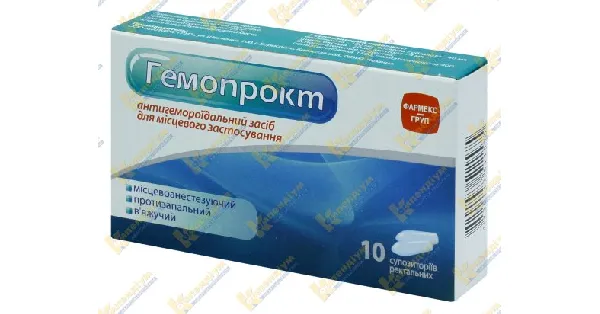
Table of Contents
INSTRUCTION FOR MEDICAL USE OF THE MEDICINAL PRODUCT HEMOPROCT (HEMOPROСT)
Composition:
Active substances: benzocaine, bismuth subgallate, zinc oxide, menthol;
1 suppository contains benzocaine 100 mg, bismuth subgallate 40 mg, zinc oxide 20 mg, menthol 4 mg;
Excipients: polyethylene glycol 1500, polyethylene glycol 400.
Pharmaceutical form. Rectal suppositories.
Main physicochemical properties: Smooth, greenish-yellow suppositories of homogeneous consistency. A funnel-shaped depression and an air channel may be present.
Pharmacotherapeutic group.
Local anti-hemorrhoidal agents. Preparations containing local anesthetics. ATC code C05A D03.
Pharmacological properties.
Pharmacodynamics.
Gemoprokt is a combination medicinal product whose therapeutic effect is determined by the pharmacological properties of the active components contained in its formulation. Gemoprokt exerts local anesthetic, anti-inflammatory, and astringent actions.
Pharmacokinetics.
Not studied.
Clinical characteristics.
Indications.
Symptomatic treatment of hemorrhoids and anal fissures.
Contraindications.
Hypersensitivity to the components of the drug.
Interaction with other medicinal products and other forms of interactions.
The drug should not be used without strict medical indications and medical supervision in combination with monoamine oxidase inhibitors (MAOIs), antidepressants, and antihypertensive agents, due to the theoretical possibility of reduced MAOI efficacy or enhanced antihypertensive effects resulting from interaction with benzocaine, particularly in cases of significant overdose or prolonged use beyond recommended doses and duration.
Special precautions for use.
During prolonged use of the drug, monitoring of blood parameters is required.
If there is heavy bloody discharge from the anus or if symptoms of the disease persist during 7 days of treatment, additional consultation with a proctologist is necessary.
Consultation with a physician prior to starting use of this drug is recommended in the following cases: marked arterial hypertension, severe cardiac arrhythmias, clinically evident thyrotoxicosis, urinary retention.
The smallest necessary amount of the medicinal product should be used. There have been reports that administration of drugs containing benzocaine may cause methemoglobinemia. Symptoms such as cyanosis of the skin, lips and nail beds, headache, dizziness, dyspnea (difficulty breathing), weakness, tachycardia, which may occur during treatment, could indicate potentially life-threatening methemoglobinemia and require immediate medical intervention.
Use during pregnancy or breastfeeding.
This drug should be prescribed to women during pregnancy or breastfeeding only after careful consideration of the benefit-risk ratio.
Ability to affect reaction rate when driving or operating machinery.
While being treated with this drug, it is recommended to avoid driving vehicles and performing tasks that require increased attention and precise coordination.
Method of Administration and Dosage
Before using the suppositories, remove them from the blister pack. The drug is administered rectally. Insert 1 suppository 1–2 times daily after an enema or spontaneous bowel movement. The duration of treatment is determined by the course and severity of the disease, the therapeutic effect achieved, and the overall treatment strategy.
Children.
There is no data available regarding the use of this drug in children.
Overdose.
Overdose is unlikely when the drug is used at therapeutic doses.
Symptoms of overdose may be related to the pharmacological effects of benzocaine. Systemic absorption of benzocaine in overdose may manifest as drowsiness, anxiety, excitement, and, in severe cases, seizures. There have been reports that administration of drugs containing benzocaine may induce methemoglobinemia. Symptoms such as cyanosis of the skin, lips, and nail beds, headache, dizziness, dyspnea (difficulty breathing), weakness, and tachycardia, which may occur during treatment, could indicate potentially life-threatening methemoglobinemia requiring immediate medical intervention.
Emergency treatment for overdose and development of methemoglobinemia consists of intravenous administration of methylene blue. Management of other overdose symptoms includes discontinuation of the drug and symptomatic therapy.
Side effects.
Occasionally, contact dermatitis and allergic reactions may occur, including hyperemia, skin rashes, and itching. The drug may cause a laxative effect and a sensation of burning in the rectal area. With prolonged use, blood-related reactions may develop – methemoglobinemia (skin, lips, and nail beds cyanosis, headache, dizziness, dyspnea, weakness, tachycardia).
Shelf life.
3 years.
Storage conditions.
Store in the original packaging at a temperature not exceeding 25 °C. Keep out of reach of children.
Packaging.
5 suppositories per strip, 2 strips per pack.
Supply category.
Over-the-counter.
Manufacturer.
LLC "FARMEKS GROUP".
Manufacturer's location and address of business activity.
100, Shevchenka St., Borispol, Kyiv region, Ukraine, 08301.