Gastritol "dr. klein"
Ukraine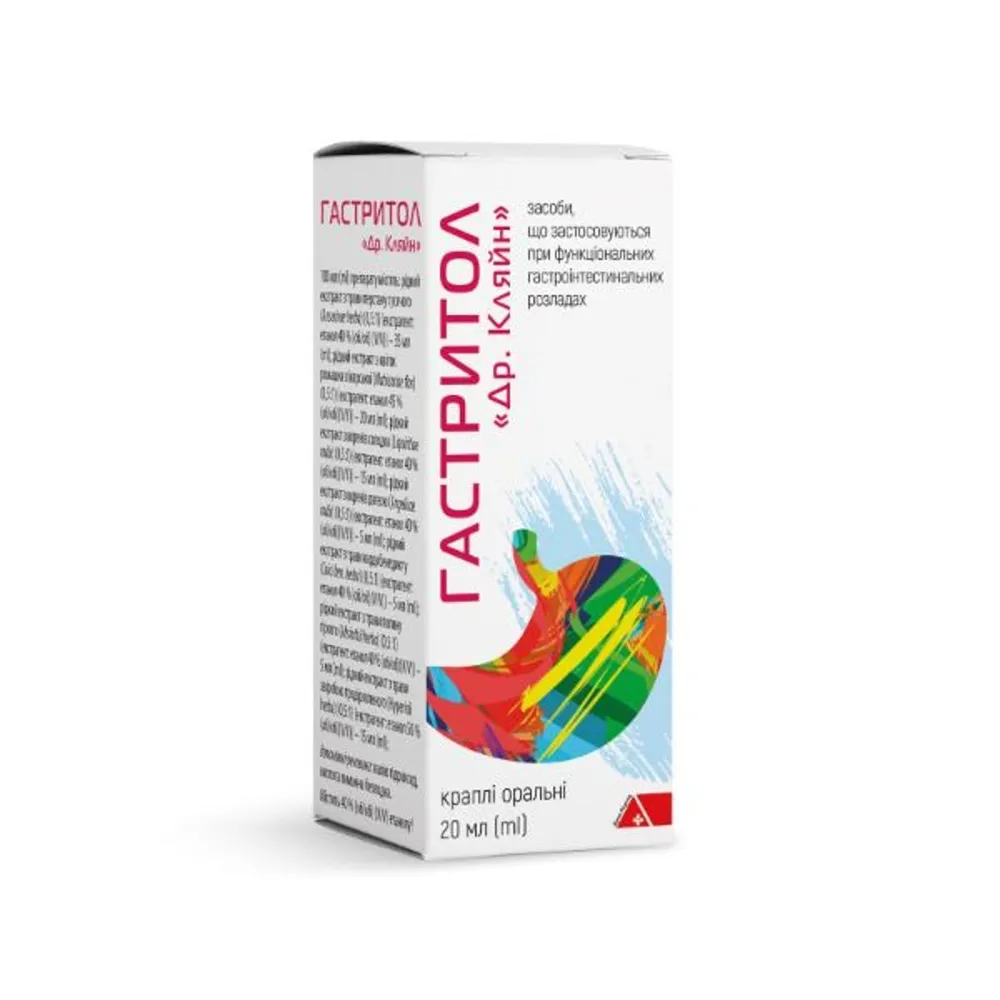
Table of Contents
INSTRUCTIONS FOR MEDICAL USE OF THE MEDICINAL PRODUCT Gastritol «Dr. Klein» (Gastritol® «Dr. Klein»)
Composition:
100 ml of the preparation contains:
liquid extract of goosegrass herb (Anserinae herba) (0.5:1) (extraction solvent: ethanol 40% v/v) – 35 ml;
liquid extract of chamomile flowers (Matricariae flos) (0.5:1) (extraction solvent: ethanol 45% v/v) – 20 ml;
liquid extract of licorice root (Liquiritiae radix) (0.5:1) (extraction solvent: ethanol 40% v/v) – 15 ml;
liquid extract of angelica root (Angelicae radix) (0.5:1) (extraction solvent: ethanol 40% v/v) – 5 ml;
liquid extract of blessed thistle herb (Cnici ben. herba) (0.5:1) (extraction solvent: ethanol 40% v/v) – 5 ml;
liquid extract of common wormwood herb (Absinthii herba) (0.5:1) (extraction solvent: ethanol 40% v/v) – 5 ml;
liquid extract of perforate St. John's wort herb (Hypericii herba) (0.5:1) (extraction solvent: ethanol 50% v/v) – 15 ml;
Excipients: potassium hydroxide, anhydrous citric acid.
Pharmaceutical form. Oral drops.
Main physicochemical properties: clear brown-colored liquid.
Pharmacotherapeutic group.
Agents used in functional gastrointestinal disorders.
ATC code A03AX.
Pharmacological properties.
The medicinal product contains active substances that act locally in the gastrointestinal tract and also exert central effects on gastric secretory and motor functions.
Potentilla anserinum (goose cinquefoil) exerts a spasmolytic effect on the musculature of the gastrointestinal tract.
Liquiritiae radix (licorice root) contains glycyrrhizic acid, which has pronounced anti-inflammatory activity, stimulates granulation tissue formation, and also reduces tone and motility of the gastrointestinal tract (spasmolytic effect). Increased vascularization of the gastric mucosa is observed.
Matricariae (chamomile) exerts anti-inflammatory, antiallergic, and regenerative effects. Chamazulene rapidly and deeply penetrates the mucous membrane. Activation of the hypophyseo-adrenal system leads to enhanced release of corticotropin and cortisone. Anti-inflammatory and antiallergic effects are also provided by β-farnesene and α-bisabolol.
Cnicus benedictus (blessed thistle) contains the bitter glycoside cnicin, which, like the bitter substances found in Angelica officinalis (garden angelica), improves blood supply to the organs of the gastrointestinal tract, thereby accelerating healing of ulcers and lesions of the gastric mucosa.
The bitter substance from Artemisia absinthium (wormwood) increases the tone of the gastric cardia and alleviates symptoms of gastrocardiac syndrome.
Hypericum perforatum (St. John's wort) affects the most important ulcerogenic factor—psychovegetative disorders. Hypericum perforatum has a cholinoblocking effect and also reduces gastric juice secretion.
Clinical characteristics.
Indications.
Functional dyspepsia, meteorism, gastritis, including chronic hyperacid gastritis, as well as part of complex treatment of gastric and duodenal ulcers.
Contraindications.
History of pelvic organ bleeding, anemia, epilepsy, hypertensive disease (stage III), cholelithiasis, pregnancy or breastfeeding.
Hypersensitivity to any of the ingredients of the medicinal product, allergic reactions to plants of the Asteraceae family.
Interaction with other medicinal products and other forms of interaction.
Medicinal products containing St. John's wort are not recommended for patients taking antibiotics, antiviral agents, sulfonamides, antihypertensive drugs (calcium channel blockers), hypocholesterolemic agents, coumarin-derived anticoagulants, cyclosporine, oral contraceptives, digoxin, or antidepressants.
Administration of preparations containing bitter wormwood may affect the action of other medicinal products acting via GABA (gamma-aminobutyric acid) receptors; therefore, concomitant use with drugs such as benzodiazepines and their derivatives is not recommended.
Special precautions for use.
The preparation contains 40% (v/v) ethanol.
One drop of the preparation contains 0.016 g of ethanol.
Caution should be exercised when administering to patients with liver diseases, central nervous system disorders, or alcoholism, as each dose of the medicinal product may pose a health risk for these patients.
Due to the presence of extracts of roots of Radix Angelicae and herb of Hyperici herba perforati in the medicinal product, prolonged exposure to sunlight should be avoided.
Formation of flakes or cloudiness, which may be observed in liquid formulations of herbal preparations, does not cause adverse effects and does not reduce the efficacy of the medicinal product.
Use during pregnancy or breastfeeding.
Due to lack of sufficient experience in use, the medicinal product is contraindicated in women during pregnancy or breastfeeding.
Ability to influence reaction rate while driving or operating machinery.
Administration of the medicinal product within the therapeutic dose range does not affect the ability to drive vehicles or operate machinery.
Method of administration and dosage.
Children from 7 to 12 years: administer 1 drop per year of life, diluted in a small amount of liquid, 3 times daily during meals;
Adults and children from 12 years: administer 20–30 drops, diluted in a small amount of liquid, 3 times daily during meals.
In severe and acute conditions, adults should take 15–25 drops every 30 minutes to 1 hour.
Duration of treatment: 3–4 weeks. If necessary, the treatment course may be repeated after 2 months.
The medicinal product must be shaken before use!
Children.
Due to insufficient experience of use, the medicinal product should not be administered to children under 7 years of age.
Overdose.
Symptoms include bitter taste in the mouth and discomfort in the liver area.
Adverse reactions.
Very rarely, in patients with high skin photosensitivity, skin reactions resembling sunburn may occur under the influence of intense solar radiation.
Allergic reactions are possible, including swelling, skin redness, rash, itching. Gastrointestinal reactions are also possible, including nausea, vomiting, stomach pain, and water-electrolyte imbalance.
If any adverse reactions occur, discontinue use of the medication and consult a physician.
Shelf life.
3 years.
Do not use after the expiry date stated on the packaging.
Storage conditions.
Store at a temperature not exceeding 25 °C.
Keep out of reach of children.
Packaging.
20 ml, 50 ml, or 100 ml in a bottle with dropper; 1 bottle per cardboard box.
Availability.
Over-the-counter (without prescription).
Manufacturer.
Dr. Gustav Klein GmbH & Co. KG
Manufacturer's address and location of business operations.
Steinenfeld 3, 77736 Zell am Harmersbach, Germany.