Gabesat
Ukraine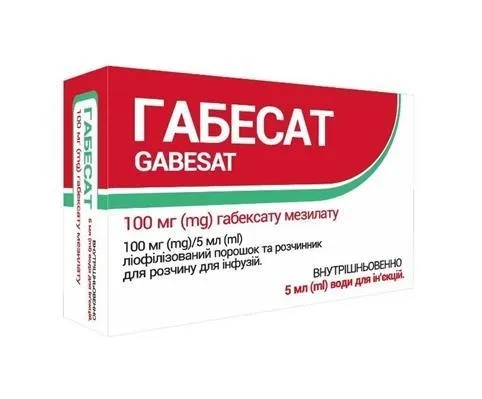
Table of Contents
Instructions for Medical Use of the Medicinal Product GABESAT (GABESAT)
Composition:
Active substance: 1 vial contains 100 mg of gabexate mesilate;
Excipient: water for injections.
Pharmaceutical form. Lyophilized powder and solvent for infusion solution.
Main physicochemical properties: white crystalline lyophilized powder. The resulting solution should be clear and free from particles.
Pharmacotherapeutic group.
Protease inhibitors. ATC code B02A B49.
Pharmacological properties.
Pharmacodynamics.
Gabexate preparation is particularly active as an inhibitor of proteolytic enzymes (trypsin, phospholipase A, plasmin, kallikrein, and thrombin (even in the absence of AT III)), and positively affects hyperproteolytic states of the pancreas, the fibrinolytic system, coagulation, and kinins. Gabexate preparation has antiplatelet thrombogenic properties.
Pharmacokinetics.
The elimination half-life of Gabexate preparation is approximately 60 seconds. When administered intravenously to healthy male subjects at a rate of 2 mg/kg/hour, the maximum concentration is reached within 5–10 minutes after the start of infusion, resulting in a hematin level of 109 ng/mL of the non-metabolized active substance. At a dose of 4 mg/kg/hour, the hematin level—the non-metabolized product—reaches 265 ng/mL.
After intravenous administration, it is rapidly metabolized to guanidinopropionic acid and parabenoate (both inactive). Elimination occurs within 24 hours, predominantly via urine, with minimal excretion in bile.
Clinical characteristics.
Indications.
Acute pancreatitis.
Contraindications.
Hypersensitivity to the active substance.
Interaction with other medicinal products and other forms of interactions.
Unknown.
In case of concomitant therapy with other parenteral preparations, Gabesat should be administered separately.
Special precautions for use.
Administration of the drug in high doses may cause necrotic ulcers at the injection site and along blood vessels, damaging the vessel wall and leading to phlebitis and increased fragility of the vein itself.
Therefore, treatment must be conducted only under medical supervision.
If pain, redness, or inflammation occurs at the injection site, treatment must be discontinued or the injection site changed, and appropriate measures should be taken.
The patient must be continuously monitored during drug administration.
Shock, anaphylactic shock, and anaphylactic reactions may occur.
If a decrease in arterial pressure, precordial oppression, dyspnea, loss of consciousness, swelling of the pharynx/larynx, pruritus, or general malaise occurs, treatment must be stopped immediately.
The patient must also be carefully monitored due to the possible development of agranulocytosis, leukopenia, thrombocytopenia, and hyperkalemia.
If changes in parameters (levels) are detected, treatment must be discontinued, and in the case of hyperkalemia, appropriate measures must be taken.
If headache, reduction in partial thromboplastin time, bleeding, hypotension, nausea, vomiting, diarrhea, skin rashes, pruritus, or facial flushing occur, the dosage should be reduced. If symptoms persist, treatment must be discontinued entirely.
The drug may have anticoagulant effects.
Use during pregnancy or breastfeeding.
During confirmed or suspected pregnancy, gabexate mesilate should be administered only at the lowest effective doses and solely for life-threatening indications.
There are no data available on excretion of the drug in breast milk.
Ability to affect driving performance and operating machinery.
During treatment with this medicinal product, patients should not drive or operate machinery.
Method of Administration and Dosage
Begin treatment with 1–3 vials per day (100–300 mg of gabexate mesilate) administered intravenously by infusion at a rate not exceeding 8 mL/min. The dosage should then be reduced as the clinical condition improves. If necessary, the above dose may be increased by 1–3 vials on the same day.
The sterile powder contained in the vial must be dissolved with the solvent provided (water for injections).
The resulting solution should be further diluted in 500 mL of Ringer’s lactate solution or 5% glucose solution. The solution should be used immediately after preparation; any unused portion must be discarded.
The solution for intravenous infusion should be administered slowly, with the infusion rate adjusted so that it does not exceed 8 mL per minute or 2.5 mg of gabexate mesilate per kg of body weight per hour.
Dosage should be adjusted according to the patient’s clinical symptoms.
Elderly Patients
The dose should be reduced as necessary in cases of any decline in physiological functions.
Children
Do not use in children.
Overdose
If symptoms such as headache, decreased partial thromboplastin time, bleeding, hypotension, nausea, vomiting, diarrhea, skin rash, itching, or facial flushing occur, reduce the dosage.
If symptoms persist, discontinue the drug and consult a physician.
Adverse reactions.
The adverse effects of gabexate mesilate listed according to the MedDRA classification system. Approximate frequency of occurrences is based on the following scale: common (> 1/100, < 1/10); uncommon (> 1/1000, < 1/100); rare (> 1/10000, < 1/1000); very rare (> 1/10000).
| Organ systems |
Frequency |
|||
| Common <10% > 1% |
Uncommon <1%>0.1% |
Rare <0.1%>0.01% |
Unknown |
|
| General disorders and administration site conditions |
Injection site reactions: necrotic ulcers, phlebitis, and vein fragility. Pain, redness |
Increased sensitivity (skin rashes, itching, inflammation at injection site). |
Fever, facial flushing |
Shock (anaphylactic shock, anaphylactic reactions, hypotension, precordial oppression, dyspnea, loss of consciousness, throat/larynx swelling or changes in general condition) |
| Cardiovascular system |
Decreased blood pressure |
|||
| Nervous system |
Headache |
|||
| Gastrointestinal system |
Nausea, vomiting |
|||
| Hemolymphopoietic system and blood clotting |
leukopenia, granulocytopenia, increased bleeding time (decreased partial thromboplastin time) |
Agranulocytosis, Thrombocytopenia, Eosinophilia |
||
| Hepatic system |
Elevated transaminases |
Jaundice |
Elevated total bilirubin |
|
| Laboratory findings |
Hypokalemia Hyponatremia |
|||
Reporting of suspected adverse reactions
Reporting of suspected adverse reactions occurring after the medicinal product has been placed on the market is important, as it allows continuous monitoring of the benefit-risk balance of the drug. Any suspected adverse reaction should be reported through the national reporting system.
In case of any adverse events, the use of the drug should be discontinued and medical advice must be sought immediately.
Shelf life.
3 years.
Do not use after the expiry date stated on the packaging.
Storage conditions.
Store in a dry, light-protected place at a temperature not exceeding 25 °C. Keep out of reach of children.
Incompatibility. When concomitant therapy with other parenteral drugs is used,
Gabesat should be administered separately.
Packaging.
100 mg of powder in a vial and solvent in a 5 ml ampoule.
1 vial and 1 ampoule in a cardboard box.
Prescription status.
Prescription only.
Manufacturer. Bioindustria Industria Farmaceutica Italiana S.p.A./Bioindustria Laboratorio Italiano Medicinali S.p.A.
Manufacturer's address and place of business.
Via de Ambrosiis 2/6, Novi Ligure, 15067, Italy.
Marketing Authorisation Holder. LLC "Novator Pharma".
Address of the Marketing Authorisation Holder and/or its representative.
4-B Yaroslavska St., office 5, Kyiv, 04071, Ukraine.