Fumarta
Ukraine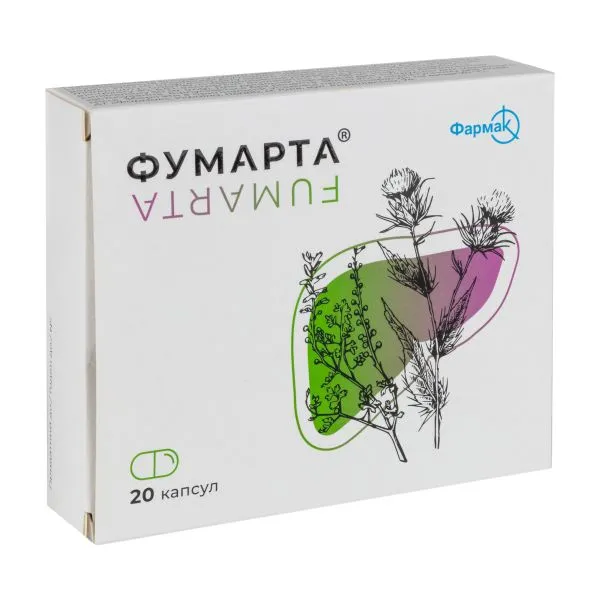
Table of Contents
INSTRUCTIONS FOR MEDICAL USE OF THE MEDICINAL PRODUCT FUMARTA® (FUMARTA)
Composition:
Active substances: dry extract of fumitory herb (Fumaria officinalis L.), dry extract of milk thistle fruits (Silybum marianum L. Gaertner);
Each capsule contains:
- dry extract of fumitory herb (Fumaria officinalis L., ratio of herbal raw material to extract 4–6:1, extraction solvent: water) — 275.1 mg;
- dry extract of milk thistle fruits (Silybum marianum L. Gaertner, ratio of herbal raw material to extract 30–44:1, extraction solvent: ethyl acetate) — 80–98 mg, equivalent to 50 mg of silymarin.
Excipients: microcrystalline cellulose, corn starch, copovidone, talc, macrogol, colloidal anhydrous silicon dioxide, magnesium stearate.
Capsule shell composition: gelatin, titanium dioxide (E 171), black iron oxide (E 172), red iron oxide (E 172), yellow iron oxide (E 172).
Pharmaceutical form. Capsules.
Main physicochemical properties: hard gelatin capsules size №0, cylindrical in shape, light brown in color, filled with a powder mixture ranging from yellowish-brown to dark brown.
Pharmacotherapeutic group. Agents used in liver and biliary tract disorders. Agents used in biliary pathology. ATC code A05A X.
Pharmacological properties.
Pharmacodynamics.
Fumarta® is a combined herbal medicinal product containing dry extract of medicinal rhubarb root and dry extract of spotted milk thistle.
The dry extract of medicinal rhubarb root contains the alkaloid fumarine, which has choleretic effect, normalizes bile secretion, and reduces the tone of the sphincter of Oddi. The dry extract of spotted milk thistle contains silymarin — a bioflavonoid comprising the isomers silybinin, silydianin, and silychristin. Silymarin has hepatoprotective effects in acute and chronic intoxications, possesses membrane-stabilizing properties, and promotes liver cell regeneration.
Pharmacokinetics.
After oral administration, silymarin is mainly eliminated with bile and undergoes enterohepatic circulation.
Clinical characteristics.
Indications.
Additional treatment of patients with biliary tract dyskinesia (including post-cholecystectomy) and concomitant chronic liver diseases.
Contraindications.
Hypersensitivity to the active substances or to other plants of the Asteraceae (Compositae) family, or to any of the excipients; acute inflammatory diseases of the liver, biliary tract, and gallbladder; acute hepatitis and cholangitis; acute poisonings of various etiologies; cholelithiasis; biliary tract obstruction; age under 18 years; pregnancy and breastfeeding period.
Interaction with other medicinal products and other forms of interactions.
When drugs containing silymarin are used concomitantly with oral contraceptives and drugs used in estrogen replacement therapy, a reduced efficacy of the latter may occur.
The medicinal product may enhance the effects of such drugs as diazepam, alprazolam, lorazepam, ketoconazole, lovastatin, vinblastine, fexofenadine, clopidogrel, and warfarin, due to inhibition of the cytochrome P450 system.
Herbal products containing silymarin are widely used as hepatoprotectors in oncological practice, administered concomitantly with cytostatic agents. Clinical studies indicate a low risk of pharmacokinetic interactions between silymarin, as an inhibitor of the CYP3A4 isoenzyme and UGT1A1, and cytostatic drugs that are substrates of these enzymes.
Alcohol consumption is prohibited during the use of this drug.
Special precautions for use.
General principles for the treatment of liver parenchyma diseases—adherence to diet, rest, and abstention from alcohol—should not be ignored.
Dosage adjustment is not required for elderly patients.
Due to the possible estrogen-like effect of silymarin at very high doses, it should be used with caution in patients with hormonal disorders (endometriosis, uterine fibroids, breast, ovarian or uterine carcinoma, prostate carcinoma). In such cases, medical consultation is required.
If jaundice develops (appearance of skin color ranging from light-yellow to dark-yellow, yellowing of the eye whites), medical advice should be sought to adjust the therapy.
Use during pregnancy or breastfeeding.
Do not use during pregnancy and breastfeeding due to insufficient clinical data.
Ability to affect reaction speed when driving vehicles or operating machinery.
No effect. However, patients with existing vestibular disorders should use the medicinal product with caution when driving vehicles or operating machinery.
Method of administration and dosage.
Fumarta**®** capsules should be taken during meals. The capsule should be swallowed whole without chewing and taken with an adequate amount of liquid.
The recommended dose for adults is 1 capsule of Fumarta**®** 3 times daily.
In the presence of nocturnal pain, an additional dose of 1 capsule before bedtime is recommended. If necessary, the daily dose may be increased up to the maximum dose — 6 capsules (2 capsules 3 times daily).
The duration of treatment should be determined individually by a physician, depending on the nature and course of the disease.
If no improvement occurs after prolonged use (2 weeks), medical advice must be sought.
Children.
Do not use in children (under 18 years of age) due to insufficient data on safety and efficacy of the medicinal product.
Overdose.
Cases of overdose have not been reported. In case of overdose, diarrhea and abdominal pain are possible. In such cases, discontinue use of the medicinal product.
Treatment is symptomatic.
Side effects
Frequency of adverse reactions according to the MedDRA classification: rare (≥1/10,000 — <1/1,000), very rare (<1/10,000), including isolated cases.
Gastrointestinal disorders: dry mouth, nausea, vomiting, dyspepsia, heartburn, mild diarrhea (rare).
Renal and urinary disorders: increased diuresis.
Immune system disorders: allergic reactions, including urticaria, skin rash, pruritus, anaphylactic reactions, dyspnea (very rare).
Vascular disorders: flushing.
Skin and subcutaneous tissue disorders: increased alopecia; skin rash (very rare).
Nervous system disorders: headache.
Musculoskeletal and connective tissue disorders: arthralgia.
Other: exacerbation of existing vestibular disorders.
Blood test results: increased bilirubin levels (frequency unknown).
Reporting of suspected adverse reactions.
Reporting suspected adverse reactions after marketing authorization is of great importance. It allows continuous monitoring of the benefit-risk balance of the medicinal product. Healthcare professionals and patients, or their legal representatives, are encouraged to report all suspected adverse reactions and lack of efficacy via the automated pharmacovigilance information system at the following link: https://aisf.dec.gov.ua.
Shelf life.
2 years.
Do not use the medicinal product after the expiry date stated on the packaging.
Storage conditions. Store in the original packaging at a temperature not exceeding 25 °C.
Keep out of reach and sight of children.
Packaging. 10 capsules in a blister. 2 or 3 blisters per carton.
Availability. Over-the-counter.
Manufacturer.
JSC "Farmak".
Manufacturer's address and place of business.
74, Kyrylivska Street, Kyiv, 04080, Ukraine.