Fortesa lido
Ukraine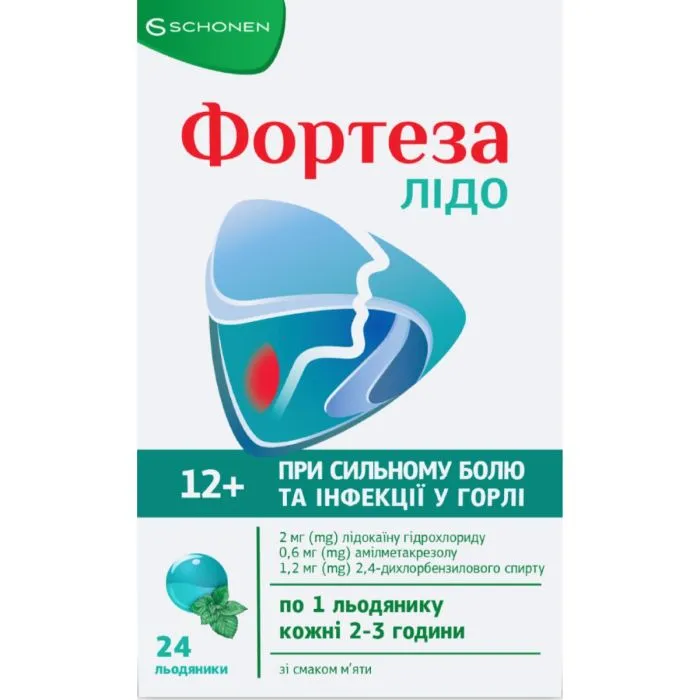
Table of Contents
INSTRUCTIONS FOR MEDICAL USE OF THE MEDICINAL PRODUCT FORTEZA LIDO (FORTEZA LIDO)
Composition:
Active substances: lidocaine hydrochloride, amylmetacresol, 2,4-dichlorobenzyl alcohol;
1 lozenge contains 2 mg of lidocaine hydrochloride; 0.6 mg of amylmetacresol; 1.2 mg of 2,4-dichlorobenzyl alcohol;
Excipients: partially denatured peppermint oil; star anise oil; levomenthol; indigocarmine (E 132); quinoline yellow (E 104); sodium saccharin (E 954); tartaric acid (E 334); sucrose; glucose solution.
Pharmaceutical form. Lozenges.
Main physicochemical properties: cylindrical, biconvex green lozenges with a mint flavour.
Pharmacotherapeutic group.
Preparations used in throat disorders. Antiseptics. Benzyl alcohol, dichloro derivative. ATC code R02A A03.
Pharmacological properties.
Pharmacodynamics.
2,4-dichlorobenzyl alcohol and amylmetacresol have antiseptic properties. Lidocaine is an amide-type local anesthetic whose action results in reversible loss of sensitivity due to prevention or reduction of generation and transmission of sensory nerve impulses at the site of application. Depolarization of the neuronal membrane and ion exchange are reversibly inhibited. Analgesic effect is provided by blocking neuronal signal transmission.
In vitro studies have shown that the combination of both active substances reversibly blocks inactive sodium channels.
Clinical trial data demonstrate that lozenges reduce throat pain and ease swallowing, with onset of action occurring within 5 minutes and duration of effect lasting up to 2 hours.
Pharmacokinetics.
Lidocaine is readily and rapidly absorbed from the mucous membranes. The plasma half-life of the drug is approximately 2 hours. Lidocaine is metabolized in the liver, forming active metabolites, including glycinexylidide. Less than 10% of lidocaine is excreted unchanged by the kidneys. Metabolites are also excreted in urine.
2,4-dichlorobenzyl alcohol is metabolized in the liver to form hippuric acid, which is excreted in urine. There are no data available regarding the metabolism and elimination of amylmetacresol.
Clinical characteristics.
Indications.
Symptomatic treatment of infections of the oral cavity and throat, including severe sore throat in adults and adolescents aged 12 years and older.
Contraindications.
Hypersensitivity to the active substances or to any of the excipients of the medicinal product.
Due to the presence of lidocaine in the formulation, this medicinal product is contraindicated in children under 12 years of age.
Allergic reaction to any component of the drug or to other amide-type local anesthetic medicinal products.
Fructose intolerance, glucose-galactose malabsorption syndrome, sucrase-isomaltase deficiency.
History of methemoglobinemia or suspicion of methemoglobinemia.
Bronchial asthma or bronchospasm.
Interaction with other medicinal products and other forms of interaction.
Concomitant or sequential use of other antiseptics is not recommended due to possible interactions (antagonism, deactivation).
The medicinal product contains lidocaine; therefore, the following interactions should be taken into account:
- beta-blockers reduce hepatic blood flow and, consequently, slow down the metabolism rate of lidocaine, increasing the risk of its toxicity;
- cimetidine may inhibit hepatic metabolism of lidocaine, increasing the risk of its toxicity;
- lidocaine may cause cross-sensitivity to other amide-type local anesthetics;
- due to potential pharmacokinetic or pharmacodynamic interactions, antiarrhythmic agents of class III, such as mexiletine and procainamide, should be used with caution;
- cytochrome P450 isoenzymes CYP1A2 and CYP3A4 are involved in the formation of MEGX, a pharmacologically active metabolite of lidocaine; therefore, certain medicinal products, such as fluvoxamine, erythromycin, and itraconazole, may increase plasma concentrations of lidocaine.
Special precautions for use
Exceeding the recommended single dose or frequency of administration may lead to adverse reactions affecting the central nervous system (CNS) and cardiovascular system.
If symptoms persist for more than 3 days, worsen, or new symptoms develop—such as fever, headache, nausea, vomiting, or skin rash—consult a physician for further evaluation and diagnosis clarification.
Exercise caution when using this medicinal product in severely ill or weakened elderly patients, as they are more likely to experience adverse reactions. Do not use the medicinal product if there are fresh, large wounds in the oral cavity or throat.
Do not use the medicinal product immediately before or during eating to prevent food from entering the airways due to the local anesthetic effect of lidocaine.
Patients with bronchial asthma should use the medicinal product under medical supervision.
Patients with glucose-galactose malabsorption syndrome or those with diabetes mellitus should be aware that one lozenge contains 1.016 g of glucose and 1.495 g of sucrose.
This medicinal product contains sucrose and therefore should not be used in patients with fructose intolerance, glucose-galactose malabsorption syndrome, or sucrase-isomaltase deficiency.
This medicinal product contains less than 1 mmol (23 mg) of sodium per dose, i.e., it is practically sodium-free.
The medicinal product contains terpenes, found in levomenthol. Excessive doses of terpenes have been reported to cause neurological complications in children, such as seizures.
Exercise caution when using the medicinal product during eating, including hot foods, as it may cause numbness of the tongue and increase the risk of injury. The local anesthetic effect may impair swallowing and thereby increase the risk of aspiration. Therefore, do not eat immediately after applying local anesthetics in the oral cavity or throat.
Patients with allergies to amide-type local anesthetics should be aware of possible cross-sensitivity to other amide-type agents such as lidocaine (see section "Interaction with other medicinal products and other forms of interaction").
Use during pregnancy or breastfeeding
Pregnancy
The safety of this medicinal product for use during pregnancy has not been established.
Extensive data on the topical use of lidocaine during pregnancy indicate no increased risk of congenital malformations. Lidocaine crosses the placenta, but due to the low dose, only a very small amount is absorbed into the fetal circulation. Animal studies have not revealed any toxic effects of the medicinal product on reproductive function.
There are no data on the use of amylmetacresol and 2,4-dichlorobenzyl alcohol—pharmacologically active substances—during pregnancy. Given the lack of reliable data, the use of this medicinal product during pregnancy is not recommended.
Breastfeeding period
The safety of this medicinal product for use during breastfeeding has not been established. A small amount of lidocaine passes into breast milk. Considering the low doses of lidocaine, it is considered unlikely to affect the infant. It is unknown whether amylmetacresol and 2,4-dichlorobenzyl alcohol pass into human breast milk. A decision should be made whether to discontinue breastfeeding or to discontinue use of the medicinal product, taking into account the benefits of breastfeeding for the child and the benefits of therapy for the mother.
Fertility
It is unknown whether the use of lidocaine, amylmetacresol, and 2,4-dichlorobenzyl alcohol affects fertility.
Ability to influence reaction speed while driving or operating machinery
The medicinal product may have a minor influence on the ability to drive or operate machinery.
Method of Administration and Dosage
The lowest dose for the shortest duration necessary to relieve symptoms should be used.
For adults and children aged 12 years and older, use 1 lozenge every 2–3 hours as needed. Do not use more than 8 lozenges within 24 hours (for children – no more than 4 lozenges within 24 hours).
The lozenge should be sucked until completely dissolved. Do not hold it against the cheek.
Do not use the medicinal product before eating or drinking.
Dosage adjustment is not required for elderly patients.
Patients with renal and/or hepatic impairment:
There is no data available on the use of the medicinal product in patients with hepatic or renal insufficiency.
Children
Do not use in children under 12 years of age.
Overdose
Due to the formulation as lozenges, accidental or intentional overdose is highly unlikely.
Overdose primarily causes excessive numbness of the upper gastrointestinal tract and may manifest as gastrointestinal discomfort.
If absorbed into systemic circulation, the medicinal product may initially stimulate the CNS, followed by CNS depression (drowsiness, loss of consciousness), and cardiovascular system depression (severe hypotension, asystole, bradycardia, apnea, seizures, coma, cardiac arrest, respiratory arrest, and death). Additionally, it may cause methemoglobinemia.
There are reports that prolonged use of high doses of the medicinal product in children under 6 years of age may induce seizures.
Symptoms
Given the low doses of active substances, overdose is unlikely.
Overdose may occur with improper use of the medicinal product (significant dose exceeding, presence of extensive mucosal lesions), leading to excessive anesthesia of the upper respiratory and gastrointestinal tracts. Systemic reactions due to lidocaine absorption may occur. The most serious complications of lidocaine overdose include toxic effects on the CNS (insomnia, restlessness, excitement, respiratory depression) and the cardiovascular system; methemoglobinemia may also develop.
Treatment
In case of overdose, if potentially severe intoxication is suspected, induction of vomiting and/or gastric lavage (within 1 hour) is required. Additional measures consist solely of supportive and symptomatic therapy under physician supervision.
Methemoglobinemia is treated by immediate intravenous administration of 1–4 mg/kg of methylene blue.
Adverse Reactions
The adverse reactions listed below were observed during short-term use of 2,4-dichlorobenzyl alcohol and amylmetacresol at over-the-counter doses. Additional adverse reactions may occur with long-term treatment of chronic conditions.
Adverse reactions associated with the use of 2,4-dichlorobenzyl alcohol and amylmetacresol are listed by organ systems and frequency of occurrence. Frequency of adverse reactions is defined as follows: very common (≥1/10), common (≥1/100 to <1/10), uncommon (≥1/1000 to <1/100), rare (≥1/10,000 to <1/1000), very rare (<1/10,000), and frequency not known (cannot be estimated from available data). Within each frequency group, adverse reactions are listed in order of decreasing severity.
| System organ class |
Frequency |
Adverse reactions |
| Immune system disorders |
Frequency unknown |
Increased sensitivity1, anaphylactic reactions, allergic reactions including rash, burning sensation in the mouth or throat and swelling of the mouth and throat, urticaria, angioneurotic edema. |
| Blood and lymphatic system disorders |
Frequency unknown |
Methemoglobinemia. |
| Skin and subcutaneous tissue disorders |
Frequency unknown |
Rash, pruritus. |
| Gastrointestinal disorders |
Frequency unknown |
Nausea, oral discomfort, abdominal pain, stomatitis, dyspepsia, heartburn. |
| Nervous system disorders |
Frequency unknown |
Dysgeusia. |
1Allergic reactions to lidocaine may manifest as angioneurotic edema, urticaria, bronchospasm, and hypotension with loss of consciousness.
Shelf life.
27 months.
Storage conditions.
Store at a temperature not exceeding 30 °C. Keep out of reach of children.
Packaging.
12 lozenges in a blister pack, 1 or 2 blisters per cardboard box.
Prescription status.
Over-the-counter (without prescription).
Manufacturer.
LOZIS FARMACEUTICAS S.L.
Manufacturer's address and place of business.
Campus Imperial, Lecaroze, Navarra, 31795, Spain.